Complete Guide to NEET PG Service Bond Rules, Compulsory Government Service, Bond Penalties, State-Wise Differences and MD/MS Admission in India
Getting admission into a postgraduate medical course is one of the most important milestones in a doctor’s professional journey. After years of MBBS education, internship, NEET PG preparation and intense competition, securing an MD or MS seat can feel like the beginning of a promising medical career. However, an important aspect that many postgraduate medical aspirants overlook during counselling is the MD/MS service bond in India. While students generally concentrate on their NEET PG rank, preferred specialization, government or private medical college, tuition fees, stipend and future career opportunities, service bond conditions can have a significant impact on their professional freedom, financial commitments and long-term career planning.
Every year, students participate in NEET PG counselling hoping to secure their preferred medical specialization in a reputed institution. Some candidates choose government medical colleges because of their relatively affordable tuition fees, while others consider private or deemed universities for their preferred clinical branches. However, accepting a postgraduate medical seat without understanding its bond conditions can create unexpected financial and professional difficulties. Depending on the applicable state government or institutional policy, postgraduate medical graduates may be required to complete a specified period of government service after their degree. Students who do not fulfil the applicable obligation may face monetary consequences under their bond agreement.
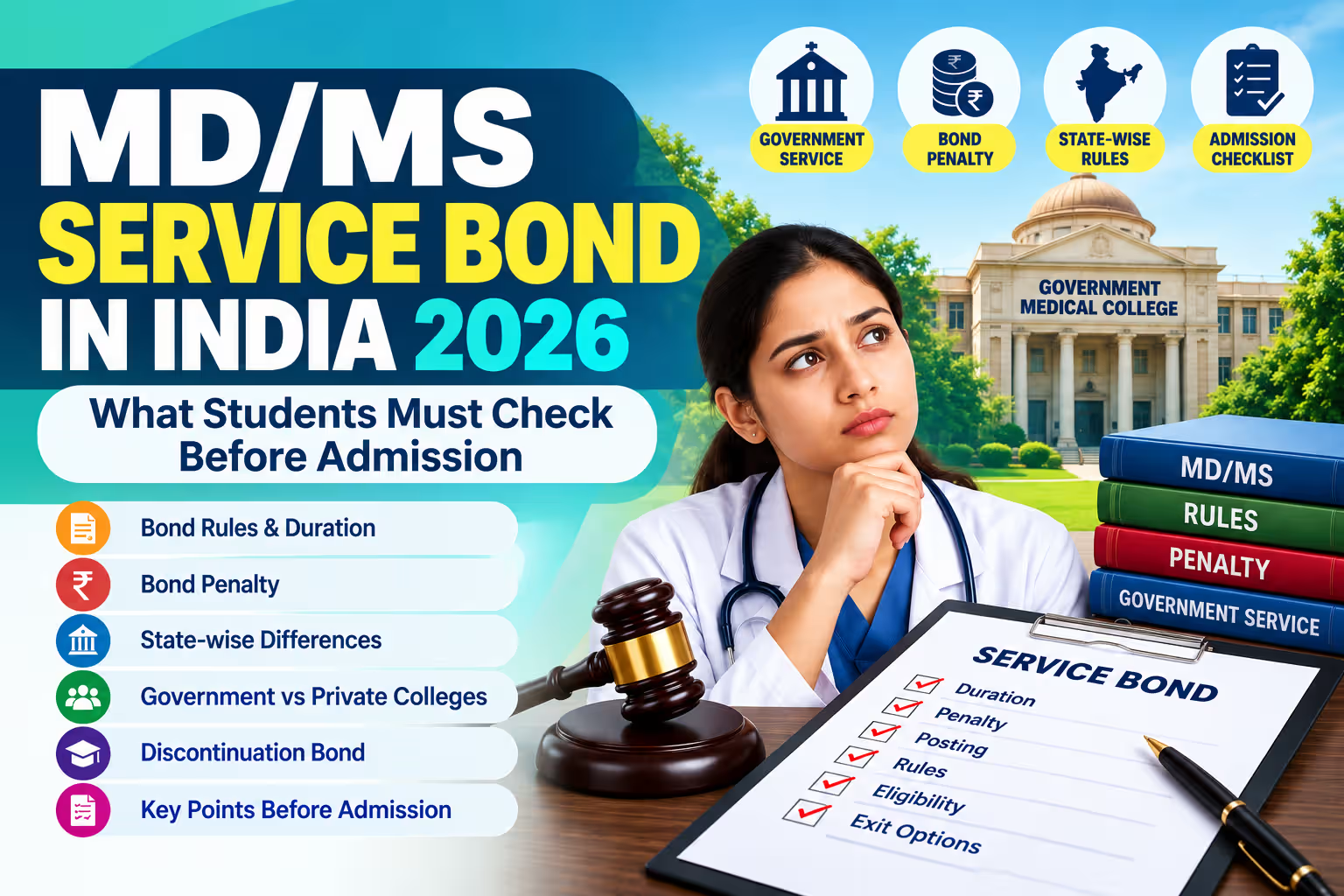
For students planning MD/MS admission in India in 2026, understanding the exact service bond rules before choice filling is therefore essential. This detailed guide explains what a medical service bond means, why such bonds exist, the difference between service bonds and discontinuation penalties, the effect of government and private medical college policies, and the important questions every medical aspirant should ask before accepting a postgraduate seat.
Students who need professional assistance with college selection, counselling strategies and postgraduate admission planning can explore ShikshaMed – Medical Admission Guidance, which provides guidance for NEET PG counselling, MD/MS admissions, college preferences and admission-related documentation.
An MD/MS service bond is a legal or contractual commitment that may require a postgraduate medical student to work for a specified period in a government healthcare institution or another designated healthcare facility after completing postgraduate medical training. Such obligations are generally prescribed through relevant state government orders, institutional rules, admission prospectuses or written bond agreements. The duration of service, conditions of employment, financial consequences for non-compliance and circumstances in which exemptions may be available depend on the particular policy applicable to the candidate.
The primary objective behind government medical service bonds is to support the availability of trained medical professionals in public healthcare institutions, particularly in regions facing shortages of specialist doctors. Government medical education often benefits from substantial public investment, and authorities may seek to ensure that doctors trained in publicly supported institutions contribute to healthcare services after completing their courses.
For example, a postgraduate medical student who secures admission into an MD General Medicine programme in a government medical college may discover that the applicable admission conditions require compulsory service after graduation. If the candidate wishes to begin private practice, join a corporate hospital or pursue a further academic qualification immediately after the MD degree, the service obligation may affect those plans. Whether the candidate can defer service, obtain an exemption or discharge the obligation through payment depends on the relevant rules and the signed agreement.
It is important to understand that India does not have one identical MD/MS service bond duration or penalty amount applicable to every medical college and every postgraduate student. Rules can vary between states, institutions, admission categories and academic sessions. Therefore, candidates must verify the latest official policy for their specific college and seat before making a final admission decision.
Government medical colleges play an essential role in producing specialist doctors who contribute to the country’s healthcare system. Public hospitals require qualified specialists in areas such as General Medicine, General Surgery, Obstetrics and Gynaecology, Paediatrics, Anaesthesiology, Orthopaedics, Radiology and several other medical disciplines. In some regions, particularly rural or underserved areas, attracting and retaining specialist doctors remains a challenge.
Service bond policies are one mechanism used by governments to encourage postgraduate medical graduates to contribute to public healthcare after receiving their training. These arrangements may help governments staff district hospitals, community healthcare facilities and other public institutions with qualified medical professionals. From a public-health perspective, a service bond can therefore be intended to support healthcare availability beyond major urban centres.
However, from a student’s perspective, the same policy may create significant career-planning considerations. A postgraduate doctor may wish to pursue DM or MCh superspecialty training, obtain a fellowship, work in a particular city, join a private hospital or explore international opportunities. A compulsory service obligation could affect the timing of these plans. Students should therefore evaluate both the benefits of their chosen medical college and the professional commitments attached to admission.
The Supreme Court of India considered compulsory medical service bonds in its judgment dated 19 August 2019 in Association of Medical Super Speciality Aspirants and Residents & Others v. Union of India & Others. The Court upheld the challenged compulsory bond conditions in the circumstances of that case and recognised the policy considerations associated with public healthcare needs. It also suggested working towards greater uniformity in service bond arrangements. This judgment does not mean that every state has identical rules or that every individual bond dispute must have the same outcome.
Before joining an MD/MS programme, candidates should understand that the word bond may refer to different obligations. A compulsory service bond, a seat-leaving penalty and a discontinuation bond are not necessarily interchangeable. These conditions may operate at different stages of the postgraduate admission and training process.
A compulsory government service bond generally requires the postgraduate medical graduate to work for an applicable period in a designated government or public healthcare institution after completing the course. The student may need to execute a formal agreement at admission, sometimes supported by a surety or other documentation. Depending on the relevant rules, the service may be associated with a specified category of healthcare institution, a government appointment process or a particular department.
The exact service duration, joining procedure, remuneration, posting arrangements and consequences of failure to report for duty should be checked in the current official policy. Candidates should not assume that compulsory service will automatically be waived if a posting is delayed or if they receive another professional opportunity.
A discontinuation bond is different from a post-course compulsory service bond. It may become relevant when a student leaves a postgraduate medical course before completion. For example, a student who joins MD Anaesthesiology and later decides to discontinue the programme to pursue another career opportunity could face a penalty under the applicable institutional or state rules.
Discontinuation conditions can vary according to when the candidate leaves, the course involved, the admission category and the policy governing that institution. Some rules may distinguish between withdrawal during counselling, resignation shortly after joining and discontinuation after the permitted resignation period. Candidates must carefully read the official admission prospectus and written undertaking rather than assuming that the same penalty applies at every stage.
A seat-leaving penalty is associated with surrendering or failing to join an allotted medical seat under the applicable counselling rules. It may involve forfeiture of a security deposit, restrictions on participation in subsequent rounds or other consequences stated in the counselling information bulletin.
Students frequently misunderstand this condition because they assume that obtaining a seat automatically gives them the freedom to reject or resign from it at any stage. In reality, the consequences of accepting, joining, upgrading or surrendering a seat depend on the specific counselling round and applicable rules. The MCC counselling procedure and the relevant state counselling rules must be examined separately.
Certain hospitals, medical institutions or training arrangements may require postgraduate candidates to execute additional agreements concerning training, employment, resignation, notice periods or financial obligations. Such provisions should be reviewed separately from any state government service obligation.
For detailed information about NEET PG admission planning, students can visit the ShikshaMed NEET PG 2026 Guidance Page.
One of the biggest mistakes during postgraduate medical counselling is assuming that a bond rule applicable in one state also applies in another. Medical service bond policies can differ considerably across state governments, institutions and types of medical seats. Even two postgraduate students pursuing the same specialization in different medical colleges may face different contractual requirements.
Students considering admission in Punjab, Haryana, Himachal Pradesh, Delhi, Rajasthan, Uttar Pradesh, Uttarakhand, Madhya Pradesh, Maharashtra, Gujarat, Karnataka, Tamil Nadu, Telangana, Kerala, West Bengal or other states must examine the latest admission notifications relevant to their intended institutions. The existence, duration and monetary terms of a bond should not be inferred merely from the state name or from policies published in previous years.
For example, a candidate comparing postgraduate medical colleges in Rajasthan and Uttar Pradesh should examine more than college reputation, tuition fees and clinical exposure. If the institutions have different service requirements, the total professional and financial commitment may also differ. A candidate intending to join a superspecialty programme immediately after MD/MS should be particularly careful about whether the selected institution’s policy provides for deferment, exemption or another arrangement.
Similarly, a medical aspirant considering government colleges in Punjab, Haryana or Himachal Pradesh should not rely solely on informal counselling discussions or previously circulated bond charts. A document from an earlier academic session may not accurately reflect current admission conditions, and certain policies may apply differently to All India Quota candidates, state quota candidates or in-service doctors.
ShikshaMed also provides an existing informational resource on State-Wise NEET PG Bond and Stipend Details. Students may use such resources for preliminary comparison, but the latest official government notifications and college admission documents should determine the final decision.
Many NEET PG candidates believe that obtaining a postgraduate medical seat through the 50% All India Quota (AIQ) automatically exempts them from state government service bond obligations. This assumption can be incorrect.
The All India Quota determines the counselling route through which an eligible candidate may obtain a seat, but it does not, by itself, establish that every state or institution-specific service bond condition is waived. Candidates admitted through AIQ may still be subject to applicable institutional or state conditions, depending on the governing rules.
Therefore, before accepting an AIQ seat, students should verify whether the compulsory service bond applies to All India Quota students, whether the terms differ from state quota seats, whether a financial undertaking must be signed and whether exemptions are available. An official clarification from the institution or appropriate authority is preferable when the prospectus does not clearly address the candidate’s category.
The official Medical Counselling Committee website should be consulted for the latest MCC counselling instructions. Candidates should also check the relevant state health department and college admission documents for bond-related obligations.
Another common question among postgraduate medical aspirants is whether service bonds apply only to government medical colleges. Although compulsory government service obligations are particularly associated with publicly supported medical education, students should not assume that all private and deemed university medical seats are free from contractual commitments.
Private and deemed medical institutions may have separate conditions relating to discontinuation, fees, deposits, training arrangements or resignation. The precise applicability of any government service bond also depends on the legal and institutional framework governing the particular seat.
For instance, a student considering MD Dermatology or MD Radiodiagnosis in a deemed university should evaluate the complete tuition fee structure, hostel and other compulsory charges, stipend policy, refund rules and applicable admission undertakings. A student considering a government medical college should perform the same review while paying particular attention to government service obligations.
The better approach is not to label all government colleges as bond colleges and all private colleges as bond-free. Each institution should be assessed using the current official documents. Candidates can also explore ShikshaMed MD/MS College-Wise Fee Information when comparing possible postgraduate medical college options.
The financial consequences of failing to complete an applicable service bond can be substantial. However, there is no single nationwide penalty amount that can accurately be quoted for all MD/MS candidates in 2026.
Some policies specify a fixed amount, while others may contain conditions linked to the duration of unserved obligations or other contractual calculations. The treatment of partial service, exemptions, delays and recovery procedures may also differ. Therefore, quoting one general penalty figure as the standard amount for every state would be misleading.
Consider a hypothetical example in which a medical college’s applicable agreement requires a period of compulsory service and specifies a financial consequence for failure to complete it. If the postgraduate graduate receives a private hospital job offer immediately after completing the course, the doctor must consider the existing commitment before accepting the opportunity. The agreement may require completion of government service, payment under an applicable exit provision or compliance with another procedure.
A candidate should examine whether the bond contains a legally available exit mechanism, what amount is payable, when payment becomes due and whether the candidate must obtain a formal discharge or no-dues certificate. These are contractual questions that should be verified from the operative documents and, when necessary, with qualified legal advice.
Students should never make a postgraduate admission decision based only on an unofficial bond penalty chart shared through social media or messaging groups.
Many postgraduate medical aspirants already have long-term plans to pursue superspecialty education. A student entering MD General Medicine may intend to pursue DM Cardiology, Gastroenterology or Neurology, while a candidate entering MS General Surgery may plan to pursue MCh training in a surgical subspecialty.
For such students, a compulsory service obligation can influence the time available for higher studies and the sequence of their career plans. Whether service may be deferred for superspecialty training, whether the obligation continues after completion of the higher qualification and whether an exemption or permission procedure exists depend on the applicable policy.
Students should not assume that admission into DM or MCh automatically cancels a previously executed service bond. Similarly, an exemption mentioned in an older state policy may not necessarily apply to the 2026 admission session.
A candidate planning superspecialty education should obtain written clarification on the treatment of higher studies before executing the bond. This is particularly important where there may be overlapping service commitments associated with different stages of medical training.
Postgraduate medical students often compare institutions using tuition fees and monthly stipends. These are important factors, but they do not provide the complete picture of a postgraduate medical seat.
The actual financial commitment may include tuition fees, hostel charges, mess expenses, examination fees, refundable deposits, other compulsory institutional charges and any amounts payable under applicable bond or discontinuation conditions. At the same time, a regular postgraduate stipend can help students manage living costs and reduce their dependence on family finances.
However, students should not treat stipend income as guaranteed without checking the institution’s written policy and applicable regulations. The stated stipend may differ from the amount actually received after relevant deductions, and any estimate over the course duration depends on payment being made according to the announced schedule.
A college with lower tuition fees may still involve a significant post-course service obligation, while another institution may involve higher educational expenses but different employment conditions. Neither option is automatically better for every student. The appropriate decision depends on the student’s financial circumstances, chosen specialty, training priorities and future career plans.
Candidates can use ShikshaMed’s NEET PG College and Branch Guidance as one resource while evaluating these factors.
Failing to fulfil an applicable service bond can have contractual and financial consequences. The exact outcome depends on the written agreement, governing government orders, institutional regulations and relevant legal provisions.
A candidate who does not report for required service or resigns before fulfilling the obligation may receive a demand under the bond terms. Depending on the circumstances, disputes may arise concerning the amount claimed, the conditions of release, service already completed or the interpretation of particular exemptions.
It is important not to assume that a bond is automatically unenforceable simply because the candidate wishes to pursue another career opportunity. The Supreme Court’s 2019 decision concerning compulsory medical service bonds is an important legal reference, although an individual candidate’s position must be evaluated using the specific agreement and current law.
Students should seek formal written clarification before making decisions that may conflict with their bond conditions. Where substantial financial liability or a disputed contractual interpretation is involved, advice from a qualified legal professional may be necessary.
Choosing between a government and private medical college is not simply a question of which institution charges lower tuition fees. Both options may offer advantages and disadvantages depending on the specialization, clinical training quality, patient load, faculty availability, hospital infrastructure, postgraduate working environment and total financial responsibility.
Government medical colleges may offer relatively affordable education and substantial clinical exposure, making them attractive to candidates seeking high-quality postgraduate training at a manageable educational cost. At the same time, a government service obligation may affect the timing of private employment, higher education or relocation.
Private and deemed medical colleges may provide other training opportunities and admission options, but their financial structure and institutional conditions require careful examination. High tuition fees, compulsory charges or restrictive discontinuation conditions can also influence the overall value of the programme.
For students with limited budgets, service bond conditions should be evaluated alongside affordability rather than treated as an isolated disadvantage. A candidate willing to work in public healthcare after graduation may view compulsory service differently from someone who has firm plans for immediate overseas employment or superspecialty training.
Ultimately, the right postgraduate institution is one that offers suitable academic and clinical training while maintaining financial and contractual conditions the student understands and is prepared to accept.
Before signing any service agreement or confirming admission, students should obtain clear answers to the following questions:
These questions are especially important during NEET PG choice filling, when students may be comparing several medical colleges under time pressure. Obtaining answers before reporting to an institution is generally preferable to discovering an unexpected obligation after admission.
A frequent mistake is checking only the previous year’s bond policy. Medical admission rules can be revised, and a policy that applied to one admission batch may not automatically apply to another. Students should always verify the official document governing their own academic session.
Another common error is assuming that a higher NEET PG rank or an All India Quota seat provides an automatic exemption. Bond applicability is determined by the relevant policy, not merely by the candidate’s examination performance.
Some students focus on tuition fees and stipend but ignore discontinuation penalties or post-course compulsory service. Others confuse counselling security deposit forfeiture with the institutional bond penalty. These different obligations should be evaluated separately.
Candidates may also rely on verbal assurances about future exemptions, service postings or superspecialty deferments without obtaining written confirmation. Important admission decisions should be supported by the current official prospectus, government orders and signed agreement.
A careful comparison of the complete admission terms can help avoid unexpected financial commitments and unnecessary disruptions to career planning.
Postgraduate medical counselling involves far more than finding a medical college based on a candidate’s NEET PG rank. Students must compare specialties, seat availability, counselling eligibility, institution preferences, fee structures, stipend policies, admission documents and applicable bond obligations. The increasing complexity of these decisions makes detailed research and timely guidance particularly valuable.
ShikshaMed provides medical admission counselling guidance for students seeking MBBS, MD/MS and other postgraduate medical education opportunities in India. The objective is to help candidates understand their available options and make informed decisions based on their educational qualifications, NEET performance, preferred branches, financial priorities and long-term career goals.
During MD/MS admission planning, students can benefit from reviewing college options in a structured manner rather than selecting institutions solely on the basis of reputation or expected cutoff. Bond terms, fees, clinical exposure and future career commitments should all be considered before a college is added to the final preference list.
Candidates seeking guidance regarding their postgraduate medical admission journey can visit the official ShikshaMed website to explore available counselling resources and services. Any state-specific bond interpretation should remain subject to verification with the responsible authority, and legal disputes should be addressed by an appropriately qualified professional.
No. There is no single identical service bond applicable to every postgraduate medical institution across India. The existence of a bond and its conditions depend on the relevant state government, institution, seat category and applicable academic-session rules. Students should verify the official admission documents before making a decision.
Some agreements may provide a financial alternative to completing service, but this cannot be assumed for every institution. Candidates must examine the exact agreement, applicable policy and procedure for formal release before relying on such an option.
It can be. Bond conditions may depend on the institution, state, training arrangement and candidate category. Students should verify the requirements of the specific MD, MS or DNB programme rather than assuming all postgraduate qualifications have the same rules.
It may be. Admission through the All India Quota does not automatically establish exemption from every state or institutional bond. Candidates should confirm the conditions applicable to their particular allotted seat.
A service bond can influence the timing of employment, superspecialty education, relocation or private practice when it requires post-course service. The practical effect depends on the duration and terms of the obligation, the candidate’s career objectives and any available exemptions or deferral provisions.
The legal effect of a subsequent policy change depends on its wording, the applicable law and the student’s admission agreement. Students should not automatically assume that a later notification applies retrospectively or that earlier terms remain unchanged in every circumstance.
Candidates should begin with the relevant state government or counselling authority website, the medical college’s official admission prospectus, institutional bond documents and the Medical Counselling Committee where applicable. Information from education websites can support preliminary research but should not replace operative official notifications.
Choice filling is a major decision-making stage because an allotted seat may be subject to counselling consequences and institution-specific admission obligations. Understanding bond conditions before finalising preferences helps students avoid selecting colleges whose financial or professional commitments may conflict with their long-term goals.
Securing a postgraduate medical seat is an important achievement, but choosing the right medical college requires more than comparing NEET PG cutoff ranks, fees and clinical branches. MD/MS service bond rules in India are an important part of postgraduate medical admission planning, especially for students considering government medical colleges or institutions with contractual service requirements.
Every candidate should examine the current official bond policy, compulsory service duration, applicable financial consequences, stipend conditions and any provisions concerning higher studies before accepting admission. Equally important is understanding the difference between a post-course service bond, an institutional discontinuation penalty and counselling-related seat-leaving consequences.
A well-informed student can compare postgraduate medical colleges more confidently and make decisions that support both immediate educational needs and long-term professional goals. No candidate should rely on outdated documents or assume that a rule applicable in one state automatically applies elsewhere.
If you are preparing for NEET PG 2026 counselling and MD/MS admission in India, explore the resources available through ShikshaMed – Medical Admission Counselling and Guidance.
Your medical career deserves more than a good college allotment. It deserves an informed decision.