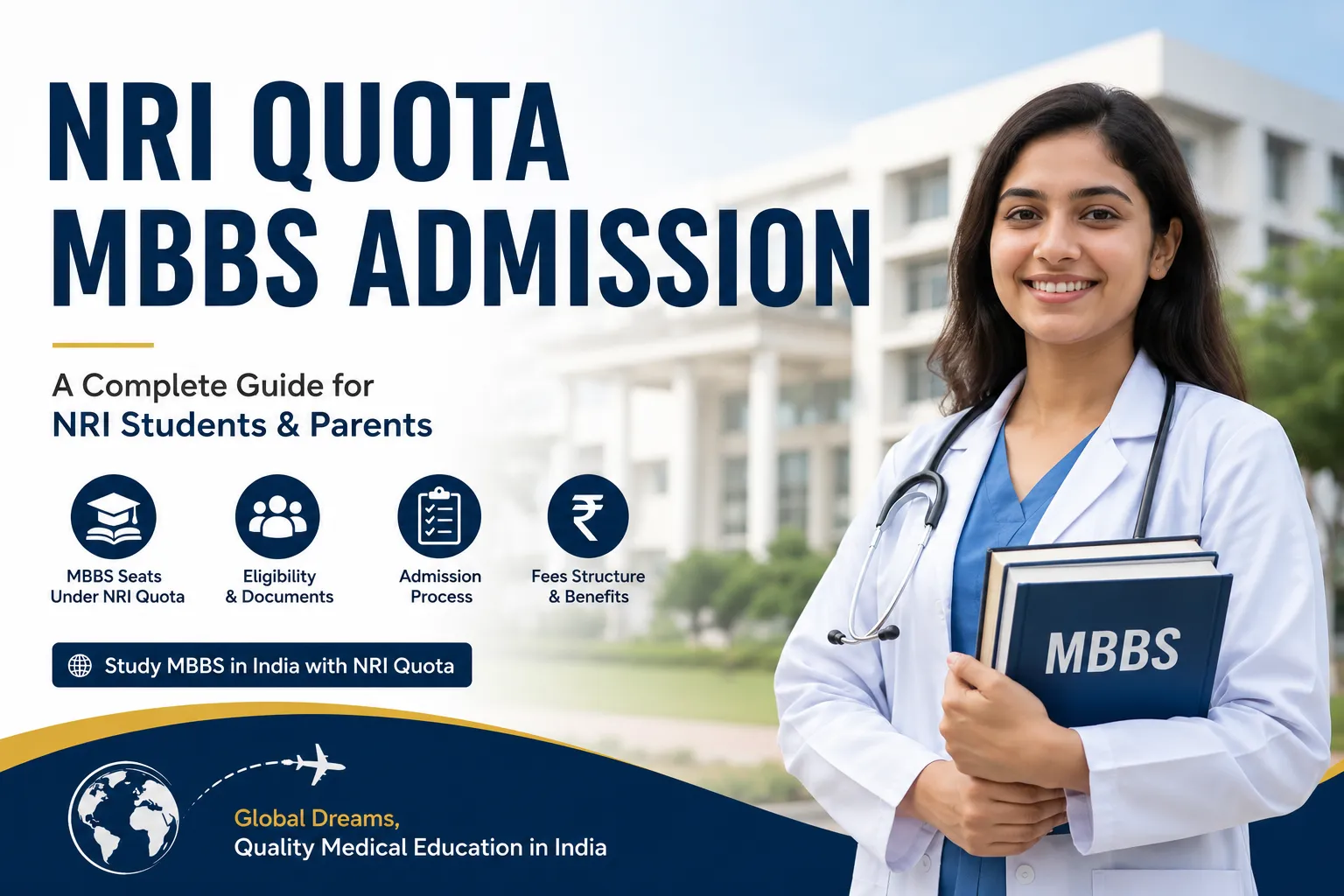
Every year, thousands of students of Indian origin — living in the UAE, UK, USA, Canada, or elsewhere — dream of wearing a white coat and practising medicine in India. If that dream resonates with you or your child, there is fantastic news: Indian medical colleges reserve dedicated seats under the NRI Quota, giving NRI, OCI, and PIO students a fair and structured path to MBBS admission without competing head-to-head with the general category.
This guide covers everything you need to know about NRI Quota MBBS Admission 2026 — from who qualifies, to which documents you need, to how the counselling process actually works.
The NRI Quota is a government-regulated reservation system that allows Non-Resident Indians (NRIs), Overseas Citizens of India (OCI), and Persons of Indian Origin (PIO) to secure MBBS seats in Indian medical colleges — both government and private — without competing in the general merit pool.
Most private and deemed universities in India reserve up to 15% of total MBBS seats under this quota. These seats are governed by the National Medical Commission (NMC), and admissions are entirely merit-based — meaning your NEET UG score is the deciding factor, not donations or management discretion.
Think of the NRI quota as a dedicated lane on a highway. You still have to drive — and drive well — but you’re not racing thousands of additional general-category candidates.
Eligibility for NRI Quota MBBS Admission is clearly defined by the NMC and counselling bodies. You qualify if you fall into any of the following categories:
Your father or mother must hold a valid NRI passport and proof of overseas residency (visa, work permit, or foreign employment certificate). You apply as their dependent.
If your parents are Indian citizens (Indian passport holders) but are currently living and working outside India, you are eligible. Proof of their overseas status is required.
If you personally hold a valid OCI or PIO card, you are eligible to apply — as long as you also clear NEET UG.
This is one of the most popular routes. Even if you are an Indian citizen studying in India, a close blood relative who is an NRI can sponsor you. Valid sponsors include:
The sponsor must submit an affidavit confirming they will bear the full course fee and financially support the student throughout the MBBS programme.
Regardless of NRI status, every candidate must meet the following academic requirements:
Yes — absolutely mandatory. This is one of the most common misconceptions among families abroad. The Supreme Court of India has made it clear: NEET is the only entrance exam accepted for MBBS admission in India, regardless of category. NRI, OCI, PIO, or foreign national — every student must clear NEET UG to be considered for any seat.
The good news is that NTA (National Testing Agency) now conducts NEET UG at international centres in cities like Dubai, Abu Dhabi, Riyadh, Doha, Muscat, Kuwait City, Singapore, Bangkok, Colombo, Lagos, and Kuala Lumpur — making it accessible to students living abroad.
Fees under the NRI quota are significantly higher than general merit seats. Here is a realistic overview:
| Type of College | Approximate Total Course Fee |
|---|---|
| Government medical colleges (NRI quota) | ₹30 – ₹50 Lakhs (full course) |
| Private / Deemed universities (NRI quota) | ₹80 Lakhs – ₹1.5 Crore (full course) |
| Annual fee in USD (some colleges) | $20,000 – $50,000 per year |
Fees vary significantly from state to state and college to college. Always verify the current fee structure on the official college website or through a trusted NRI MBBS admission consultant before making any financial commitments.
NRI quota seats are available in both government and private medical colleges across India. Here is a quick overview:
States including Rajasthan, Haryana, Punjab, Goa, Himachal Pradesh, Chandigarh, and Puducherry reserve NRI quota seats in government institutions. These are highly sought after due to their lower fees compared to private colleges.
Most private medical colleges across Karnataka, Maharashtra, Tamil Nadu, Andhra Pradesh, Telangana, Kerala, West Bengal, Bihar, Uttarakhand, Delhi, and Puducherry offer NRI quota MBBS seats.
For detailed college-wise NRI quota seats and fees, visit the official ShikshaMed NRI Quota MBBS Admission 2026 guide for a regularly updated list.
Here is how the complete NRI MBBS admission process works, from start to finish:
Step 1 — Qualify NEET UG 2026 Register and appear for the NEET UG exam. Aim for the highest score possible — even within the NRI quota, competition exists and a better rank means access to better colleges.
Step 2 — Verify Your NRI Eligibility Confirm whether you are applying as a direct NRI/OCI/PIO candidate or as an NRI-sponsored student. Arrange your sponsor’s documents accordingly.
Step 3 — Shortlist Colleges Research and shortlist medical colleges that offer NRI quota MBBS seats, are recognised by the NMC, and fall within your budget and NEET rank range.
Step 4 — Register for Counselling Register on the MCC (Medical Counselling Committee) portal for All India Quota seats, or on the respective state counselling authority portal for state quota seats. Select “NRI Quota” during registration.
Step 5 — Submit Documents Upload and submit all required documents (see the list below) during the counselling registration window. Incomplete or incorrect documents can result in disqualification.
Step 6 — Participate in Seat Allotment Based on your NEET score, college preferences, and seat availability, you will receive a seat allotment. Some colleges may conduct interviews — verify this in advance.
Step 7 — Confirm Admission & Pay Fees Accept the allotted seat, pay the NRI quota fee (often required in USD or equivalent), and complete the document verification process at the college to confirm your admission.
Having your documents in order is critical. Missing or incorrect paperwork is one of the most common reasons for delays. Here is the full checklist:
Academic Documents
Identity & NRI Status Documents
Other Documents
All documents must be properly attested. We strongly recommend getting documents verified by a trusted NRI MBBS admission expert before submission to avoid last-minute issues.
Navigating the NRI quota system — with its multiple counselling portals, state-wise rules, document requirements, and fee structures — is genuinely complex. That is where ShikshaMed makes a real difference.
With over 26 + years of dedicated experience in NRI and MBBS admissions, ShikshaMed has one of the highest seat allotment success rates in the country. Their team specialises exclusively in NRI quota cases — not as a side service, but as their core focus.
Here is what sets them apart:
Whether you are looking at NRI quota seats in government medical colleges or private deemed universities, whether you are an OCI cardholder in London or an NRI-sponsored student in Delhi — ShikshaMed’s NRI MBBS admission team is equipped to guide you through every step.
The NRI Quota is a genuine and structured opportunity for students of Indian origin to pursue MBBS in India’s top medical colleges. It is not a shortcut — you still need to clear NEET and meet all eligibility criteria — but it does provide a separate, less competitive pool of seats designed specifically for your situation.
The key to success is preparation: score well in NEET, gather your documents early, understand the counselling process, and seek expert help when needed.
For the most detailed, up-to-date information on NRI Quota MBBS Admission 2026 — including college-wise seat availability, fees, and counselling dates — visit ShikshaMed’s official page and connect with their NRI admission experts today.