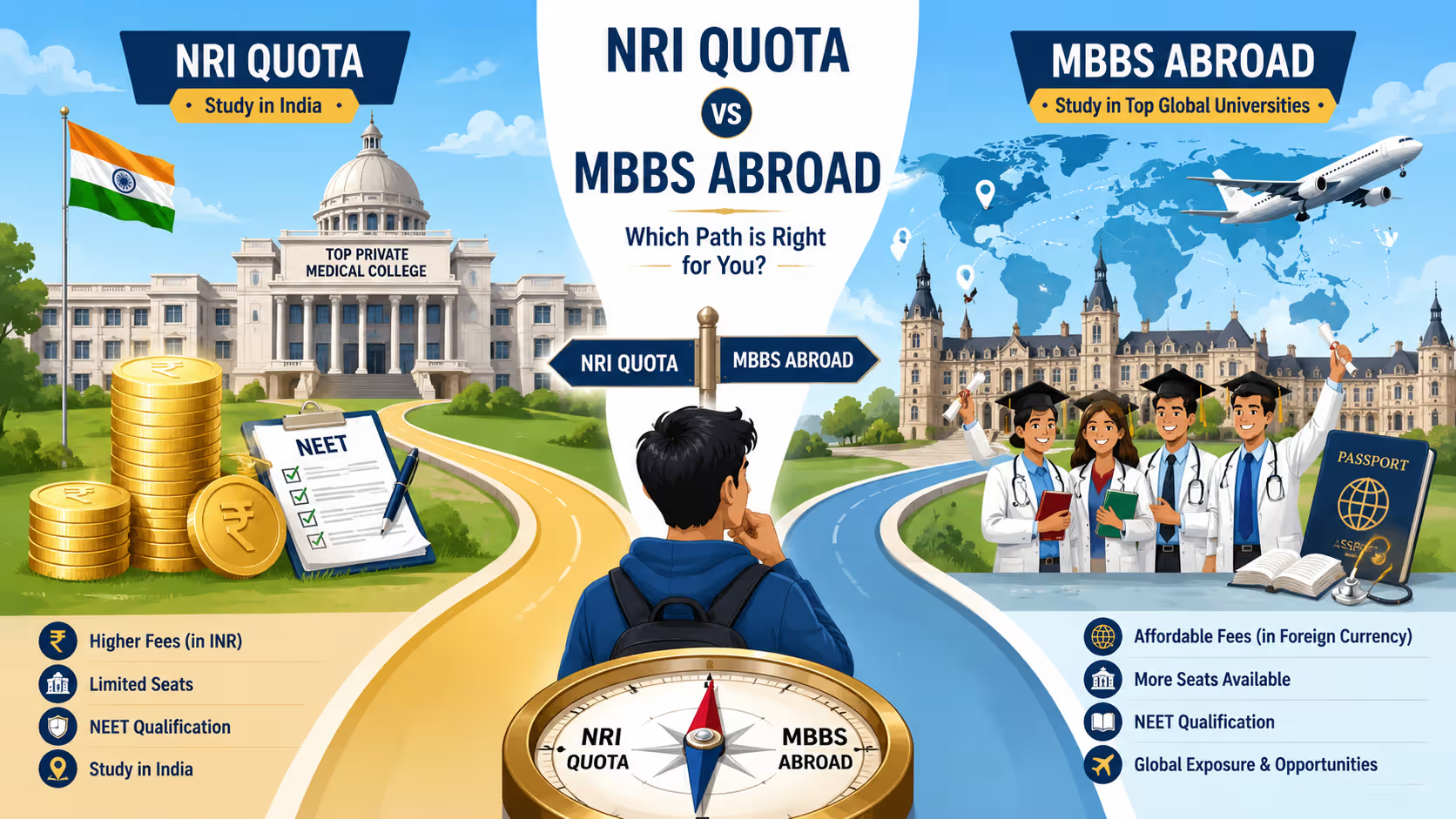
Every year, thousands of Indian students and families face one of the most consequential decisions in a medical career: choose the NRI Quota pathway in India or pursue MBBS abroad. Both routes offer legitimate paths to becoming a doctor, but they differ dramatically in cost, eligibility, competition, documentation, and long-term career implications. This comprehensive guide compares both options side-by-side using 2026 data so you can make an informed, confident decision.
At Shiksha Med, we have guided over 30,000+ students through this exact choice since 2013. We understand the nuances, the stress, and the paperwork that can make or break an admission. Our Chandigarh office at SCO 80-81-82, Sector 34A is open six days a week for free consultations.
The numbers behind this decision are stark. India has approximately 1.09–1.15 lakh MBBS seats across 700+ medical colleges, but nearly 24 lakh students appear for NEET-UG every year. Of these, only about 55,000 are government seats at genuinely affordable fees. The remaining 52,000+ seats are in private and deemed universities, where fees range from ₹50 lakh to ₹1.5 crore or more. This brutal competition is the reason why lakhs of qualified students actively consider the NRI Quota and MBBS abroad options.
For the 2026 admission cycle, both pathways have updated rules and requirements. Here is what you need to know to choose the right one.
The NRI Quota is a reserved category of MBBS seats in Indian private and deemed medical colleges, specifically set aside for Non-Resident Indians (NRIs), Overseas Citizens of India (OCI), Persons of Indian Origin (PIO), and students sponsored by close NRI blood relatives. It was introduced to give Indian-origin families abroad a structured, transparent path into Indian medical education. For a complete breakdown of the NRI quota eligibility, required documents, and step-by-step application process, visit our detailed guide on NRI Quota MBBS Admission 2026.
Eligibility is broader than most families assume. You can apply under the NRI Quota if:
Important: Counselling authorities are strict about “close blood relative.” Distant relatives or family friends generally do not qualify as sponsors.
NRI Quota seats carry significantly higher tuition than government or even management quota seats. Fees are typically charged in USD and range from $25,000 to $40,000 per year depending on the college. At an exchange rate of ₹83/USD, this translates to approximately ₹21–33 lakhs per year.
Here are indicative annual NRI fees for 2026 from select top private colleges:
| College | NRI Annual Fees (USD) | Approx. INR (₹83/USD) |
|---|---|---|
| KMC Manipal | $40,000 | ₹33.2 Lakhs |
| Sharda University | $35,000 | ₹29 Lakhs |
| SRM Medical | $35,000 | ₹29 Lakhs |
| Santosh Medical | $32,000 | ₹26.5 Lakhs |
| SGT Medical | $30,000 | ₹24.9 Lakhs |
For a full 5.5-year MBBS course, the total cost through NRI Quota can range from ₹1.2 crore to ₹3 crore or more, including tuition, hostel, and miscellaneous expenses.
The NRI Quota admission process follows these steps:
Critical Warning: Incomplete or unverified documents are the number one reason NRI applications stall or fail. Embassy attestations and notarized sponsorship affidavits take time, so start collecting paperwork well before counselling opens. To understand each of these steps in greater detail, including document checklists and important deadlines, refer to our comprehensive NRI quota admission guide.
MBBS abroad refers to completing a Bachelor of Medicine and Bachelor of Surgery degree from a recognized international medical university. Countries across Eastern Europe, Central Asia, and South Asia offer accredited 5.5-year MBBS programs that are taught in English, follow curricula aligned with WHO and Indian medical standards, and cost a fraction of private MBBS programs in India. For detailed information on country-specific costs, top universities, and the admission process, explore our dedicated MBBS abroad consulting page.
More than 25,000 Indian students choose MBBS abroad every year. With the right guidance and a genuine NMC-compliant university, this path leads to a full medical license to practice in India after clearing the licensing exam.
The National Medical Commission (NMC) has set strict guidelines under the Foreign Medical Graduate Licentiate (FMGL) Regulations 2021. These are non-negotiable for your foreign degree to be valid in India:
Here are the most popular NMC-approved countries for Indian students, with estimated total costs (tuition + hostel + living for the full course). To compare these and other popular destinations in more detail, visit our main MBBS abroad guide.
| Country | Total Cost (6 Years) | Tuition/Year | Living/Month |
|---|---|---|---|
| Kyrgyzstan | ₹11 – ₹19 Lakhs | ₹1.8 – ₹3 Lakhs | ₹8,000 – ₹12,000 |
| Uzbekistan | ₹13 – ₹24 Lakhs | ₹2 – ₹3.5 Lakhs | ₹7,000 – ₹12,000 |
| Kazakhstan | ₹17 – ₹28 Lakhs | ₹3 – ₹4.5 Lakhs | ₹12,000 – ₹18,000 |
| Philippines | ₹20 – ₹34 Lakhs | ₹3.5 – ₹5 Lakhs | ₹10,000 – ₹15,000 |
| Russia | ₹22 – ₹40 Lakhs | ₹2.5 – ₹6 Lakhs | ₹15,000 – ₹20,000 |
| Georgia | ₹32 – ₹51 Lakhs | ₹3.7 – ₹5.8 Lakhs | ₹10,000 – ₹18,000 |
Note: These are all-inclusive estimates as of 2026. Actual costs vary by city, university, and lifestyle choices. Beware of consultants who claim “MBBS abroad under ₹10 lakhs” — this typically covers only partial first-year tuition and ignores hostel, food, visa, insurance, and flights.
Before applying, every Indian student must fulfil these requirements:
Here is a comprehensive comparison of the two routes based on the key decision factors:
| Factor | NRI Quota (India Private) | MBBS Abroad |
|---|---|---|
| Annual Tuition | $25,000 – $40,000 (₹21–33 Lakhs) | ₹2 – ₹6 Lakhs |
| Total Cost (Full Course) | ₹1.2 – ₹3.5 Crore | ₹15 – ₹40 Lakhs |
| Donation/Capitation Fees | No (legally prohibited) | No |
| Hidden Costs | Hostel, mess, deposits, exam fees | Visa, insurance, flights, living expenses |
Verdict: MBBS abroad is significantly more affordable — often one-fourth to one-tenth the cost of an NRI Quota seat.
| Factor | NRI Quota | MBBS Abroad |
|---|---|---|
| NEET Qualifying | Mandatory | Mandatory |
| Minimum Score Required | Lower than general merit, typically 400+ | Qualifying marks only (360+ for General) |
| Competition Pool | NRI category candidates only | International students |
Verdict: Both require NEET, but NRI Quota competition is limited to NRI candidates, while abroad admission relies more on your overall academic profile and university-specific criteria.
| Factor | NRI Quota | MBBS Abroad |
|---|---|---|
| Indian Licensing Exam | None needed — direct practice | NExT (replaced FMGE from 2025) mandatory |
| Pass Rate Concern | Not applicable | Varies by university |
| Indian Internship | Completed at same college | Must clear NExT and complete internship |
Verdict: NRI Quota graduates can start practising immediately. MBBS abroad graduates face the additional hurdle of clearing NExT.
| Factor | NRI Quota | MBBS Abroad |
|---|---|---|
| NRI Sponsorship Proof | Essential (passport, visa, affidavit) | Not applicable |
| Relationship Certificate | Essential (for sponsored candidates) | Not applicable |
| Embassy Attestation | Required | Required (Apostille for many countries) |
| Student Visa | Not applicable | Required |
Verdict: Both require extensive paperwork, but NRI Quota documentation is more relationship and sponsorship-focused, while abroad requires visa and apostille processes.
| Factor | NRI Quota | MBBS Abroad |
|---|---|---|
| Degree Recognition | NMC Approved | NMC Approved (if WDOMS listed) |
| Global Mobility | Limited — requires exams for other countries | Moderate — some countries offer direct pathways |
| Clinical Exposure | Indian patient demographics | International patient demographics |
Verdict: Both degrees are NMC-approved for Indian practice. For global careers, MBBS abroad may offer slight advantages depending on the destination.
The single biggest differentiator and risk of MBBS abroad is the licensing exam. FMGE pass rates have historically been 15–25% overall. However, context matters enormously:
The NRI Quota is the right choice if:
Scenario Example: If you are an NRI parent living in Dubai and want your child to study in India, the NRI Quota offers a structured, transparent route with lower NEET competition than the general category. The trade-off is the significantly higher fee.
MBBS abroad is the right choice if:
Scenario Example: If your NEET score is 400–550 and your only Indian option is a private college charging ₹80 lakh–1.5 crore, MBBS abroad at ₹20–40 lakhs gives you the same NMC-approved MBBS degree for a fraction of the cost — provided you clear NExT after returning.
Based on counselling thousands of families through this decision, here is a simple framework to decide:
At Shiksha Med, we have been guiding students through this exact decision since 2013. With 13+ years of specialised medical admission experience and 440+ medical college tie-ups, we offer comprehensive support for both NRI Quota and MBBS Abroad admissions.
Our services include:
You can book a free consultation with our expert counsellors in three easy ways:
Yes, NEET-UG qualification is mandatory for both routes. For NRI Quota, it’s required for counselling. For MBBS abroad, it’s required for NMC recognition of your foreign degree when you return to India.
MBBS abroad is significantly cheaper. NRI Quota in India costs ₹1.2–3.5 crore total, while MBBS abroad costs ₹15–40 lakhs total for the full course.
Yes, through NRI sponsorship. A close blood relative abroad (uncle, aunt, grandparent) can sponsor your admission, provided they provide a notarized sponsorship affidavit and valid NRI documentation.
Yes, provided the university is listed in WDOMS, follows NMC FMGL 2021 guidelines (54 months + 12-month internship in English), and you clear the NExT exam after returning to India.
You need a qualifying NEET score — just above the cutoff (360+ for General). There is no specific high score required for foreign universities. The NEET requirement is purely for NMC recognition of your degree when you return to India.
NRI Quota is reserved exclusively for NRI/OCI/sponsored candidates with higher fees ($25,000–40,000/year), while Management Quota is open to any NEET-qualified candidate with comparatively lower fees (₹20–35 lakhs/year).
NExT is a two-step exam. Step 1 is a theory exam with 540 MCQs conducted over three days, covering subjects like Medicine, Surgery, and Pediatrics. Step 2 is a clinical skills assessment. Students must clear both steps to receive their license to practice in India.
There is no universally correct answer. NRI Quota is the right path if your family is NRI and can afford the higher fees, and you want to study in India with no licensing exam hurdle. MBBS abroad is the right path if your NEET score limits you to expensive Indian options or your career ambitions extend beyond India, and you are prepared to clear the licensing exam after returning.
The wrong answer is always an uninformed decision based on panic, agent pressure, or incomplete comparisons. With the right guidance and planning, both routes can lead to a successful medical career.
To get personalised guidance based on your NEET score, budget, and career goals, reach out to Shiksha Med today. Our experienced counsellors are here to help you make the right decision for your medical future.
Shiksha Med — India’s Most Trusted MBBS Consultant Since 2013
📍 Head Office: SCO 80-81-82, Ground Floor, Sector 34A, Opposite Passport Office, Chandigarh – 160022
📞 Phone: +91 90414-41449 | +91 90414-41450
📧 Email: info@shikshamed.com
🌐 Website: shikshamed.com