Medical PG Admission Guide | ShikshaMed
Choosing the right postgraduate medical college after completing MBBS is one of the most significant decisions in a doctor’s professional journey. Every year, medical graduates across India prepare for the National Eligibility cum Entrance Test for Postgraduate courses (NEET PG), aiming to secure admission into their preferred MD, MS, DNB or other eligible postgraduate medical programmes. However, qualifying for NEET PG is only the beginning. The next challenge is understanding the counselling process, selecting the right speciality, comparing medical colleges, evaluating fees and preparing an effective choice-filling strategy.
This is why many doctors and their families search online for the best NEET PG counselling consultant in India, a reliable MD MS admission consultant, or professional NEET PG counselling guidance that can help them understand their admission possibilities.
NEET PG counselling in India involves multiple admission pathways, including the All India Quota, eligible state quota seats, private medical colleges, deemed universities and National Board of Examinations in Medical Sciences (NBEMS) programmes. Each pathway has different admission conditions, institutional fees, eligibility requirements and counselling procedures. A candidate who does not understand these differences may overlook suitable colleges, misunderstand admission expenses or prepare a choice list that does not reflect their actual priorities.
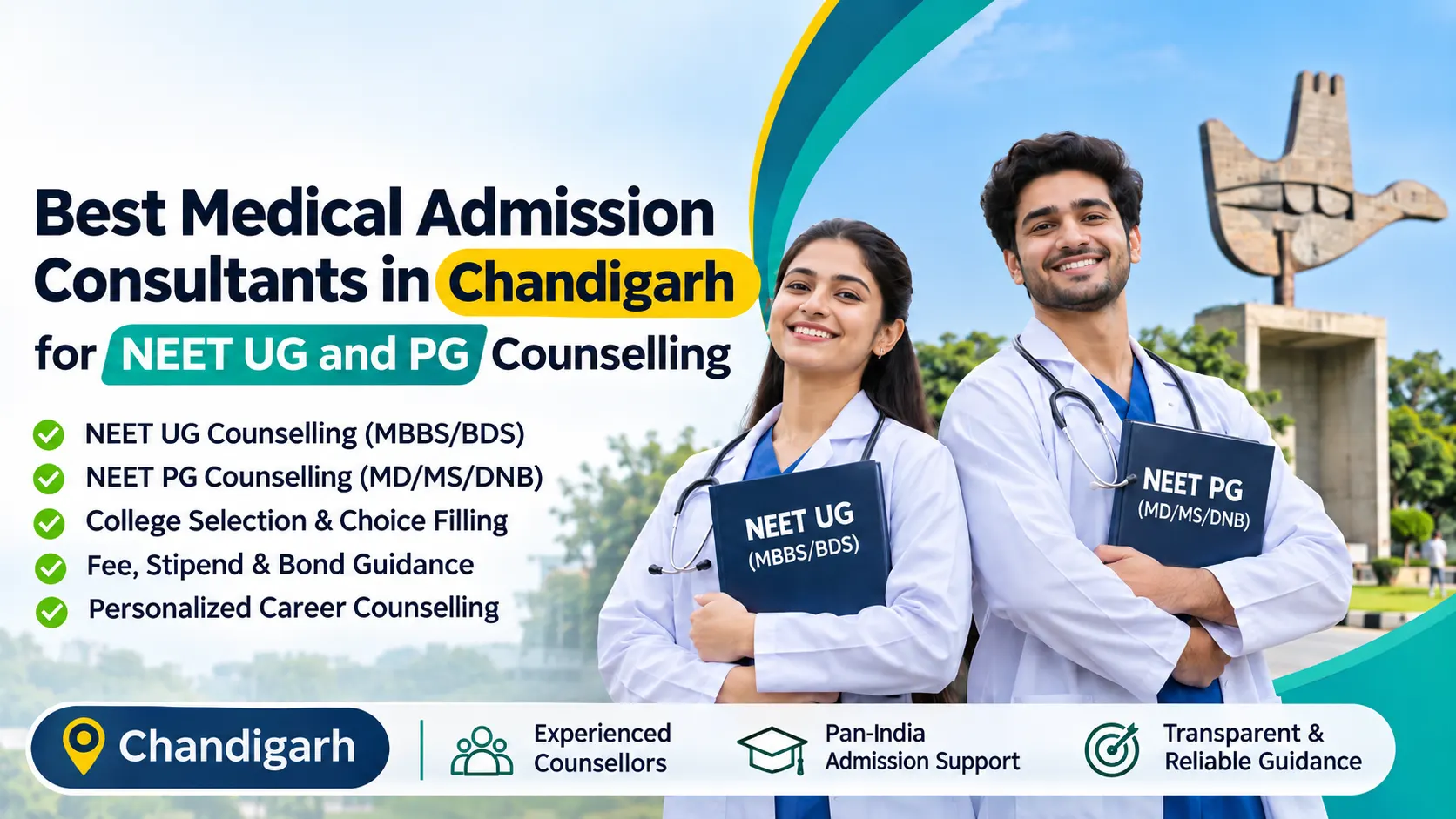
At ShikshaMed, our focus is to help medical graduates make informed postgraduate admission decisions through personalised counselling, NEET PG rank analysis, college comparisons, choice filling guidance and admission planning. Our counselling approach considers each candidate’s academic profile, career interests, preferred location and financial budget rather than relying on NEET PG rank alone.
This comprehensive guide explains how to choose a trustworthy NEET PG counselling consultant, understand the MD/MS/DNB admission process, compare medical colleges, interpret previous-year closing ranks, assess fees and bonds, and plan your postgraduate medical career.
NEET PG counselling is the official seat-allocation process through which eligible medical graduates compete for admission to postgraduate medical programmes according to examination merit, applicable eligibility requirements, reservation policies, candidate preferences and seat availability.
NEET PG is conducted by the National Board of Examinations in Medical Sciences (NBEMS) and serves as an eligibility-cum-ranking examination for admission to several postgraduate medical pathways. These include MD, MS and postgraduate diploma programmes, as well as Post-MBBS DNB, applicable NBEMS Diploma courses and direct six-year DrNB programmes.
The Medical Counselling Committee (MCC), under the Directorate General of Health Services, conducts centralised counselling for postgraduate medical seats within its jurisdiction. This includes 50% All India Quota postgraduate seats in participating medical colleges, deemed university seats, certain central university seats and applicable NBEMS seats. State counselling authorities separately manage their respective state-level admission processes.
For medical graduates, understanding the difference between these counselling systems is essential. A candidate eligible for a particular state quota may have admission opportunities different from those available through MCC. Likewise, a candidate considering a deemed university must evaluate a different fee structure and applicable admission conditions from those of a government medical college.
Doctors who want a structured overview of admission pathways can explore the NEET PG Counselling Services at ShikshaMed, which provides information about postgraduate medical counselling and admission planning.
The postgraduate medical admission process is competitive, complex and financially significant. Candidates must make decisions that can affect their medical training, future speciality, professional opportunities and family finances.
Searching for a NEET PG admission consultant in India is often motivated by questions such as: Which MD/MS college can I get with my NEET PG rank? Is MD General Medicine possible within my budget? Which medical colleges offer suitable Radiology or Dermatology programmes? Should I choose MD, MS or DNB? Can I participate in another state’s counselling? How can I compare private medical college fees? Which college should I place first in my NEET PG choice list?
These questions cannot be answered accurately by examination rank alone.
For example, two doctors with similar NEET PG ranks may have substantially different options because of their category, domicile, institutional eligibility, speciality preference and budget. One candidate may prioritise a government medical college, while another may consider a private or deemed institution to pursue a preferred clinical branch. A third candidate may prefer a well-established DNB training hospital instead of a less suitable MD/MS programme.
Professional NEET PG counselling guidance can help candidates organise this information, identify eligible options and make decisions based on official admission rules.
However, no counselling consultant can guarantee a seat, change a candidate’s official rank or bypass eligibility requirements. The final admission decision remains subject to the authorised counselling process.
Finding the right postgraduate medical admission consultant requires more than searching for the most visible website or the company advertising the largest number of successful admissions.
A trustworthy MD/MS admission consultant in India should provide transparent information, explain official counselling rules and help candidates understand both opportunities and limitations.
The consultant should understand MCC counselling, state counselling procedures, private medical college admissions, deemed university participation and DNB admission pathways. Since regulations and admission procedures may change, knowledge must be supported by current official notifications rather than past experience alone.
A good counselling service should evaluate the candidate’s NEET PG All India Rank, category, domicile, speciality preference, acceptable states and maximum educational budget. Generic college lists that ignore these factors can be misleading.
Medical college selection should consider recognised programmes, clinical training, infrastructure, patient load, faculty, stipend, hospital environment and total educational expenses. The consultant should distinguish verified information from estimates.
Candidates should understand the scope of services, counselling fees, refund policies and whether any additional charges apply. Professional counselling fees should never be confused with payments made to official counselling authorities or educational institutions.
A consultant should not promise a confirmed government MD/MS seat, guaranteed Radiology admission or admission without following the official process. Such claims should be treated cautiously.
Depending on the services agreed upon, assistance may include registration guidance, document preparation, college shortlisting, choice filling, allotment interpretation and reporting support.
For personalised guidance, candidates can request an initial discussion through the ShikshaMed Free PG Counselling Session.
Candidates searching for MD MS admission in India should first understand the different postgraduate medical qualification pathways.
MD programmes generally focus on medical, diagnostic, laboratory-based or related postgraduate disciplines. Common examples include MD General Medicine, MD Paediatrics, MD Anaesthesiology, MD Dermatology, MD Psychiatry, MD Pathology, MD Radiodiagnosis and MD Community Medicine.
The nature of training varies considerably between specialities. Some involve extensive direct patient management, while others focus more heavily on diagnostics, laboratories, preventive care or academic practice.
MS programmes focus primarily on surgical disciplines, including MS General Surgery, MS Orthopaedics, MS Obstetrics and Gynaecology, MS Ophthalmology and MS Otorhinolaryngology.
Candidates considering surgical specialities should evaluate operative exposure, case volume, faculty supervision, emergency workload and opportunities to develop practical skills.
DNB broad-speciality programmes are administered under the NBEMS framework. Post-MBBS DNB broad-speciality training is generally a three-year programme, subject to the applicable programme regulations.
DNB training is offered through accredited hospitals and institutions, which may differ in patient profile, clinical exposure, infrastructure and teaching systems.
Instead of assuming that MD/MS is always better than DNB, candidates should assess the particular institution, speciality, recognition and career requirements. Teaching eligibility and certain professional requirements should be checked against the latest applicable NMC and NBEMS regulations.
For candidates exploring different postgraduate pathways, the ShikshaMed NEET PG Resources provide a starting point for understanding counselling, fees, bonds, stipends and admission considerations.
Choosing the right postgraduate medical speciality is one of the most important parts of NEET PG career planning. Although popular branches attract significant interest, the best speciality for one doctor may not be appropriate for another.
General Medicine involves the diagnosis and management of adult medical conditions and provides broad clinical exposure. Candidates interested in internal medicine, inpatient management, complex clinical cases and further specialised training may consider this pathway.
Radiodiagnosis focuses on medical imaging and diagnostic interpretation. Candidates should evaluate imaging equipment, teaching exposure, reporting responsibilities, faculty support and programme recognition.
Dermatology covers diseases of the skin, hair, nails and related medical conditions. Training quality, outpatient exposure, procedural opportunities and institutional facilities should be considered before selecting a programme.
Paediatrics focuses on medical care for infants, children and adolescents. Candidates should evaluate neonatal care facilities, paediatric emergency services, inpatient exposure and supervision.
Anaesthesiology includes perioperative care, anaesthesia management, intensive care exposure and related clinical responsibilities. Training environments can vary significantly between hospitals.
General Surgery involves operative and perioperative management of surgical conditions. Case complexity, surgical volume and structured supervision are particularly important.
This speciality focuses on pregnancy, childbirth and disorders affecting the female reproductive system. Clinical exposure, labour room facilities and emergency management experience are key considerations.
Orthopaedics involves the management of musculoskeletal injuries and conditions. Candidates may compare trauma workload, operative exposure, rehabilitation facilities and training standards.
Other options include Psychiatry, Ophthalmology, ENT, Respiratory Medicine, Emergency Medicine, Pathology, Microbiology, Pharmacology and Community Medicine.
The most suitable NEET PG branch depends on your clinical interests, training expectations, long-term career goals and available admission opportunities. A high-demand speciality is not automatically the right speciality for every candidate.
One of the most frequently searched topics among postgraduate medical aspirants is “Which MD/MS college can I get with my NEET PG rank?”
A NEET PG college predictor is an admission-planning tool or analytical approach that uses historical counselling results and candidate-specific information to estimate potential college and speciality options.
A meaningful prediction should consider NEET PG All India Rank, applicable category, quota, state domicile, eligibility, preferred speciality, college type, budget, previous-year closing ranks, counselling round and currently notified seat availability.
It is important to understand that a previous year’s closing rank is not a guaranteed cutoff for a future counselling round. Closing ranks may change because of seat additions or withdrawals, candidate preferences, competition, reservation rules and changes in available programmes.
For example, a candidate targeting MD General Medicine in government medical colleges may have a different set of realistic options from someone willing to consider private colleges, deemed universities and DNB programmes. Similarly, candidates considering Radiodiagnosis, Dermatology or Paediatrics must assess branch-specific competition rather than relying on a broad rank category.
ShikshaMed has published a dedicated NEET PG Rank-Wise College and Branch Predictor Guide, which explains how candidates can approach rank-based college selection while considering domicile, budget, branch preference and counselling quota.
For better admission planning, candidates should compare multiple qualifying colleges rather than relying on a single prediction.
Previous-year NEET PG closing ranks are useful for understanding historical admission patterns. Candidates often search for NEET PG cutoff for MD General Medicine, NEET PG Radiology cutoff, DNB General Medicine closing rank or private medical college MD/MS cutoff.
However, these searches are meaningful only when the correct quota, category, college, branch and counselling round are considered.
A closing rank for a General category All India Quota seat cannot automatically be applied to a state quota seat or a different category. Likewise, the closing rank of a branch in one private college may be significantly different from the closing rank in another institution.
Round-wise movement should also be interpreted carefully. Later counselling rounds do not necessarily guarantee a more favourable seat, and vacancies may differ considerably between institutions.
Candidates should use historical cutoffs to create a reasonable range of possibilities and then verify the relevant current-year official seat matrix and admission rules.
To explore historical information, visit the NEET PG Cutoff Resources at ShikshaMed.
One of the most challenging postgraduate medical admission decisions is choosing between government medical colleges, private medical colleges and deemed universities.
Government medical colleges often offer relatively lower tuition fees than many private institutions, making them attractive to cost-conscious candidates. However, admission to popular government college specialities can be highly competitive.
Candidates should also evaluate service bonds, stipend policies, hospital workload, institutional facilities and location.
Private medical colleges may provide additional choices for candidates who cannot secure their preferred speciality in government institutions or who prioritise a particular location or programme.
Fee structures, quota availability, stipend arrangements, bonds and training environments vary between institutions.
Deemed universities participating in MCC counselling may offer postgraduate medical programmes across multiple clinical and non-clinical specialities. Their tuition fees can be substantial, and candidates should consider the complete financial commitment before participating.
A deemed university seat is not guaranteed simply because a candidate can afford the published tuition fee. Merit, eligibility, programme availability and counselling rules still apply.
There is no universally correct answer.
A candidate with a limited budget may prioritise a government medical college or an affordable DNB programme. Another candidate may prefer a particular clinical speciality available in a private or deemed institution.
The decision should be based on speciality preference, training quality, financial affordability, verified institutional information and long-term goals.
The cost of postgraduate medical education is an essential part of admission planning. Candidates searching for private medical college MD/MS fees in India should compare total expenses rather than focusing exclusively on the first-year tuition fee.
The financial structure may include annual tuition fees, university charges, hostel and accommodation expenses, examination fees, refundable deposits and other institution-specific charges.
Students should also review the applicable stipend and any compulsory service bond or discontinuation penalty.
Consider a purely illustrative situation in which one medical college charges ₹20 lakh annually and another charges ₹25 lakh annually for a three-year course.
The tuition difference alone would amount to ₹15 lakh over three years, before additional charges. However, this does not establish which institution offers better value.
The quality of training, stipend, location, hospital exposure, facilities and contractual obligations must also be considered.
These figures are only a calculation example, not verified fee quotes for any particular medical college.
Candidates are advised to obtain the latest official fee notification and written admission conditions before arranging funds.
Many medical graduates and families search for NRI quota MD/MS admission, management quota postgraduate medical admission and private medical college direct admission.
These terms require careful understanding.
NRI and management quota seats, wherever provided under the applicable regulatory framework, are still governed by the relevant official eligibility criteria, counselling rules, merit requirements and seat availability.
A candidate seeking admission through an NRI quota may have to satisfy specific documentary conditions, including applicable NRI status or sponsorship requirements. The exact documents and relationship criteria depend on the counselling authority and governing rules.
Candidates should not assume that NRI quota conditions are identical across all Indian states and institutions.
Likewise, management quota does not automatically mean that a candidate can bypass NEET PG eligibility or the authorised counselling procedure.
Before applying, candidates should verify the quota-specific fee structure, documentation requirements, eligibility provisions and admission procedure using the responsible authority’s latest official prospectus.
Understanding the difference between MCC counselling and state counselling is essential for candidates planning MD/MS admission across India.
MCC conducts counselling for specified centrally administered postgraduate seats, including 50% All India Quota seats in participating institutions, deemed university seats, certain central university seats and designated NBEMS seats.
State counselling authorities manage seats within their respective jurisdictions according to the applicable state rules.
A medical graduate may be eligible to participate in more than one counselling process, depending on the published eligibility conditions. However, registration in one counselling system does not automatically establish eligibility in another.
Candidates should independently verify domicile requirements, reservation eligibility, institutional conditions, admission fees, applicable bonds and restrictions on joining, resignation or further participation.
Medical graduates exploring multiple states should avoid assuming that a counselling rule applicable in one state will apply nationwide.
For official central counselling rules, candidates should consult the Medical Counselling Committee.
Choice filling is a critical part of postgraduate medical counselling. A candidate’s preference order should reflect the colleges and specialities they genuinely wish to join, subject to eligibility.
A well-planned NEET PG choice filling strategy begins with identifying the candidate’s preferred specialities and acceptable institutions. The next step is reviewing relevant historic closing ranks, officially available seats, financial commitments, programme quality and location preferences.
Candidates should avoid arranging colleges simply according to their perceived chance of allotment. They should understand the counselling system’s preference-based allotment rules and order eligible options according to their genuine priorities.
It is equally important to verify the available choices on the official counselling portal before submission and carefully follow the prescribed locking procedure.
A candidate should not include a programme without understanding its admission expenses or contractual conditions merely because a seat may be available.
For a more detailed explanation of round-wise counselling considerations, read NEET PG Round 2 Counselling: Choice Filling, Cutoff Trends and Seat Upgradation.
Candidates frequently ask whether they can upgrade an allotted seat, retain an earlier seat, resign after joining or participate in another counselling round.
These questions cannot be answered using one general rule for every situation.
The permitted options depend on the relevant counselling authority, allotment round, joined or non-joined status, security deposit rules and current admission scheme.
Rules may also change between counselling years. Therefore, candidates should never make financial or admission decisions based solely on advice applicable to an earlier session.
Before reporting to an allotted college, candidates should read the current information bulletin, confirm the joining procedure and understand any applicable forfeiture or resignation provisions.
ShikshaMed’s NEET PG Joining Rules and Common Mistakes Guide explains important considerations that medical graduates should review before admission.
Documentation is another essential part of medical postgraduate counselling. Candidates commonly need their NEET PG admit card, scorecard or rank details, allotment letter, MBBS qualification documents, internship completion certificate, medical registration proof, valid photo identification and applicable category certificates.
Additional documents may be necessary depending on domicile requirements, institutional eligibility, PwD status, NRI quota participation or specific counselling regulations.
Original documents, permitted alternatives, formats and reporting requirements must be checked against the official admission instructions.
Candidates should also ensure that their names, identification details and supporting certificates are consistent across the documents they submit.
An admission consultant may help organise the document checklist, but only the competent authority can determine whether the documents satisfy the applicable admission requirements.
Another common search query is “MD/MS admission with low NEET PG rank.”
Candidates with lower ranks may still have admission pathways worth evaluating, but the realistic options depend on whether they meet the current eligibility criteria, their category, quota, speciality preference, financial budget and available seats.
Some candidates may consider less competitive specialities, participating private medical colleges, deemed universities, DNB programmes or other eligible options.
However, none of these pathways guarantees admission, and a low rank should never be interpreted as automatic eligibility for a particular college or quota.
Rather than giving up immediately or relying on unsupported promises, candidates should review the official allotment data and assess their realistic opportunities.
For further information, explore MD/MS Admission With Low NEET PG Rank.
ShikshaMed is a medical admission counselling service providing guidance to students and doctors exploring undergraduate and postgraduate medical education opportunities.
For NEET PG candidates, the counselling process often begins by understanding the aspirant’s rank, qualification, category, domicile, career goals and available educational budget.
A personalised consultation may help identify which admission pathways should be examined, which medical colleges merit further comparison and which speciality options align with the candidate’s priorities.
Candidates can discuss their examination performance, category and intended speciality to identify suitable areas for further research.
ShikshaMed assists candidates in comparing medical colleges and eligible postgraduate training programmes according to candidate-specific preferences.
Candidates receive guidance on the importance of comparing published tuition charges, stipend conditions and contractual obligations.
Support includes understanding the relevant registration pathways, participation conditions and counselling requirements.
Candidates can seek help reviewing eligible colleges, comparing specialities and organising their preference lists in accordance with their priorities.
ShikshaMed also provides guidance on commonly required admission documentation and the importance of following the relevant official reporting instructions.
These services are intended to support informed decision-making. Official counselling authorities remain responsible for registration acceptance, verification, seat allotment and admission decisions.
Medical graduates who would like to discuss their requirements can Book a Free Initial PG Counselling Session With ShikshaMed.
Even well-qualified medical graduates may encounter difficulties if they overlook important aspects of the counselling process.
One common mistake is relying exclusively on previous-year closing ranks without checking the relevant quota or category. Another is selecting a college based on reputation without evaluating its speciality-specific training environment.
Candidates may also underestimate the total cost of a private MD/MS programme or overlook service bond obligations.
Some aspirants register for counselling without carefully reading the information bulletin, while others depend on unofficial social media updates rather than confirming important changes through the authority’s website.
A particularly serious mistake is assuming that an admission consultant can guarantee a seat or arrange admission outside the official process.
Careful planning, verified information and timely action can reduce these avoidable risks.
Postgraduate medical education is not simply about securing any available MD, MS or DNB seat. It is about choosing a programme that supports the doctor’s preferred clinical career and offers an appropriate training environment.
A medical graduate interested in clinical practice may prioritise hospital exposure and hands-on training. Another candidate pursuing an academic career may consider research opportunities, teaching infrastructure and future eligibility requirements.
Others may prioritise location, long-term financial stability or the possibility of further specialised training.
Effective NEET PG counselling should therefore consider both immediate admission opportunities and broader professional objectives.
A balanced decision takes into account the preferred branch, institutional training quality, affordability, applicable regulations and personal circumstances.
There is no universally verified national ranking identifying one consultant as the best. Candidates should compare counselling experience, service transparency, knowledge of official admission rules and the availability of personalised support. ShikshaMed provides NEET PG counselling guidance to doctors exploring MD/MS/DNB admission in India.
Yes. A consultant can help compare available specialities, medical colleges, historical cutoffs and educational expenses. However, the final speciality choice should reflect the doctor’s clinical interests and long-term goals.
You should evaluate previous-year closing ranks, eligible quota, category, domicile, speciality preferences and current seat availability. A rank-based assessment can estimate possibilities but cannot guarantee an allotment.
NEET PG is the standard national entrance examination for admission to MD/MS and related postgraduate medical pathways covered by its framework. Certain institutions and programmes have separate entrance and admission systems, such as INI-CET for participating Institutes of National Importance. Always verify the examination and eligibility applicable to the intended programme.
The possibility depends on current eligibility, applicable category, quota, college, financial budget and seat availability. Without these details, it is not reliable to promise an MD General Medicine seat at a particular rank.
MCC manages centrally administered postgraduate seats within its defined jurisdiction, while state counselling authorities administer their respective state-level admission processes under applicable rules.
Neither pathway is universally superior. The appropriate choice depends on speciality, institution, training environment, recognition, programme structure and long-term career requirements.
No. Tuition fees and additional charges vary considerably by institution, programme, quota and applicable fee regulations. Candidates should verify the officially published fee structure for the intended college.
Eligible candidates may apply for NRI quota seats where such seats are available and the applicable documentation and eligibility requirements are satisfied. The precise conditions depend on the competent counselling authority.
Participation in multiple counselling systems may be possible when the candidate meets their respective eligibility conditions. Candidates must follow all applicable restrictions regarding allotment, joining, resignation and further participation.
Requirements commonly include NEET PG examination documents, MBBS qualification records, internship completion proof, medical registration, identification and applicable category or quota certificates. The official information bulletin and college instructions determine the final checklist.
Yes. ShikshaMed offers postgraduate medical counselling assistance covering college shortlisting, MD/MS/DNB branch comparison, historical cutoffs, fees, admission procedures and choice filling guidance.
No. Allotment is subject to the applicable admission regulations, merit, candidate eligibility, preferences and availability of seats. Candidates should avoid anyone promising a guaranteed admission outside the authorised process.
Finding the right NEET PG counselling consultant in India is not simply about choosing the first service appearing in a Google search. It is about selecting guidance that supports accurate information, transparent decision-making and a realistic understanding of admission opportunities.
An effective MD/MS/DNB admission strategy should consider examination rank, career interests, institutional quality, training environment, fee affordability, applicable quotas and official counselling rules.
Candidates should research colleges carefully, compare multiple postgraduate options and avoid making high-value financial commitments without reviewing the published admission conditions.
Whether you are seeking a government MD/MS seat, exploring a private medical college, considering a deemed university or comparing DNB programmes, structured guidance can make the decision-making process clearer.
At ShikshaMed, our aim is to help aspiring postgraduate doctors understand their available choices and approach medical admissions with better preparation.
Looking for personalised NEET PG counselling guidance, MD/MS college selection assistance or DNB admission counselling?
Connect with ShikshaMed to discuss your rank, preferred speciality, state eligibility and financial budget.
ShikshaMed – We Plan, You Achieve
Head Office: Sector 34, Chandigarh, India
Call/WhatsApp: +91 9041441449 | +91 9041441450
Website: https://shikshamed.com/
Book Your Counselling Session: https://shikshamed.com/free-pg-counselling/