Updated: November 2026 | By Team ShikshaMed
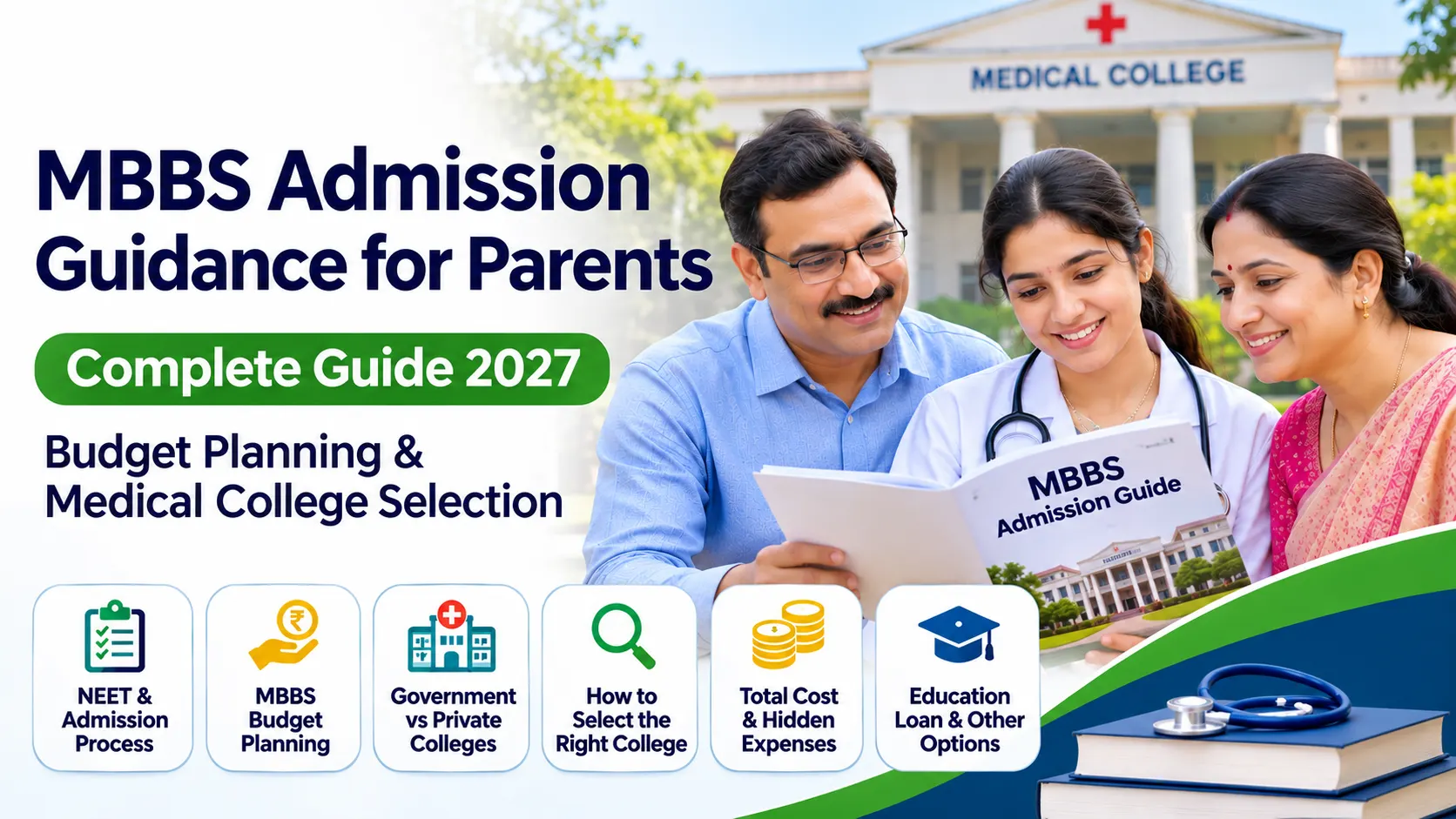
Choosing the right medical college is one of the most important decisions a family makes when a student dreams of becoming a doctor. For many parents in India, MBBS admission is not simply about securing a seat in a government or private medical college. It is about ensuring that their child receives quality medical education, develops strong clinical skills, studies in a safe environment, and completes the degree without unnecessary financial pressure on the family.
Every year, thousands of parents begin searching for answers to important questions such as: What is the total cost of MBBS in India? Which private medical college should we choose? How much money should we keep ready for tuition fees and hostel expenses? Is a government medical college always better than a private institution? Can a student get MBBS admission with a lower NEET rank? How do we identify a medical college that offers good education, hospital exposure, and reasonable fees?
These questions become even more important when families are planning to spend several lakhs or even more than a crore of rupees on medical education. A college may appear affordable when parents look only at its annual tuition fees, but the complete financial commitment can be considerably higher after including hostel expenses, mess charges, security deposits, examination fees, transportation, and other academic costs.
This is why MBBS admission guidance for parents should begin with careful financial planning and informed college selection rather than focusing only on the reputation or popularity of a particular institution.
At ShikshaMed, we help students and parents understand medical admission options in India and abroad, compare institutions, evaluate budgets, and navigate the applicable counselling process. Our approach focuses on helping families make practical decisions based on NEET performance, eligibility, available seats, official fee structures, and long-term educational goals.
This comprehensive guide explains everything parents should consider before selecting a medical college for MBBS admission in India in 2027.
Before planning their child’s medical education, parents should understand how MBBS admission works in India. Admission to recognized MBBS programmes is based on the National Eligibility cum Entrance Test for Undergraduate courses, commonly known as NEET UG.
The examination is conducted by the National Testing Agency (NTA), and candidates must meet the applicable eligibility conditions. The NEET score, All India Rank, category, domicile eligibility, applicable reservation provisions, seat availability, and counselling rules influence the options available to a student.
Importantly, qualifying NEET does not automatically guarantee an MBBS seat. A candidate must also participate in the relevant admission or counselling procedure and meet the requirements for the particular seat category and institution.
Parents should understand the difference between qualifying for NEET and obtaining admission. The qualifying percentile establishes basic eligibility, while actual admission depends on competitive rankings, available seats, and the rules applicable to each counselling authority.
For the 2027 admission cycle, families should follow the official information released by NTA, the Medical Counselling Committee, the National Medical Commission, and the relevant state counselling authorities.
Students interested in exploring different states can begin with the medical college information and admission resources available through ShikshaMed’s official website.
Based on the official NEET UG 2026 bulletin, candidates generally need to meet the prescribed qualifying examination requirements involving Physics, Chemistry, Biology or Biotechnology, and English. Candidates must also satisfy the prescribed minimum age requirement of 17 years by 31 December of the examination year. The 2026 rules did not prescribe an upper age limit.
Because admission regulations can be revised, students planning for NEET UG 2027 should confirm the final eligibility requirements in the 2027 information bulletin rather than relying on older online articles.
Parents should also ensure that their child’s educational certificates, identity documents, date of birth, category documents, and domicile information are accurate well before registration begins.
Official Reference: National Testing Agency – NEET UG
One of the biggest mistakes families make during MBBS admission is selecting a college first and calculating the total expenditure later.
Medical education is a long-term financial commitment. In India, the standard MBBS programme consists of approximately four and a half academic years followed by one year of compulsory rotating medical internship. Parents therefore need to consider expenses over the complete course, including the internship period where applicable.
A family may be comfortable paying the first-year tuition fees but could face financial difficulties if the same amount must be paid annually over several academic years.
For example, a private medical college charging ₹15 lakh per year may initially appear manageable. However, if the institution charges tuition for four and a half academic years, the tuition commitment alone may reach ₹67.5 lakh. Hostel accommodation, mess charges, examinations, deposits, travel, and personal expenses may increase the total further.
Some institutions follow different approved fee schedules, and the number of fee-paying years or instalments may differ. Parents should therefore obtain a written, institution-specific fee schedule rather than assuming that every college follows the same payment structure.
A good MBBS budget should answer three questions: How much can the family comfortably spend in total? How much money will be available each year? What financial reserve will remain for unexpected expenses?
The ideal medical college is not necessarily the one with the lowest advertised annual fee. It is one that offers an appropriate combination of verified educational standards, clinical exposure, affordability, and a sustainable payment plan.
Parents can start comparing published college-wise fee information through the ShikshaMed MBBS Fee Structure page. All amounts should be reconfirmed against the latest official college or counselling authority notifications before making a payment.
One of the most common questions parents ask is whether their child should join a government medical college or a private medical institution.
Government medical colleges generally have lower tuition fees for many categories of seats, which makes them financially attractive. However, admission is highly competitive, and the available options depend on the candidate’s NEET rank, category, quota, and relevant state or national counselling rules.
Private medical colleges provide additional opportunities for eligible NEET-qualified candidates, but their fee structures can be considerably higher. Private institutions may also differ widely in their teaching hospitals, patient footfall, faculty strength, infrastructure, hostel facilities, and overall educational environment.
It would be incorrect to assume that every government college is better than every private college, or that expensive private colleges automatically provide superior education. Families should evaluate individual institutions rather than judging quality solely by management type.
| Factor | Government Medical Colleges | Private Medical Colleges |
|---|---|---|
| Tuition Fees | Generally lower | Usually higher |
| Competition | Often very high | Depends on college and seat category |
| NEET Requirement | Mandatory | Mandatory |
| Clinical Exposure | Depends on hospital and patient flow | Depends on hospital and patient flow |
| Infrastructure | Varies by institution | Varies by institution |
| Hostel Facilities | College-specific | College-specific |
| Admission Route | Applicable central/state counselling | Applicable central/state counselling |
| Financial Commitment | Often comparatively lower | Can be substantially higher |
For families with limited budgets, government medical colleges may be the first preference. However, students whose ranks do not support their preferred government options may consider private colleges after carefully evaluating their total fees and the family’s ability to fund the course.
Parents should avoid making admission decisions based exclusively on campus photographs, advertisements, or promotional claims. Instead, they should investigate the institution’s current approval status, teaching hospital, academic environment, and official admission conditions.
The total cost of an MBBS degree depends on the college, state, seat category, fee-paying duration, accommodation arrangements, and other institution-specific charges.
There is no single nationwide MBBS fee that applies to every government or private medical college.
Parents researching MBBS fees in India should calculate the full educational expense rather than comparing only tuition charges. The following illustrative example demonstrates why complete budget planning is important.
The figures below are hypothetical planning assumptions, not the fees of any particular college.
| Expense | Estimated Amount |
|---|---|
| Annual Tuition Fee | ₹15,00,000 |
| Tuition for 4.5 Years | ₹67,50,000 |
| Hostel and Mess for 5.5 Years, at ₹2,00,000/year | ₹11,00,000 |
| Books, Instruments, Travel and Miscellaneous Expenses | ₹2,50,000 |
| Illustrative Total | ₹81,00,000 |
This example demonstrates how a medical college with annual tuition of ₹15 lakh could require an overall education budget of approximately ₹81 lakh under the stated assumptions.
Actual charges can be higher or lower. Some colleges require separate security deposits, examination fees, university charges, or other approved payments. Hostel charges may increase over time, and tuition billing may differ from the assumption used above.
Parents should ask for the latest official fee order and a complete written schedule showing which charges are mandatory, which are refundable, and when each payment is due.
For additional comparison, families can review the ShikshaMed Medical College Fee Structure and request clarification of the latest officially notified fee details.
Apart from tuition fees, parents should examine hostel fees, mess expenses, annual university charges, examination fees, books, clinical instruments, uniforms, transport, personal expenditure, laundry, and travel between home and college.
They should also ask whether hostel accommodation is compulsory, whether annual fee increases are permitted under the applicable rules, whether a bank guarantee or fee security is required, and whether any security deposit is refundable.
If a college demands an amount that is not shown in its applicable approved fee schedule, parents should request written clarification and verify the charge with the relevant authority before paying.
Choosing a medical college requires more than comparing tuition fees and checking whether a seat is available.
A medical student spends several years learning basic medical sciences, developing clinical knowledge, interacting with patients, preparing for examinations, and completing compulsory practical training. The environment in which these activities take place can influence the student’s confidence, professional development, and overall experience.
Parents should compare colleges according to the following important factors.
The first consideration is whether the institution is legally permitted to admit students to the relevant MBBS programme for the intended academic year.
The National Medical Commission publishes information relating to medical colleges, courses, and permitted seats. Parents should verify the specific college, course, and current admission capacity through the appropriate official sources.
A college appearing on an old list does not automatically confirm every admission claim made for a later academic session.
Before paying any substantial amount, families should check the latest NMC information and the applicable counselling seat matrix.
Official Reference: NMC College and Course Search
Clinical training is an essential part of medical education. Parents should investigate whether the attached teaching hospital provides meaningful opportunities for students to observe and learn from real clinical practice.
Relevant factors include the availability of outpatient and inpatient services, emergency care, major clinical departments, diagnostic facilities, and appropriate supervised clinical teaching.
Parents can ask about hospital activity, clinical postings, internship arrangements, and the availability of faculty members. Where possible, speaking with current students and visiting the campus can provide useful practical insight.
A visually impressive hospital building does not necessarily prove strong clinical training. The quality of teaching and access to appropriate supervised patient care are more important than promotional photographs.
Medical education is academically demanding, especially during the transition from school-level learning to professional subjects such as anatomy, physiology, biochemistry, pathology, pharmacology, medicine, surgery, and obstetrics and gynaecology.
Parents should consider faculty availability, academic schedules, practical laboratories, library resources, mentoring systems, examination support, and the institution’s general learning environment.
Student feedback can be useful, but parents should compare information from multiple reliable sources rather than relying on one positive or negative review.
For many families, MBBS admission also means sending their child to another city or state for the first time.
Hostel conditions, campus security, anti-ragging mechanisms, accessible medical support, hygiene, and student grievance procedures therefore deserve serious consideration.
Parents should ask about hostel rules, wardens, emergency assistance, student welfare services, anti-ragging arrangements, and communication systems for urgent concerns.
The goal is to identify a campus where the student can study comfortably, maintain a healthy routine, and seek support whenever necessary.
State selection can significantly influence the available colleges, tuition fees, accommodation costs, and eligibility for particular seat categories.
Some families prefer medical colleges close to home, while others are willing to explore institutions throughout India if they find a suitable combination of education quality and affordability.
However, parents should not assume that being NEET-qualified automatically makes a student eligible for every state quota seat in India. Domicile requirements, institutional eligibility rules, category reservations, and private-college participation conditions differ across states.
Punjab offers established medical education institutions and options across different types of medical colleges. Families considering the state should review the latest Punjab counselling notifications, fee structures, applicable eligibility rules, and institution-specific information.
Parents can explore the MBBS in Punjab Admission Guide for an introduction to medical college options in the state.
Haryana is another option for students exploring medical colleges in North India. Parents should carefully examine the financial commitment associated with private colleges, the applicable government fee orders, and any service bond or other requirements.
For state-specific information, refer to the MBBS in Haryana Guide.
Uttar Pradesh has a broad medical education landscape with government and private institutions in different cities. Families should compare individual colleges based on current admission rules, official fees, teaching facilities, accommodation, and location.
Other states such as Karnataka, Maharashtra, Rajasthan, Madhya Pradesh, Tamil Nadu, and Telangana may also deserve consideration, depending on the student’s eligibility and the admission options available in the relevant year.
Instead of selecting a state purely because someone claims that admission is easier there, parents should use the current official seat matrix, previous allotment trends, and verified eligibility rules to create a realistic shortlist.
NEET performance plays a major role in medical college admission. However, parents should understand that the student’s marks alone do not provide a complete picture of admission chances.
The All India Rank is usually more useful for comparing competitive positions, but even rank must be considered alongside the category, quota, domicile status, seat matrix, and other applicable eligibility conditions.
A college that admitted a student at a particular rank in one year may have a different closing rank in the next year because applicant preferences, seat availability, and other circumstances can change.
Parents should therefore use previous-year cutoffs as reference points rather than admission guarantees.
A practical college shortlist can include institutions that appear competitive for the student’s rank, institutions with more realistic historical admission possibilities, and eligible alternatives that fit the family’s budget.
Every choice should be made after checking whether the student actually meets the requirements for that particular seat.
Families seeking help with the process can explore the resources and counselling support available at ShikshaMed.
Management quota and NRI quota are often discussed by parents researching private MBBS admissions. However, these seat categories are frequently misunderstood.
Management quota is not a route to bypass NEET eligibility or lawful counselling requirements. Eligible candidates must follow the admission procedure and applicable rules for the relevant institution and jurisdiction.
Likewise, NRI quota seats have specific eligibility, documentation, and fee conditions that can vary according to the counselling authority, state regulations, and applicable institution rules.
Parents considering NRI quota must verify the permitted relationship or sponsorship requirements, necessary certificates, documentation formats, fee currency, and relevant deadlines.
A student should never rely on an unofficial promise that a medical seat can be secured without complying with the prescribed admission process.
For more information on the subject, parents can read the ShikshaMed NRI Quota MBBS Admission Guide.
The relevant 2027 official notices should always take precedence over earlier guidance.
A medical admission decision can affect a family’s savings and borrowing obligations for several years. Avoiding preventable financial mistakes is therefore particularly important.
One common mistake is comparing colleges using only their first-year tuition fees. A family may select an institution because the initial payment seems affordable without checking whether the same amount or a higher amount must be paid during later years.
Another mistake is relying on verbal assurances about discounts, refunds, deposits, or future fee changes. Any important financial condition should be confirmed in official written documentation.
Some parents also make decisions in a hurry because they are worried about losing an opportunity. While official counselling deadlines must be respected, unnecessary pressure from unauthorized intermediaries should not influence major payments.
Parents should avoid transferring money to personal bank accounts or making payments in exchange for unofficial promises of guaranteed admission.
They should use the payment methods prescribed by the applicable counselling authority or institution, retain receipts, and verify the legitimacy of every demand.
Finally, families should avoid exhausting all available savings simply to secure a particular college. A realistic education budget should preserve enough financial stability to cover other essential household responsibilities.
An education loan may be a useful option for families who cannot comfortably pay the full MBBS expenditure from available savings.
However, parents should understand the complete borrowing cost before committing to a loan.
Important considerations include the sanctioned amount, interest rate, fixed or floating interest conditions, repayment schedule, moratorium terms, collateral requirements, processing fees, and whether interest accrues during the study period.
Parents should also consider the possibility that their child may wish to pursue postgraduate medical education after MBBS rather than immediately entering full-time employment.
For this reason, the family should examine how loan repayments would be managed after graduation and whether sufficient income or financial reserves would be available.
It is generally sensible to compare written offers from multiple regulated lenders and understand the exact repayment obligation instead of choosing an education loan solely because the initial instalment appears affordable.
Scholarships, eligible government schemes, and institution-specific financial assistance may also be worth exploring, but availability and eligibility must be verified individually.
When two or more colleges appear suitable, parents should create a structured comparison rather than making decisions based on reputation alone.
For example, one institution may charge lower tuition fees but require additional accommodation expenses because it is located far from home. Another may have higher annual fees but provide a better fit in terms of hospital training, family proximity, or student support.
A practical comparison should include:
| Selection Factor | Questions Parents Should Ask |
|---|---|
| Admission Eligibility | Is the student eligible for this seat category? |
| NMC Status | Is the MBBS course permitted for the admission year? |
| Total Fees | What is the complete written fee schedule? |
| Teaching Hospital | What clinical learning opportunities are available? |
| Faculty | Are suitable teaching and academic resources available? |
| Hostel | What are the facilities, rules, and actual costs? |
| Location | Is travel practical and affordable? |
| Safety | What student welfare and grievance systems exist? |
| Internship | What are the training arrangements and applicable conditions? |
| Financial Sustainability | Can the family fund the course without excessive strain? |
Parents can assign their own priorities to these factors. For example, a family with a limited budget might place greater weight on tuition affordability, while another family may consider proximity to home especially important.
The final decision should reflect the student’s educational needs and the family’s financial circumstances.
Document preparation is an important part of medical admission planning. Missing, incorrect, or inconsistent documents can create difficulties during registration, verification, or reporting.
The exact requirements vary according to the year, authority, category, and institution. However, families can begin by organizing the student’s NEET admit card and scorecard, Class 10 and Class 12 academic certificates, valid identity proof, photographs, and other documents required by the relevant admission authority.
Where applicable, students may also need domicile certificates, category certificates, EWS documents, PwBD certificates, NRI-related certificates, or additional institutional forms.
Parents should verify the spelling of the student’s name, date of birth, parent details, category, and other particulars across all documents.
A digital folder containing clearly scanned copies and a separate organized set of originals can simplify the admission process.
Families should not assume that documents accepted by one state or counselling authority will automatically satisfy the requirements of another.
When parents find that private MBBS education in India exceeds their available budget, they sometimes explore medical education abroad.
Countries such as Georgia and Russia are commonly considered by Indian students researching overseas medical programmes. However, an international medical degree must be evaluated carefully, particularly if the student intends to practise medicine in India after graduation.
Parents must verify the university’s legal standing, the complete programme structure, the language of instruction and clinical training, internship arrangements, and compliance with the rules applicable to foreign medical graduates.
They should also investigate the pathway for registration and medical practice in India, including the licensing or screening requirements applicable when the student graduates.
A university’s advertisement or a claim of international recognition is not sufficient proof that every regulatory requirement for Indian graduates will be fulfilled.
The complete cost should include tuition fees, accommodation, food, travel, visa or residence-related expenses, health insurance, currency fluctuations, and other compulsory charges.
Parents exploring international options can read:
The final decision should be based on verified regulatory and academic information rather than comparing tuition fees alone.
MBBS admission planning should ideally begin before the counselling process starts.
Parents who wait until the last moment may have limited time to compare universities, investigate fees, arrange financial documents, or understand different seat categories.
Early preparation allows families to examine medical colleges systematically, estimate the required budget, review domicile and category eligibility, arrange supporting certificates, and consider alternative admission options.
Once the student’s NEET score and rank become available, the family can refine the college shortlist according to official admission information.
However, preparing early does not mean paying an institution or intermediary to reserve a seat outside the lawful admission process.
Parents should distinguish between legitimate advance planning and unauthorized seat-booking claims.
The objective is to enter the counselling period with a clear understanding of available options, financial limits, and the documents required.
Medical admission can feel complicated because it involves several interconnected decisions: NEET performance, college eligibility, state rules, seat categories, tuition fees, documentation, and reporting requirements.
Parents may understand one part of the process but still have questions about another. For example, a family may know its maximum education budget but remain uncertain about which states or medical colleges deserve consideration.
At ShikshaMed, our medical admission guidance is designed to help students and parents evaluate available opportunities more systematically.
Our counselling support includes discussing NEET performance, understanding eligible admission pathways, identifying medical college options, comparing published fee information, reviewing documentation requirements, and providing guidance on the applicable choice-filling and admission procedures.
We believe that successful admission planning should consider both the student’s academic future and the family’s financial well-being.
The purpose of professional counselling is to make the available information easier to understand and help families make informed choices. Admission and seat allotment remain subject to the relevant official counselling procedures, eligibility criteria, merit position, and seat availability.
Parents who want personalized assistance can connect with our team through the ShikshaMed Contact Page.
Before making a major financial commitment, every family should be able to answer a few important questions.
First, is the college legally permitted to admit students to the relevant MBBS programme for the intended academic year? Second, is the student’s admission being processed through the appropriate official counselling mechanism?
Third, has the institution provided the full applicable fee structure in writing? Parents should understand the tuition schedule, hostel arrangements, deposits, and any additional compulsory charges.
Fourth, what is the institution’s actual teaching and clinical environment? Families should examine the teaching hospital, academic support, student welfare arrangements, and practical learning opportunities.
Fifth, can the family comfortably complete the financial commitment without endangering essential household needs?
And finally, does the student feel comfortable with the college, its location, and the learning environment?
These questions are more valuable than selecting a medical college merely because its name appears frequently in advertisements or online recommendations.
Parents should begin by understanding NEET eligibility, estimating the complete course budget, checking the student’s admission options, and comparing medical colleges using official fees, permitted seats, teaching facilities, and counselling rules.
There is no uniform private MBBS fee across India. The amount varies significantly by institution, state, seat category, and approved fee structure. Parents should calculate tuition, accommodation, deposits, and other compulsory expenses for the complete programme before deciding.
A student who meets the applicable NEET qualifying requirements may be eligible to participate in certain counselling processes, but admission depends on rank, category, quota, institution, seat availability, and other applicable rules. A low score does not guarantee a private-college seat.
Not necessarily. Government colleges often offer an important tuition-fee advantage, but teaching quality, clinical exposure, facilities, and student support vary between institutions. Parents should compare individual colleges rather than assuming that management type alone determines quality.
Parents should consult the National Medical Commission’s official college and course information, check the latest permitted-seat information, and verify that the college appears in the relevant official admission or counselling records.
Yes. Management quota does not remove the requirement to meet applicable NEET eligibility and admission regulations. Admissions must follow the prescribed lawful process.
Parents should investigate accommodation, mess charges, university and examination fees, security deposits, transport, educational materials, personal expenses, and any other compulsory charges included in the applicable official fee schedule.
Proximity to home can reduce travel expenses and make family support more accessible, but it should be considered alongside the quality of education, affordability, college eligibility, and the student’s preferences.
The answer depends on the family’s financial circumstances, expected borrowing costs, repayment ability, and other financial obligations. Parents should compare loan conditions and consider obtaining independent financial advice before making a large borrowing commitment.
No legitimate consultant can override official eligibility, counselling, merit, or seat-allotment rules. Families should avoid anyone promising guaranteed admission outside the authorized process.
Families can begin preparing in advance by reviewing eligibility, arranging documents, discussing budgets, and researching colleges. Final decisions should be based on the official 2027 examination and counselling notifications.
ShikshaMed provides admission-related guidance to help parents understand college options, compare budgets, review admission requirements, and prepare for the applicable counselling process.
For personalized assistance, visit ShikshaMed or use the Contact Us page.
MBBS admission is much more than obtaining a medical seat. It is a long-term educational and financial decision that should be made with careful research, realistic expectations, and a clear understanding of the available opportunities.
Parents should remember that a popular college is not automatically the best choice for every student, and a higher tuition fee does not necessarily mean better medical education. The right institution is one that meets regulatory requirements, provides suitable academic and clinical training, supports student welfare, and fits within the family’s sustainable financial capacity.
Before finalizing a college, compare its complete fees, permitted MBBS seats, hospital training opportunities, accommodation conditions, and official counselling requirements. Never make substantial payments based on undocumented promises or incomplete information.
For families preparing for MBBS admission in 2027, early planning and reliable guidance can make the decision-making process clearer and more organized.
Planning MBBS Admission for Your Child? Connect With ShikshaMed.
At ShikshaMed – We Plan, You Achieve, we help students and parents explore MBBS admission options, understand college fees, and prepare for important admission decisions.
Website: www.shikshamed.com
Contact: +91 9041441449 / +91 9041441450
Email: info@shikshamed.com
Office: Sector 34, Chandigarh, Punjab region, India
Contact Our Team: ShikshaMed Admission Guidance