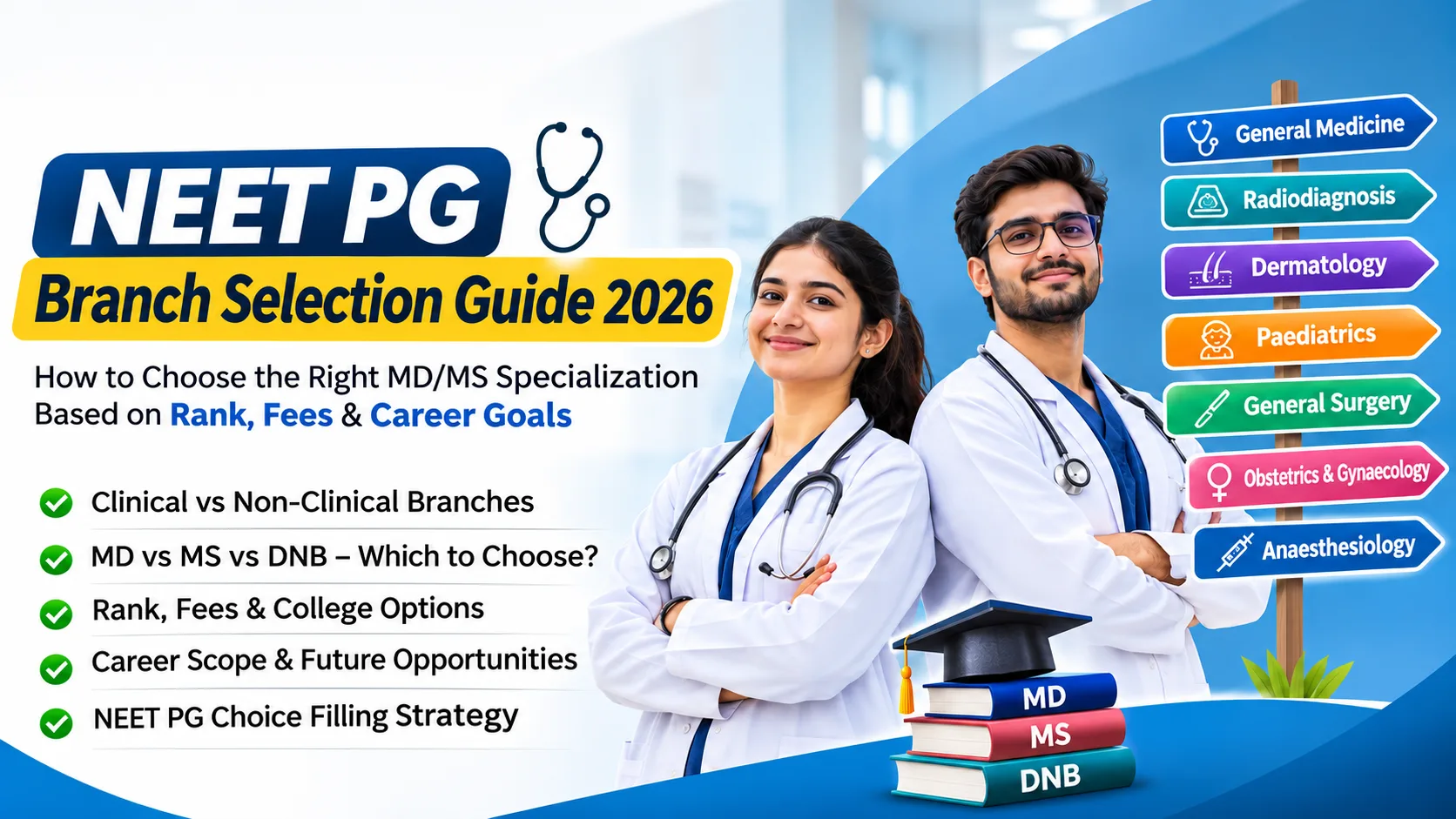
Choosing the right MD/MS branch after MBBS is one of the most important decisions in a doctor’s professional journey. Your postgraduate specialization influences the patients you treat, the procedures you perform, your working environment, further training opportunities, and long-term career satisfaction.
Every year, NEET PG aspirants face similar questions:
There is no single specialization that is best for every doctor. The right NEET PG branch selection depends on clinical interests, NEET PG rank, category, available seats, college quality, financial capacity, and future career goals.
In this comprehensive guide, ShikshaMed explains how to approach MD/MS branch selection strategically and make an informed admission decision.
NEET PG branch selection is the process of choosing a postgraduate medical specialization after qualifying for the National Eligibility cum Entrance Test for Postgraduate courses.
Through the applicable counselling processes, eligible candidates compete for postgraduate medical seats in MD, MS, DNB and other notified programmes.
A branch is not simply a course title. It determines the type of professional training and clinical responsibilities that will shape much of your future medical practice.
For example:
The most suitable specialization should match both your professional interests and realistic admission opportunities.
Students seeking personalized admission planning can explore NEET PG Counselling Guidance by ShikshaMed.
Postgraduate medical education generally involves several years of intensive academic learning, practical training, clinical responsibilities and examinations.
Your specialization may influence:
Career direction: Your branch determines the field in which you receive advanced training and the qualifications you can pursue later, subject to eligibility requirements.
Daily responsibilities: A surgeon, radiologist, physician, psychiatrist and pathologist can have very different working routines.
Patient interaction: Certain specialties involve extensive direct patient care, while others focus more heavily on diagnostics, procedures, research or laboratory services.
Emergency duties: Some specialties require frequent emergency coverage, although actual workloads depend on the department, institution and job.
Financial planning: The total cost of postgraduate training may vary considerably between government, private and deemed university institutions.
Long-term satisfaction: Interest in your chosen specialty matters because the nature of work continues well beyond residency.
A branch selected entirely because of popularity or perceived income may not suit your strengths and preferences.
Therefore, MD/MS branch selection should be based on informed comparison rather than social pressure.
Understanding the different types of postgraduate specializations is an essential part of NEET PG counselling.
Clinical branches generally involve direct patient assessment, treatment and ongoing medical care.
Examples include:
| MD Specialization | Main Area of Training |
|---|---|
| MD General Medicine | Adult medical diseases and internal medicine |
| MD Paediatrics | Child and adolescent healthcare |
| MD Dermatology, Venereology & Leprosy | Skin, hair, nails and related diseases |
| MD Psychiatry | Mental health and psychiatric disorders |
| MD Respiratory Medicine | Respiratory and pulmonary diseases |
| MD Anaesthesiology | Anaesthesia, perioperative and critical care |
| MD Emergency Medicine | Emergency assessment and management |
| MD Family Medicine | Comprehensive and continuing healthcare |
These branches differ in patient populations, schedules, procedures, diagnostic responsibilities and future opportunities.
Surgical branches involve operative training and related patient management.
Common examples are:
| MS Specialization | Main Area of Training |
|---|---|
| MS General Surgery | Surgical management of a broad range of conditions |
| MS Orthopaedics | Bone, joint and musculoskeletal disorders |
| MS Obstetrics & Gynaecology | Women’s reproductive health, childbirth and surgery |
| MS Ophthalmology | Eye diseases and ophthalmic surgery |
| MS Otorhinolaryngology (ENT) | Ear, nose, throat and related conditions |
Surgical training may be appropriate for doctors who enjoy procedural skills, operative decision-making and hands-on clinical work.
These branches play an important role in investigation, diagnosis and patient management.
Examples include:
Radiodiagnosis is a patient-care specialty with clinical and procedural responsibilities; it should not be assumed to be a purely non-clinical branch.
These include areas such as:
Such branches may offer careers in academics, research, public health, laboratory sciences, forensic services and other relevant professional settings.
Important: Branch availability, exact programme titles and recognized qualifications must be checked against the National Medical Commission and the current counselling seat matrix.
One of the most searched topics among postgraduate medical aspirants is MD/MS branch selection by rank.
Your All India Rank is important because counselling allotments are merit-based. However, rank alone does not determine which branch or college you can secure.
Actual admission opportunities depend on multiple factors:
Previous-year allotment results provide a useful reference. They can show where seats were allotted under particular categories and counselling rounds.
However, a previous-year closing rank is not a guaranteed admission cutoff for the current year.
For instance, a branch may be available at a particular rank in one institution or category but remain unavailable at the same rank in another institution.
A change in seat numbers, participating colleges, candidate preferences or counselling rules can also affect allotment outcomes.
Students should therefore compare the exact institution, course, quota, category, round and year before using any closing-rank figure.
For detailed admission planning, read our NEET PG 2026 Rank-Wise College and Branch Predictor Guide.
Several medical specializations attract strong interest among postgraduate aspirants. Each has different advantages, training demands and limitations.
General Medicine provides broad clinical training in adult medical diseases.
It may be a suitable option for doctors who enjoy clinical diagnosis, complex cases, inpatient care and long-term disease management.
Potential career directions include hospital practice, internal medicine practice, teaching and further specialty training, subject to eligibility.
Consider this branch if: You enjoy clinical reasoning, medicine-based patient care and broad diagnostic challenges.
Radiodiagnosis focuses on imaging-based diagnosis using modalities such as X-ray, ultrasound, CT and MRI, along with relevant procedures.
Doctors interested in imaging technology, anatomy, diagnostic interpretation and image-guided work may find this branch attractive.
However, working hours, emergency responsibilities and career opportunities depend on the role and institution.
Consider this branch if: You enjoy medical imaging, technology and detailed diagnostic analysis.
Dermatology involves the diagnosis and treatment of skin, hair, nail and related disorders.
Depending on training, further qualifications and scope of practice, career opportunities can include medical dermatology, procedures, teaching and specialist clinical practice.
Consider this branch if: You are interested in skin diseases, outpatient care and dermatological procedures.
Paediatrics focuses on the medical needs of infants, children and adolescents.
It can involve outpatient care, inpatient management, neonatal medicine and emergency responsibilities.
Consider this branch if: You enjoy working with children and managing a variety of paediatric conditions.
General Surgery is appropriate for doctors interested in operative procedures, surgical emergencies and perioperative patient management.
Training can be physically and mentally demanding, particularly in departments with substantial emergency workloads.
Consider this branch if: You prefer operative work, procedural decision-making and surgical patient care.
Obstetrics and Gynaecology focuses on pregnancy, childbirth, reproductive healthcare and gynaecological disorders.
It offers both medical and surgical training.
Consider this branch if: You are interested in women’s healthcare, childbirth and procedural medicine.
Anaesthesiology involves operating theatre care, perioperative assessment, airway management and related critical-care competencies.
It can be a good option for doctors interested in physiology, pharmacology, procedures and acute patient management.
Consider this branch if: You enjoy technical clinical skills, teamwork and managing patients around surgery.
Psychiatry focuses on mental health assessment, diagnosis and treatment.
It involves clinical interviewing, therapeutic relationships, medication management and multidisciplinary care.
Consider this branch if: You are interested in mental health, communication-based care and understanding behaviour.
Key takeaway: No specialty should be described as universally superior in salary, lifestyle or career success. Individual interests, expertise, location and training quality matter greatly.
Choosing the right specialization also requires choosing an appropriate institution.
A government medical college may offer a relatively lower tuition fee structure, while some private or deemed university institutions may provide a preferred branch that is not realistically available to a candidate through government seats.
| Comparison Factor | Government Medical College | Private/Deemed Institution |
|---|---|---|
| Tuition fees | Often comparatively lower | Can be significantly higher |
| Clinical exposure | Depends on patient load and department | Depends on patient load and department |
| Competition | Often strong for preferred branches | Varies by college, quota and fees |
| Infrastructure | Institution-dependent | Institution-dependent |
| Bond requirements | May apply | May also apply |
| Stipend | Varies by applicable rules | Varies by institution and rules |
| Faculty and training | Must be evaluated individually | Must be evaluated individually |
It would be incorrect to assume that every government college is better than every private college, or vice versa.
Before finalizing a college, assess its recognized seats, departmental training, faculty, patient load, working conditions and total costs.
You can review our MD/MS College-Wise Fee Structure Guide when preparing your financial shortlist.
Budget is a major factor in medical postgraduate admission planning.
Many aspirants focus only on annual tuition fees. In reality, the full financial commitment can include several additional expenses.
Before selecting a college, review:
For a typical three-year broad-specialty MD/MS programme, your financial planning should account for the complete programme duration.
Illustrative example only:
Suppose a college charges ₹20 lakh annually in tuition fees for three years.
The base tuition commitment would be:
₹20,00,000 × 3 = ₹60,00,000
This excludes hostel, living expenses, other applicable charges and any future fee revisions.
The example is not a verified fee quotation for any particular institution.
This decision requires balancing career interest with financial sustainability.
A preferred specialty may offer stronger long-term personal satisfaction, but taking on an unaffordable financial commitment can create significant pressure.
Candidates should compare realistic admission alternatives and assess how the investment fits their financial circumstances without relying on uncertain future income projections.
Read more about MD/MS Admission in India for a broader view of admission planning.
Another major decision during NEET PG counselling is whether to select an MD, MS or DNB programme.
All three pathways can lead to postgraduate specialist qualifications, provided the programme and qualification meet applicable regulatory requirements.
MD programmes generally focus on medical, diagnostic and other relevant specialty disciplines.
Training is offered in medical colleges and eligible institutions according to the applicable regulatory framework.
MS programmes focus on surgical specialties and include operative and related clinical training.
DNB programmes are administered through the National Board of Examinations in Medical Sciences and offered at accredited training institutions.
The training environment may differ across institutions. Candidates should consider clinical exposure, case mix, teaching, examinations, mentorship and their career plans.
The recognition and teaching eligibility of DNB qualifications are governed by applicable NMC regulations and may depend on specific qualification and training conditions.
| Factor | What to Evaluate |
|---|---|
| Recognition | Exact qualification and applicable regulations |
| Clinical training | Patient load, procedures and case mix |
| Academic support | Teaching, mentorship and research |
| Assessment | Examination structure and requirements |
| Career goals | Practice, academia or further training |
| Cost | Tuition, stipend and other expenses |
| Location | Hospital, city and personal circumstances |
Rather than assuming one pathway is always better, compare individual programmes.
For a detailed comparison, explore MD vs DNB General Medicine: Which Is Better?.
Medical career planning should go beyond current admission trends.
A specialty that is popular today may not automatically be the best option for your long-term professional satisfaction.
Consider these questions:
Do you enjoy direct patient care?
Branches such as General Medicine, Paediatrics, Psychiatry and several others involve substantial patient interaction.
Do you prefer procedures and operative work?
General Surgery, Orthopaedics, Obstetrics and Gynaecology, Ophthalmology and other procedural specialties may be worth considering.
Do you enjoy diagnostics and technology?
Radiodiagnosis, Pathology, Microbiology and related specialties offer different diagnostic career pathways.
Are you interested in research, teaching or public health?
Several pre-clinical, para-clinical and public health disciplines can be relevant.
Do you plan to pursue further specialty training?
Investigate whether your postgraduate qualification meets the eligibility requirements for the specific further programme you want to pursue.
A good career decision begins with understanding the actual work involved in each specialization.
Selecting your preferred specialization is important, but the quality of training can make a significant difference.
Two institutions offering the same MD/MS course may provide different levels of clinical exposure and educational support.
Before choosing a college, investigate the following factors.
A department with diverse clinical cases can offer valuable learning opportunities, provided there is appropriate supervision and training.
Experienced teachers and supervisors can support clinical skills, academic progress and research development.
Depending on the specialty, assess operating theatres, ICUs, imaging equipment, laboratories, emergency services and other relevant facilities.
Look into departmental teaching activities, case discussions, research support, library resources and assessment systems.
Where possible, seek balanced, firsthand information about duty hours, supervision, workload, safety and working conditions.
Check that the specific programme and intake are appropriately permitted or recognized under the applicable regulatory framework.
Do not assume that recognition of an institution’s MBBS programme automatically confirms the status of every postgraduate course it offers.
Correct choice filling is a critical part of postgraduate medical admission.
Even a carefully researched branch and college shortlist can become ineffective if preferences are entered incorrectly.
A sound approach is to prepare your list before the official choice-filling window begins.
Choose the specialties you would genuinely consider pursuing.
Avoid selecting an unwanted course merely to increase the number of options.
Include only programmes for which you meet the applicable eligibility criteria and are willing to join.
Verify the exact seat type, category, institution and course.
Examine official previous-round and previous-year allotment results.
Use these figures to understand possible options, not to guarantee an allotment.
Confirm tuition, deposits, hostel fees, stipend conditions and service-bond obligations before adding a choice.
A preference list should reflect the choices you actually want, taking into account the official allotment and upgradation rules.
Do not automatically place a less-preferred college higher solely because you believe its closing rank is easier.
Check course names, college names, quotas, category details and the order of preferences.
Registration, security deposit, choice locking, seat acceptance, reporting, resignation and upgradation rules may differ by counselling authority and round.
For central PG counselling, refer to the Medical Counselling Committee. For state quota seats, consult the relevant official state counselling authority.
Important: Candidates must read the current information bulletin and notices before making decisions that could affect their seat, deposits or eligibility for future rounds.
Popularity does not prove that a specialization suits your strengths or career interests.
A previous closing rank cannot predict every future allotment.
Faculty, case exposure, department resources and teaching standards should be part of your decision.
Candidates should calculate total admission expenses, bond requirements and practical financial commitments.
Advice from others can be useful, but the final specialization should align with your own professional goals.
Candidates should verify training structures, qualification recognition and applicable teaching eligibility regulations.
An incorrectly ordered or unsuitable choice list can create avoidable admission difficulties.
No consultant or institution can legitimately guarantee an official NEET PG seat allotment outside the applicable merit-based counselling process.
Before finalizing your MD/MS or DNB preferences, ask yourself:
If several answers remain unclear, further research is preferable to making a rushed decision.
Choosing a postgraduate medical specialization involves multiple decisions that should be considered together.
ShikshaMed provides NEET PG counselling and medical admission guidance to help candidates evaluate their available pathways.
Our guidance focuses on:
Rank and eligibility analysis: Reviewing NEET PG rank, category, domicile and relevant counselling eligibility.
Branch shortlisting: Helping candidates compare specializations based on interests, goals and admission options.
College comparison: Evaluating government, private, deemed university and DNB programmes where relevant.
Fee and budget planning: Helping candidates understand published institution fees and other admission-related costs.
Previous cutoff analysis: Reviewing relevant official allotment trends to identify realistic choices.
Choice filling guidance: Helping candidates prepare a preference list based on verified options and personal priorities.
Counselling support: Providing information about registration, document preparation, allotment and reporting requirements.
ShikshaMed’s objective is to support well-informed admission decisions, not to promise a particular allotment.
For individual guidance, visit our NEET PG Counselling Consultant page or Request a PG Counselling Session.
There is no universally best branch. MD General Medicine, MD Radiodiagnosis, MD Dermatology, MD Paediatrics, MS General Surgery, MS Obstetrics and Gynaecology and other specialties may be appropriate for different candidates. Your interests, clinical strengths and career goals should guide the decision.
Start with your rank, category, counselling eligibility and budget. Compare official seat matrices and previous allotments for the exact institution, branch, quota and category. Prepare a shortlist of specializations you genuinely want to pursue.
Possibilities depend on the year, category, seat matrix, available institutions, counselling round and fee constraints. A lower rank does not automatically rule out every clinical branch, but no allotment can be guaranteed.
Neither is universally better. General Medicine and Radiodiagnosis involve substantially different work. Choose according to your clinical interests, preferred responsibilities and career plans.
Compare training quality, department facilities, fees, patient exposure, faculty, bond conditions and your preferred specialization. Institution quality should be evaluated individually.
DNB qualifications have recognized pathways under the applicable regulatory framework. However, precise recognition, teaching eligibility and other career requirements must be checked under the relevant NMC and NBEMS rules.
There is no reliable universal ranking applicable to all doctors. Earnings vary with qualifications, experience, location, employment setting, subspecialty training, patient demand and other factors. Expected salary alone is not a sound basis for branch selection.
Work-life balance depends on specialization, workplace, emergency responsibilities, career stage and individual practice arrangements. Residency workloads may differ significantly from later professional practice.
Changing an allotted seat or course is governed by the applicable counselling, upgradation, resignation and admission rules. Candidates should not assume that a branch can be changed freely after joining.
There is no single factor. A well-prepared preference list should consider genuine branch and college preferences, eligibility, fees, seat availability and current official counselling rules.
Previous-year ranks are useful for understanding admission trends, but cannot guarantee future results. They must be interpreted with the correct category, quota, institution, specialty and counselling round.
Candidates can seek guidance from qualified mentors, current residents, official counselling sources and experienced admission advisory services.
ShikshaMed provides support for branch comparison, college selection, fee assessment and NEET PG counselling planning.
NEET PG branch selection is a long-term career decision, not simply a race for the most popular specialization.
The ideal MD/MS or DNB programme should combine your clinical interests, admission eligibility, training expectations, financial capacity and professional goals.
Before finalizing your preferences, research the branch carefully, verify the institution, compare official allotment information and review all relevant counselling conditions.
A thoughtful decision today can help establish a strong foundation for your future medical career.
ShikshaMed | Medical Admission & NEET PG Counselling Guidance
Get support with MD/MS/DNB college shortlisting, branch comparison, previous allotment analysis, budget planning and choice filling.
Call/WhatsApp: +91 9041441449 | +91 9041441450
Head Office: SCO 81–82, Ground Floor, Opposite Passport Office, Sector 34A, Chandigarh – 160022.
Website: www.shikshamed.com
Book a Session: ShikshaMed PG Counselling