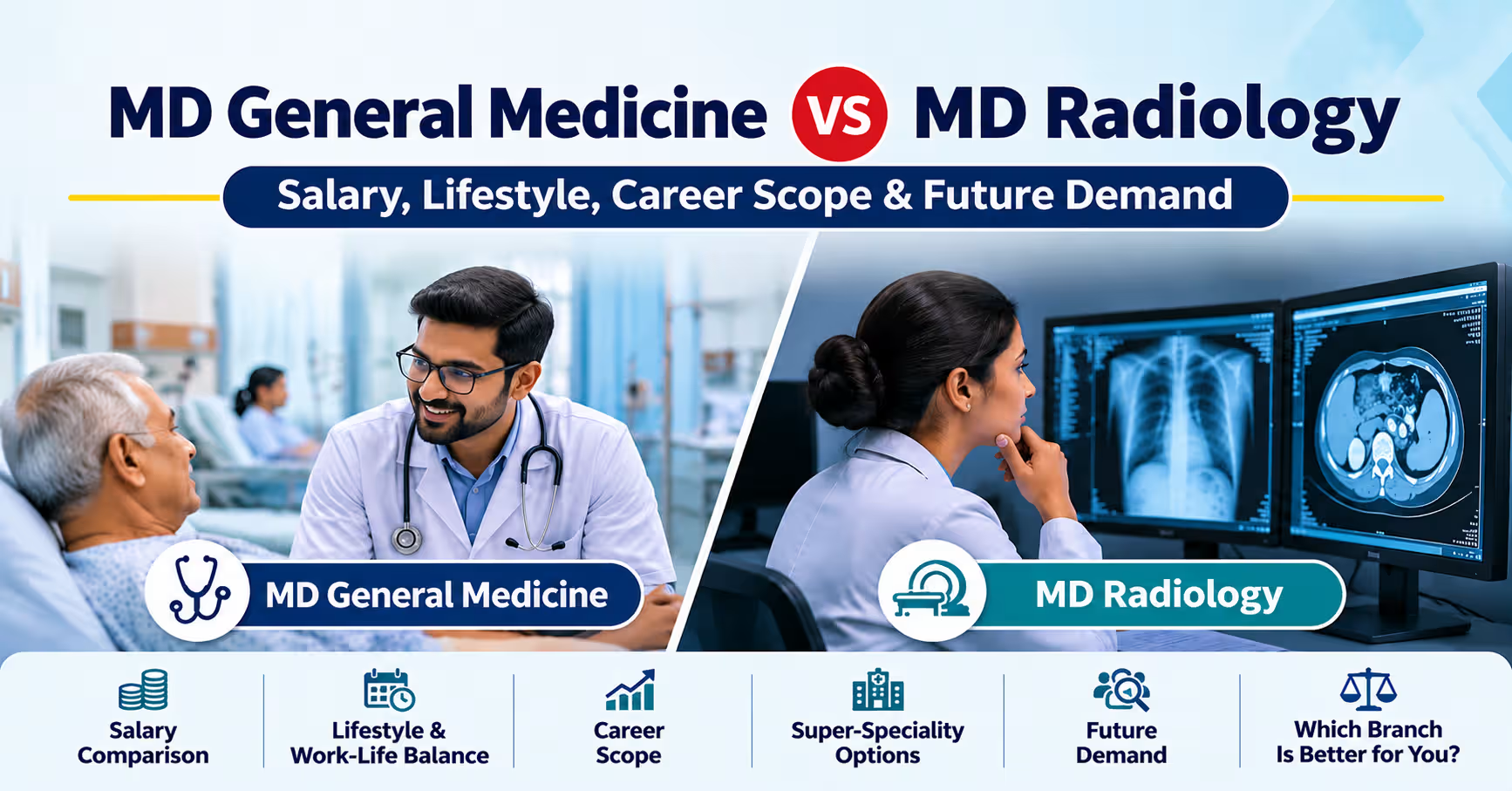
Choosing the right postgraduate medical speciality after MBBS is one of the most important decisions in a doctor’s professional journey. Among the most sought-after clinical branches in NEET PG counselling, MD General Medicine and MD Radiodiagnosis, commonly known as MD Radiology, continue to attract medical graduates because of their career opportunities, earning potential, professional recognition and opportunities for further specialisation.
While MD General Medicine offers extensive patient interaction, clinical diagnosis, disease management and opportunities to pursue super-speciality courses such as Cardiology, Neurology and Gastroenterology, MD Radiology focuses on advanced diagnostic imaging, medical technology and image-guided procedures.
Both branches can offer rewarding professional careers, but they differ significantly in terms of working hours, clinical responsibilities, emergency duties, earning models and future career pathways.
This comprehensive guide will help NEET PG aspirants compare MD General Medicine and MD Radiology and make an informed decision based on their professional interests, financial expectations, lifestyle preferences and long-term career goals.
MD General Medicine is a three-year postgraduate medical programme that focuses on the diagnosis, treatment and management of diseases affecting adults. It provides comprehensive training in clinical medicine, emergency care, infectious diseases, cardiovascular disorders, neurological conditions, metabolic diseases and multisystem disorders.
A general medicine specialist plays a central role in patient care by evaluating symptoms, identifying underlying medical conditions, prescribing appropriate treatments and coordinating with other specialists whenever necessary. Physicians frequently manage patients suffering from diabetes, hypertension, thyroid disorders, respiratory diseases, liver disorders, kidney diseases and complex medical emergencies.
One of the biggest advantages of MD General Medicine is its versatility. Doctors can establish independent clinical practices, work as consultants in multispeciality hospitals, pursue academic careers or obtain further super-speciality qualifications.
MD Radiodiagnosis is a three-year postgraduate medical programme that focuses on diagnosing diseases through advanced medical imaging technologies. Radiologists play an essential role in modern healthcare by helping clinicians identify diseases accurately and determine appropriate treatment strategies.
During postgraduate training, radiology residents learn to interpret X-rays, ultrasound examinations, CT scans, MRI scans, mammography and other diagnostic imaging procedures. Radiologists also participate in multidisciplinary medical discussions and may perform image-guided diagnostic and therapeutic interventions.
With the increasing use of advanced medical technology, preventive healthcare screening and minimally invasive procedures, radiology has become an important component of modern medical practice.
| Particular | MD General Medicine | MD Radiology |
|---|---|---|
| Course Duration | 3 Years | 3 Years |
| Speciality Type | Clinical Medicine | Diagnostic and Interventional |
| Primary Role | Diagnosis and Patient Treatment | Medical Imaging and Diagnosis |
| Patient Interaction | Very High | Variable |
| Emergency Duties | Frequently High | Institution-dependent |
| Night Duties | Common | Depends on Work Profile |
| Work-Life Balance | Variable | Often More Predictable |
| Independent Practice | Excellent Potential | Excellent Potential |
| Initial Clinic Investment | Generally Lower | Higher for Imaging Centre Ownership |
| Super-Speciality Options | Extensive | Focused Specialisations |
| Remote Working | Limited Teleconsultation | Teleradiology Opportunities |
| Technology Dependency | Moderate to High | Very High |
| NEET PG Competition | Very High | Extremely High |
| Long-Term Career Scope | Excellent | Excellent |
Salary is an important consideration for medical graduates while selecting their postgraduate speciality. However, the earning potential of a doctor depends on several factors, including professional experience, geographical location, medical institution, clinical expertise, additional qualifications, patient volume and employment arrangements.
MD Radiology can offer attractive earning opportunities through diagnostic centres, corporate hospitals, imaging facilities and teleradiology services. In certain regions experiencing a shortage of qualified radiologists, hospitals may offer particularly competitive compensation.
MD General Medicine also provides excellent earning opportunities through hospital consultancy, independent clinical practice, inpatient management and further super-specialisation. Experienced physicians with an established patient base may develop substantial professional income over time.
Selected specialist vacancies advertised in November 2026 — monthly compensation
MD General Medicine
₹3–5 lakh
MD Radiology
₹3–10 lakh
Bars represent the upper end of advertised salary ranges, not average salaries.
These figures represent selected specialist recruitment advertisements and should not be interpreted as guaranteed starting salaries or national averages. Newly qualified doctors may receive considerably lower offers, depending on the institution and location. Doctors Placements+2
Radiology may offer attractive early-career earning opportunities in certain private healthcare settings, particularly where experienced radiologists are in short supply. Physicians, on the other hand, can build long-term earning potential through independent practice, hospital consultancy and super-speciality training.
A successful general physician, cardiologist, neurologist or gastroenterologist may earn more than many radiologists. Similarly, experienced radiologists working in advanced imaging, interventional radiology or multiple diagnostic facilities may achieve substantial professional income.
Ultimately, professional expertise, reputation and career development play a greater role than the postgraduate degree alone.
Lifestyle is becoming an increasingly important consideration among medical graduates. Many young doctors want to pursue a rewarding medical career while maintaining sufficient time for their families, personal interests and physical and mental well-being.
The professional life of a general physician can be demanding because of extensive patient responsibilities, emergency consultations, inpatient rounds and the management of critically ill patients. Physicians working in large hospitals frequently encounter complex medical emergencies that require immediate decision-making.
During residency, general medicine students may experience lengthy working hours, night duties, emergency admissions and intensive care responsibilities. However, after completing postgraduate training, doctors may choose more predictable working arrangements through outpatient clinics, scheduled consultations or academic positions.
General medicine is particularly suitable for doctors who enjoy direct patient interaction, clinical problem-solving and the satisfaction of managing patients throughout their treatment journey.
Diagnostic radiology may provide relatively structured working hours in outpatient diagnostic centres and scheduled imaging departments. Radiologists can also explore remote reporting opportunities through teleradiology, depending on applicable professional and institutional requirements.
However, radiology is not necessarily a stress-free speciality. High reporting volumes, diagnostic accuracy requirements, prolonged screen exposure, emergency imaging and interventional procedures can create considerable professional pressure.
Radiologists working in trauma centres, emergency hospitals and interventional departments may also experience unpredictable schedules and night duties.
| Lifestyle Factor | General Medicine | Radiology |
|---|---|---|
| Ward Rounds | Frequent | Generally Limited |
| Night Duties | Common | Variable |
| Patient Follow-up | Extensive | Generally Limited |
| Emergency Work | High in Acute Care | High in Emergency Imaging |
| Remote Working | Limited | Greater Potential |
| Scheduled Practice | Possible | Often Available |
| Professional Stress | Clinical and Patient Management | Diagnostic Accuracy and Workload |
MD General Medicine offers one of the broadest career pathways available to postgraduate medical graduates. Physicians are required in government hospitals, private hospitals, medical colleges, corporate healthcare institutions, community healthcare facilities and independent clinical practices.
The increasing burden of diabetes, hypertension, cardiovascular diseases and other chronic medical conditions supports the continued need for physicians capable of managing complex adult health problems.
General medicine is particularly attractive for candidates who wish to develop a long-term clinical practice and establish strong professional relationships with patients and their families.
Radiology has become an essential part of almost every major medical speciality. From identifying fractures and infections to evaluating cancers, neurological disorders and cardiovascular conditions, diagnostic imaging supports a wide range of medical decisions.
Radiologists can work in corporate hospitals, independent diagnostic centres, medical colleges, specialised imaging departments, cancer hospitals, trauma centres and teleradiology organisations.
The expansion of digital imaging networks and remote reporting services may further diversify career opportunities for appropriately trained radiologists.
One of the most significant differences between these two postgraduate branches is the availability of further super-speciality training.
MD General Medicine provides access to numerous medical super-specialities, making it an attractive choice for candidates planning to pursue advanced clinical qualifications. MD Radiology offers more focused opportunities in advanced diagnostic and interventional imaging.
After MD General Medicine
DM Cardiology
DM Neurology
DM Nephrology
DM Gastroenterology
DM Endocrinology
DM Medical Oncology
DM Clinical Haematology
DM Clinical Immunology & Rheumatology
After MD Radiology
DM/DrNB Interventional Radiology
DM Neuroradiology
Fellowship in Cardiac Imaging
Fellowship in Musculoskeletal Imaging
Fellowship in Breast Imaging
Fellowship in Paediatric Radiology
Fellowship in Oncological Imaging
Admission to DM and DrNB programmes depends on the applicable entrance examination, recognised feeder qualification and current eligibility regulations. Fellowship programmes may have separate institution-specific requirements and are not equivalent to DM qualifications. Medical Dialogues+1
The future demand for general medicine specialists in India is expected to remain substantial because of changing lifestyles, increasing chronic disease prevalence, an ageing population and the expansion of healthcare services.
Conditions such as diabetes, hypertension, cardiovascular disorders, kidney diseases, obesity and respiratory illnesses frequently require continuous medical supervision. General physicians play a vital role in early diagnosis, preventive healthcare, treatment coordination and long-term disease management.
India also continues to face geographical disparities in specialist availability, particularly outside major metropolitan areas. These healthcare needs may create opportunities for qualified physicians in both established urban healthcare institutions and developing cities. PRS Legislative Research+1
Furthermore, the ability to establish an independent outpatient clinic with relatively modest infrastructure requirements compared with an advanced imaging facility makes general medicine an attractive option for doctors interested in healthcare entrepreneurship.
The demand for radiology services is expected to evolve alongside advancements in healthcare technology, diagnostic imaging, cancer screening and minimally invasive medical procedures.
Modern hospitals increasingly depend on advanced imaging techniques for accurate disease diagnosis, treatment planning and monitoring. CT scans, MRI examinations, ultrasound and other imaging technologies are becoming important components of healthcare delivery across metropolitan cities and developing regions.
Teleradiology is also expanding access to specialist imaging interpretation in areas where qualified radiologists may not be locally available. Research on Indian radiology highlights the importance of digital reporting infrastructure and the mismatch between imaging workload and specialist availability. PubMed Central (PMC)+1
Radiologists who continuously develop their skills in advanced imaging, artificial intelligence, subspeciality interpretation and image-guided interventions may be particularly well positioned to adapt to the future healthcare environment.
Artificial intelligence has become one of the most discussed topics among medical graduates considering MD Radiology. Many NEET PG aspirants are concerned that automated diagnostic systems could reduce future employment opportunities for radiologists.
AI-powered imaging tools can already assist with identifying abnormalities, prioritising urgent scans, supporting image analysis and improving reporting efficiency. However, medical imaging requires clinical correlation, contextual interpretation, communication with treating physicians and professional accountability.
Radiologists also perform complex procedures, evaluate uncertain findings and contribute to multidisciplinary treatment decisions. These responsibilities extend beyond automated image recognition.
AI is likely to transform radiology workflows rather than simply eliminate the profession. Nevertheless, the long-term effect on employment, reporting volumes and compensation remains uncertain. PubMed Central (PMC)+1
Future radiologists should therefore develop strong clinical knowledge, technological adaptability, procedural skills and familiarity with AI-assisted diagnostic systems.
Both medical specialities offer excellent opportunities for doctors interested in establishing their own healthcare businesses. However, the investment requirements and operating models differ considerably.
| Business Factor | General Medicine Clinic | Radiology Centre |
|---|---|---|
| Initial Investment | Generally Lower | Generally Higher |
| Equipment Requirements | Basic Clinical Equipment | Specialised Imaging Equipment |
| Patient Base | Direct Consultations | Direct Patients and Referrals |
| Infrastructure Cost | Relatively Lower | Relatively Higher |
| Maintenance Cost | Generally Lower | Equipment-dependent |
| Income Model | Consultations and Clinical Services | Imaging and Diagnostic Services |
| Regulatory Requirements | Applicable Clinic Regulations | Additional Equipment and Imaging Regulations |
| Business Expansion | Clinics and Multispeciality Hospitals | Imaging Networks and Diagnostic Centres |
A general physician can establish an outpatient practice and gradually expand services according to patient demand. Radiologists can establish diagnostic centres, collaborate with hospitals or provide professional imaging interpretation services without necessarily owning expensive imaging equipment.
An independently owned CT or MRI facility requires substantial capital, trained staff, equipment maintenance and applicable regulatory approvals. Therefore, diagnostic centre revenue should not be confused with the owner’s net professional income.
MD General Medicine and MD Radiodiagnosis are among the highly preferred postgraduate medical branches in India. Both specialities generally attract candidates with competitive NEET PG ranks, particularly for government medical colleges and affordable private institutions.
MD Radiology frequently witnesses strong competition because of its earning opportunities, technology-oriented work and perceived lifestyle advantages. MD General Medicine remains highly competitive because of its broad clinical scope, independent practice opportunities and extensive super-speciality pathways.
The admission closing rank for both branches depends on the candidate’s category, All India Rank, counselling round, institution type, seat availability and tuition fees.
Candidates with higher numerical ranks may also explore DNB General Medicine, DNB Radiodiagnosis, deemed universities and private medical colleges participating in applicable counselling processes.
For NEET PG 2026 admissions, candidates should compare the latest official MCC and state counselling allotment results before preparing their preference lists.
Return on investment is particularly important for candidates planning to pursue postgraduate medical education in private medical colleges or deemed universities.
Higher tuition fees do not necessarily guarantee a higher future salary. Candidates should consider the total cost of postgraduate education, expected stipend, educational loan interest, professional opportunities and realistic earning potential.
Illustrative figures. Enter the actual medical college fees to compare your three-year educational cost.Medicine annual fee (₹ lakh)Radiology annual fee (₹ lakh)Annual additional expenses (₹ lakh)Monthly stipend (₹ lakh)
General Medicine – net cost
Radiology – net cost
Difference in educational cost
Assumes constant annual fees and monthly stipend over three years. Excludes loan interest, refundable deposits and lost earnings.
For example, if MD General Medicine costs ₹30 lakh annually and MD Radiology costs ₹45 lakh annually, the difference in tuition fees alone over three years is ₹45 lakh.
Candidates must evaluate whether the additional educational expenditure is justified by their professional interests, long-term financial objectives and realistic career opportunities.
MD General Medicine may be the better option if you enjoy direct patient interaction, detailed clinical examination, complex disease diagnosis and long-term patient management. It is particularly suitable for doctors who want to pursue super-specialities such as Cardiology, Neurology, Gastroenterology or Nephrology.
Candidates who wish to establish independent outpatient clinics, develop a loyal patient base and remain actively involved in clinical treatment may find general medicine professionally fulfilling.
However, candidates should be prepared for demanding residency schedules, emergency responsibilities and continuous patient management.
MD Radiology may be the better option if you are interested in medical technology, anatomy, diagnostic imaging, visual interpretation and image-guided medical procedures.
Doctors who prefer analytical diagnostic work, opportunities for remote reporting and a potentially more structured work schedule may find radiology attractive.
Candidates should nevertheless be comfortable with prolonged screen-based work, high diagnostic responsibility, technological advancements and continuous learning.
| Your Career Priority | Potentially Better Choice |
|---|---|
| Direct Patient Interaction | MD General Medicine |
| Technology-Oriented Career | MD Radiology |
| Wider Medical Super-Speciality Options | MD General Medicine |
| Remote Reporting Opportunities | MD Radiology |
| Lower Initial Private Practice Investment | MD General Medicine |
| Advanced Diagnostic Imaging | MD Radiology |
| Long-Term Patient Relationships | MD General Medicine |
| Potentially Predictable Working Hours | MD Radiology |
| Becoming a Cardiologist or Neurologist | MD General Medicine |
| Image-Guided Procedures | MD Radiology |
| High Earning Potential | Both |
| Long-Term Career Opportunities | Both |
There is no universally superior medical speciality. The best decision depends on your individual interests, personality, financial circumstances and professional aspirations.
Radiologists may receive higher salary offers in certain private healthcare settings. However, experienced physicians and super-speciality doctors can also achieve substantial earning potential. Income depends on experience, location, expertise and professional practice.
Diagnostic radiology may offer more predictable working hours in some settings. General physicians operating scheduled outpatient clinics can also maintain an excellent work-life balance.
Both branches have strong long-term prospects. General medicine benefits from the need for chronic disease management, while radiology benefits from advancements in medical imaging and diagnostic technology.
Yes. Qualified radiologists can establish diagnostic facilities, subject to applicable registration, infrastructure, equipment and regulatory requirements.
Yes. MD General Medicine is an eligible feeder qualification for DM Cardiology, subject to the applicable super-speciality admission requirements.
MD Radiodiagnosis is generally a highly competitive postgraduate medical speciality, particularly in government medical colleges and affordable institutions.
AI may change reporting workflows and workforce requirements, but radiologists continue to provide clinical interpretation, professional oversight and procedural expertise. Its long-term employment impact remains uncertain.
General medicine may be more accessible for doctors seeking to establish a clinic with lower initial infrastructure costs. Radiology offers diagnostic business opportunities but may require greater investment for equipment ownership.
MD General Medicine and MD Radiology are both excellent postgraduate medical specialities offering professional growth, earning potential and valuable contributions to healthcare.
MD General Medicine is particularly suitable for doctors who enjoy patient care, clinical diagnosis, disease management and extensive super-speciality opportunities. MD Radiology is attractive for doctors who prefer advanced diagnostic technology, medical imaging, analytical work and image-guided interventions.
Rather than selecting a postgraduate branch solely based on salary, popularity or perceived lifestyle advantages, candidates should evaluate their genuine interests, personality, financial budget and long-term professional goals.
Do not choose a branch simply because it has a higher cutoff. Choose a speciality that matches the doctor you want to become.
Choosing the right medical speciality and medical college requires accurate information, rank analysis, financial planning and professional counselling.
ShikshaMed provides personalised admission guidance for MD, MS, DNB and PG Diploma courses across India.
Our counselling services include:
SHIKSHAMED PRIVATE LIMITED
Head Office: SCO 81–82, Ground Floor, Opposite Passport Office, Sector 34A, Chandigarh – 160022.
Call / WhatsApp: +91 9041441449 | +91 9041441450
Website: www.shikshamed.com
SHIKSHAMED – WE PLAN, YOU ACHIEVE!
Disclaimer: Salary figures are indicative recruitment examples, not guaranteed earnings. Future demand projections are qualitative assessments. Admission depends on merit, eligibility, seat availability and official counselling regulations.