Every year, lakhs of Indian students appear for NEET-UG hoping to secure a seat in a government medical college. Yet the number of MBBS seats in India remains far smaller than the number of qualified aspirants, and private medical colleges often charge fees that are simply out of reach for most middle-class families. As a result, studying MBBS abroad has become one of the most practical and popular alternatives for Indian students who want to become doctors without paying a donation or capitation fee.
But “MBBS abroad” is a phrase that comes with a warning label. For every genuinely good university overseas, there are dozens of agents and unaccredited institutions eager to enroll Indian students, collect fees, and disappear the moment a problem arises. The single biggest factor that separates a safe, career-building decision from a costly mistake is whether the university is properly recognized — by the country it operates in, by international directories, and ultimately by India’s National Medical Commission (NMC) for the purpose of practicing medicine back home.
This guide walks through exactly what “NMC/WHO approved” really means today, and gives you a practical, step-by-step framework for choosing the right medical college overseas.
Many students search for an “NMC approved list of medical colleges abroad,” expecting a neat, official roster they can simply pick from. That list does not exist anymore. The Medical Council of India (MCI), which the NMC replaced in 2020, used to maintain such a list decades ago, but it was withdrawn. Today, the NMC does not endorse or approve individual foreign medical colleges by name. Instead, it lays down a set of regulations — the Foreign Medical Graduate (FMG) Regulations — that any Indian student pursuing a medical degree abroad must satisfy in order to be eligible to practice medicine in India.
This is an important distinction because it shifts the responsibility onto the student (and their family) to verify a university’s legitimacy, rather than relying on a government-issued shortlist. Understanding this is the first step to making a smart decision.
Rather than approving specific colleges, the NMC sets out conditions that a foreign medical degree must meet before its holder can register to practice in India. Broadly, these include:
1. NEET-UG qualification before admission. Any Indian student who wants their foreign medical degree recognized in India must have qualified NEET-UG before taking admission abroad. Admission to a foreign medical program without a valid NEET-UG score will make you ineligible for a license in India, no matter how reputed the university is.
2. Minimum duration and structure of the course. The NMC requires the medical course to run for a minimum of 54 months of academic study, followed by a 12-month internship, closely mirroring the structure of MBBS programs in India. A university that offers an unusually short or compressed medical degree should raise red flags immediately.
3. Medium of instruction. The course must be taught substantially in English (or the student must undergo a recognized bridge program), since the final licensing exam in India is conducted in English.
4. Recognition by the local regulatory authority. The university and the degree it awards must be recognized by the health/education ministry or medical council of the country where it is located. A college that isn’t even recognized domestically has no chance of producing a degree valid in India.
5. Clearing the licensing/screening exam in India. Historically this was the Foreign Medical Graduate Examination (FMGE). India is transitioning to the National Exit Test (NExT), which is expected to become the common qualifying exam for both Indian and foreign medical graduates to obtain a license to practice in India. Whichever exam is in force at the time you graduate, passing it is non-negotiable — no foreign degree, however prestigious, allows you to skip this step.
Because these are the actual, current requirements, “choosing an NMC approved college” in practice means choosing a college that will not disqualify you from meeting any of the above conditions.
While the NMC does not approve colleges by name, one credential does function as a near-universal filter for legitimacy: listing in the World Directory of Medical Schools (WDOMS).
WDOMS is jointly maintained by the World Federation for Medical Education (WFME) and FAIMER (Foundation for Advancement of International Medical Education and Research), in a project that originally grew out of the World Health Organization’s own directory of medical schools. Medical regulatory authorities around the world, including bodies in the US, UK, and India, use this directory to verify that a medical school genuinely exists and issues legitimate qualifications.
A few important nuances worth understanding:
If a university cannot be found in WDOMS, that alone should be treated as a serious warning sign, regardless of what an agent or brochure claims.
Make sure your NEET-UG qualification is valid for the admission cycle you’re targeting, since this is the non-negotiable starting point for NMC recognition later.
Go to the official World Directory of Medical Schools website and search the university’s exact legal name. Cross-check the country, and note any comments or caveats listed against the entry.
Every country has its own body governing medical education (a Ministry of Health, Ministry of Education, or a medical council). Confirm that the specific university — not just the country — is licensed to award medical degrees there.
Look for a program of at least 54 months of study plus a 12-month internship, with a clearly documented curriculum. Ask for the official course structure document, not just a marketing brochure, and compare it against NMC’s minimum requirements.
A medical degree is only as good as the hands-on clinical training behind it. Ask specifically:
Ask the university (or your counsellor) for the historical pass percentage of its graduates in India’s licensing exam. A consistently low pass rate across several years is one of the most reliable indicators that the teaching quality does not match India’s practical standards, even if the college is technically “recognized.”
Compare tuition, hostel, food, one-time admission charges, and mandatory insurance across universities. Be wary of colleges that ask for a large “donation” or unusually high one-time capitation-style payment — legitimate NMC-compliant admissions abroad are meant to be merit-based, without donation or capitation fees.
Look into the safety record of the city/country, the process for obtaining a student visa, and whether the university (or your counselling partner) offers support once you land — airport pickup, hostel allotment, and orientation.
Reach out to seniors already studying there, ideally through independent channels (not only contacts supplied by the agent) to get an unfiltered sense of teaching quality, hostel conditions, and how honestly the college communicated its fees and requirements.
Before wiring any money, have the admission offer, fee structure, and course details reviewed — ideally by an experienced education consultant or a lawyer familiar with foreign admissions — to confirm there are no clauses that conflict with NMC eligibility norms.
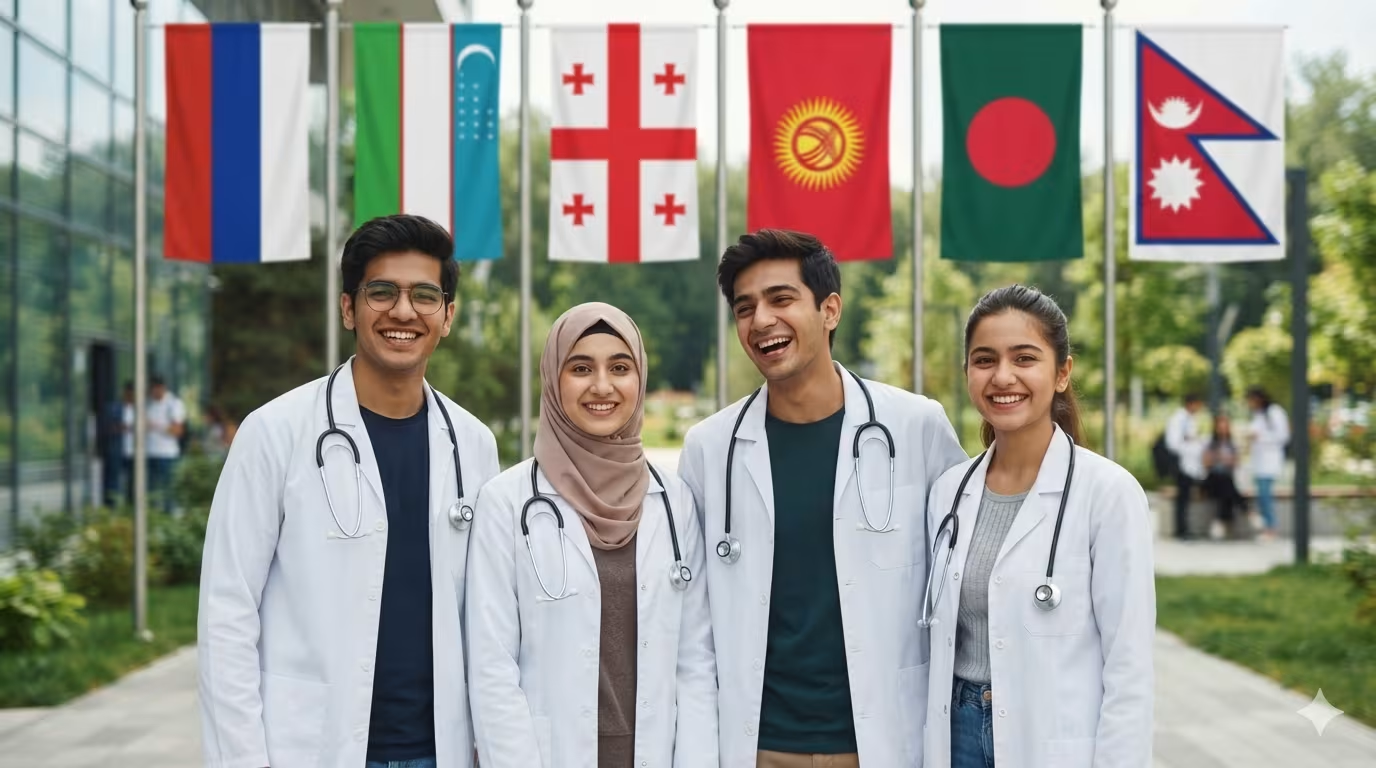
Indian students pursuing MBBS abroad most often look at Russia, Georgia, Uzbekistan, Kyrgyzstan, Kazakhstan, the Philippines, China, Bangladesh, Nepal, and Armenia, largely because of lower tuition costs, availability of English-medium programs, and a track record of Indian students studying there. Popularity, however, is not the same as suitability for your specific goals — always run each shortlisted university through the verification steps above rather than choosing purely by country reputation.
Given how much verification is involved — NEET-UG eligibility, WDOMS status, local accreditation, course structure, and historical licensing exam performance — many students choose to work with an experienced admissions counselling platform rather than navigating the process alone. Counsellors who specialize in MBBS-abroad admissions can shortlist universities that already meet NMC’s structural requirements, help you compare verified fee structures, and flag red flags in offer letters before you commit. If you’re starting this research, ShikshaMed is a resource worth exploring for university shortlisting and admission guidance for Indian students planning MBBS abroad.
Is there an official NMC list of approved medical colleges abroad? No. The NMC does not currently publish or maintain a fixed list of approved foreign medical colleges. Instead, it sets regulatory conditions — NEET-UG qualification before admission, a minimum 54-month course plus a 12-month internship, English-medium instruction, and passing India’s licensing exam — that any foreign degree must satisfy for recognition.
Is FMGE still the exam foreign medical graduates need to clear? FMGE has historically been the qualifying exam for foreign medical graduates seeking a license in India. It is being phased out in favor of the National Exit Test (NExT), which is intended to become the common licensing exam for both Indian and foreign medical graduates. Always check the current status on the NMC’s official website, since exam transitions can affect timelines for the year you graduate.
Does being listed in WDOMS mean a college is automatically good? Not necessarily. A WDOMS listing confirms that a medical school exists and is recognized by its home country’s regulatory authority — it is a verification tool, not a quality ranking. You still need to separately evaluate clinical training, faculty, hostel conditions, and historical licensing exam pass rates.
Can I get direct admission abroad without NEET-UG? No. For the degree to be valid for practicing in India, you must have qualified NEET-UG before taking admission to a foreign medical program. Admission without a valid NEET-UG score will make the resulting degree ineligible for recognition in India, regardless of the university’s reputation.
How do I know if a university is charging a legitimate fee versus a hidden donation/capitation charge? Ask for a complete, itemized fee structure in writing — tuition, hostel, mess, insurance, and any one-time charges — and compare it against what other verified students at the same university have actually paid. Genuine NMC-compliant admissions abroad are meant to be merit-based and free of donation or capitation-style payments.
Choosing a medical college overseas is one of the most consequential decisions of a student’s academic life, and it deserves the same rigor you’d apply to any major financial and career commitment. There is no shortcut in the form of an “official NMC-approved list” — the real work lies in verifying WDOMS listing, confirming local country recognition, checking the exact course structure against NMC’s minimum requirements, and honestly assessing clinical exposure and historical licensing exam performance. Do this diligently, and an MBBS abroad can be a genuinely rewarding, affordable path to becoming a licensed doctor in India.