Becoming a doctor is a dream for thousands of students in India, but behind that dream lies a long journey of education, training, counselling and financial planning. Parents often begin with one simple question: “How much does MBBS cost in India?” However, if a student wants to become a specialist doctor, the financial journey does not necessarily end with MBBS. It may continue through NEET UG, MBBS admission, internship, NEET PG and MD/MS.
The actual cost of becoming a doctor in India can therefore vary enormously. A student studying MBBS and MD/MS in government institutions may spend substantially less on tuition than someone completing the same journey through private or deemed medical colleges. The final amount depends on the college, state, quota, course, specialization, hostel, living expenses and several other factors.
For students and parents planning medical education, it is therefore more useful to understand the complete cost from MBBS to MD/MS rather than looking only at the first-year MBBS tuition fee. In this guide, we will break down the major expenses involved and explain what families should check before making a medical admission decision.
There is no single fixed amount required to become a doctor in India. The cost can differ significantly from one student to another because medical college fee structures are not uniform across the country.
A student’s total medical education budget can depend on several factors:
This is why parents should avoid calculating their budget based only on a college’s advertised tuition fee. The more useful calculation is the total cost of attendance throughout the medical course.
For many students, becoming a doctor begins after Class 12 with NEET UG. After qualifying and participating in the applicable counselling process, the student may secure an MBBS seat. The MBBS journey includes academic and clinical training along with compulsory internship requirements.
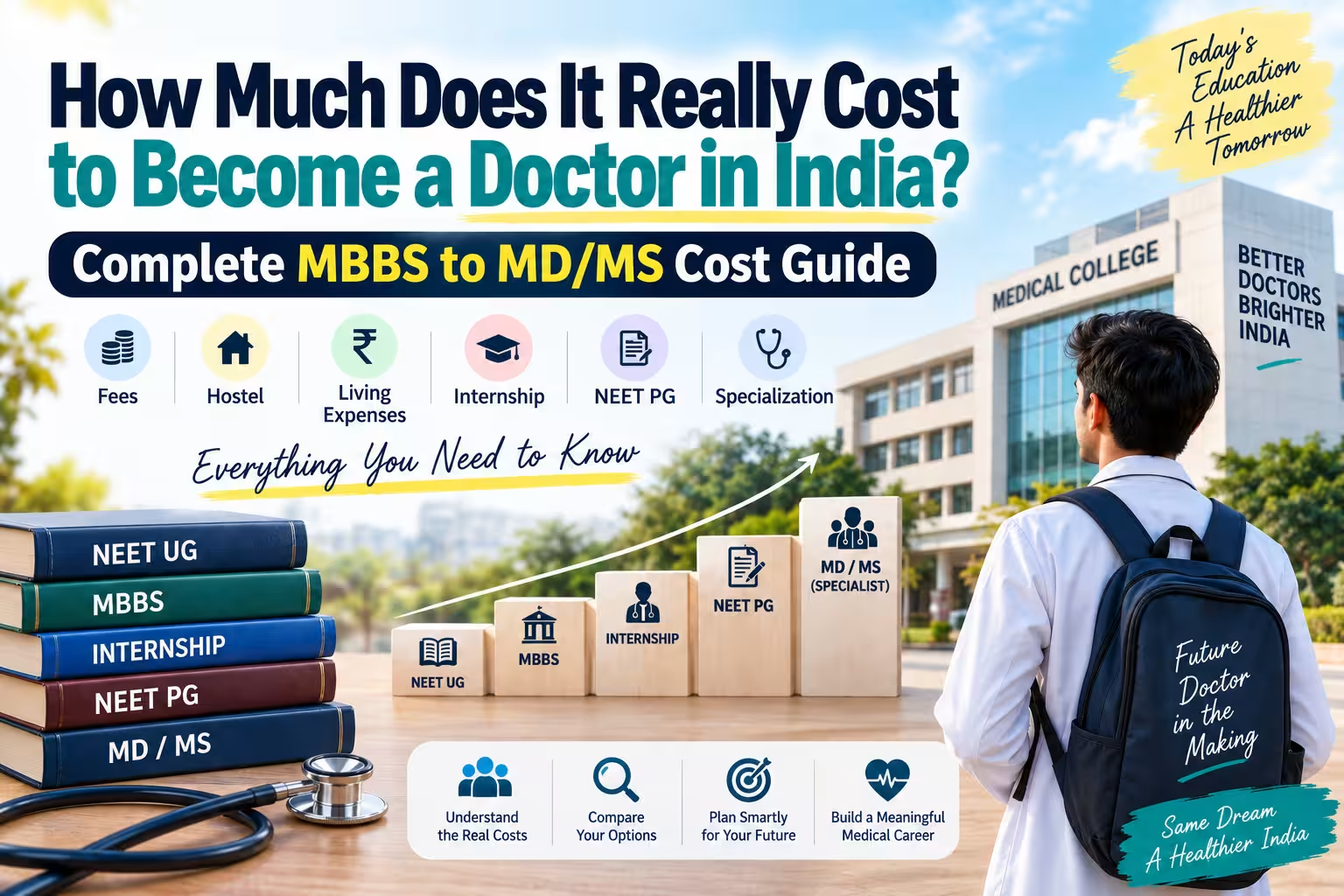
Students who later want to specialize may continue their journey through postgraduate medical education. A typical pathway can look like this:
Class 12 → NEET UG → MBBS Counselling → MBBS → Internship → NEET PG → PG Counselling → MD/MS → Specialist Doctor
Each stage can bring new academic as well as financial requirements. Families planning only for the first year of MBBS may therefore underestimate the long-term investment involved in becoming a specialist doctor.
The expenses associated with becoming a doctor often begin even before admission to medical college. Some students prepare independently for NEET, while others choose online, classroom or residential coaching programs. Depending on the student’s preparation strategy, this can become the first significant expense of the medical journey.
There can also be expenses associated with entrance examinations and counselling, including application fees, counselling registration, security deposits, documentation, medical examinations and travel for physical reporting where required.
Typical pre-admission expenses may include:
These expenses are separate from the actual college fee, but they should still be considered when preparing a complete medical education budget.
For most NEET aspirants, a government medical college is financially attractive because tuition fees are generally much lower than those charged by many private and deemed medical institutions. This is one of the major reasons government MBBS seats remain highly competitive.
However, there is no single government MBBS fee applicable across India. The amount varies according to the state, institution, category and applicable regulations. Students may also need to consider hostel charges, university fees, security deposits and, in some states or institutions, service bond requirements.
Therefore, even when a student receives a government medical college, parents should verify the complete official fee structure and applicable bond conditions before completing admission.
If a government MBBS seat is not available at a student’s rank, private medical colleges may provide additional admission possibilities. This is also where careful financial planning becomes particularly important because private medical college fees can differ substantially by state, college and seat category.
Depending on the counselling system and institution, students may encounter state/private quota, management quota, minority or NRI seats. The applicable tuition fee can vary according to the category under which admission is offered.
Parents should also remember that private MBBS cost is not limited to tuition. A college may separately charge for hostel accommodation, mess, university registration, examination, security deposits and other institutional expenses.
Before accepting a seat, always obtain and understand the complete official fee structure. Students exploring this route can also read our detailed guide on Management Quota MBBS Admission 2026 to understand the admission process and important considerations.
Deemed universities are another important option for students exploring MBBS admission in India. Eligible students can participate in the applicable centralized counselling process for these institutions, subject to the rules for that academic year.
The cost of studying MBBS at a deemed university varies from institution to institution and can be considerably higher than many government medical colleges. Therefore, parents should calculate the entire course cost rather than comparing only annual tuition fees.
When comparing deemed medical colleges, consider:
A medical college should not be selected simply because a seat is available. The institution should make sense academically, financially and according to the student’s long-term career plans.
Management and NRI categories can provide additional possibilities for eligible NEET candidates, but these seats can involve a significantly higher financial commitment. The exact fee depends on the state, college, quota and applicable counselling rules.
One important misconception should also be cleared: management quota does not mean MBBS admission without NEET. Students must follow the applicable eligibility requirements and authorized counselling process.
Families should be cautious of anyone promising a medical seat outside the recognized admission process. Always verify the counselling authority, seat category, college status and official fee structure before making any payment.
Tuition fees receive most of the attention when families compare medical colleges, but living expenses accumulated over several years can also become significant. Hostel charges vary depending on the college and the type of accommodation provided. Mess charges may be collected monthly, semester-wise or annually.
Medical students may also need textbooks, a stethoscope, lab coat, dissection kit and other basic clinical or laboratory equipment during different stages of their course. In addition, everyday expenses such as transportation, mobile and internet bills, laundry, food outside the hostel and travel home should be considered.
A realistic MBBS budget should therefore include:
One of the most common mistakes during medical college comparison is using the formula “Tuition Fee + Hostel Fee = Total MBBS Cost.” In reality, several other mandatory or optional charges may be applicable.
Depending on the institution, students may encounter admission charges, refundable security deposits, hostel security, examination fees, university registration, laboratory charges, library fees, student activity charges and transportation costs.
Some institutions include certain expenses in the main fee while others collect them separately. This is why parents should ask the college for a year-wise written fee structure and understand which payments are refundable and which are non-refundable.
Internship is an important part of medical training because it allows students to gain practical experience in different clinical departments under supervision. Depending on the institution and applicable rules, interns may receive a stipend.
The stipend amount is not identical across every medical college or state. Students should therefore verify the current internship and stipend policy of the specific institution instead of relying on a general figure found online.
For many students, MBBS is the beginning of their medical career rather than the final academic destination. Those who want to become specialists may pursue postgraduate medical education after completing the required eligibility and entrance process.
Popular postgraduate specialties include General Medicine, General Surgery, Radiodiagnosis, Dermatology, Paediatrics, Psychiatry, Anaesthesiology, Orthopaedics, Obstetrics & Gynaecology, Ophthalmology and ENT.
This is where parents who planned only for MBBS may encounter another major financial decision.
Just like MBBS, there is no single fixed MD/MS fee in India. Postgraduate medical education costs depend heavily on whether the student secures a government, private or deemed seat. The selected specialty can also have a major impact on the fee structure, particularly in private institutions.
Government postgraduate seats generally carry lower tuition fees than many private alternatives. Private and deemed PG fees, however, can vary substantially according to the college, quota and specialty.
This means a generic search for “MD/MS fees in India” may not provide enough information to prepare an accurate budget. Students need to compare the specific college + branch + quota + applicable year’s fee structure.
Students preparing for postgraduate medical admission can read ShikshaMed’s MD/MS Admission in India Guide and our detailed MD/MS Fees 2026 – College-Wise Fee Structure.
Postgraduate medical fees can vary not only between colleges but also between specialties. High-demand clinical branches in some private institutions may carry very different fee structures from other specialties.
This makes postgraduate planning a balance between three major factors: preferred branch, NEET PG rank and available budget. A student may have a preferred specialty, but the realistic options will depend on the counselling situation and financial capacity of the family.
Good planning therefore involves evaluating the student’s career preference alongside the financial implications of each available option.
The easiest way to understand the total cost of becoming a specialist doctor is to look at the different pathways a student might follow.
This route generally involves comparatively lower tuition expenditure, although competition for both undergraduate and postgraduate government seats can be intense. Applicable bonds, fees and stipend policies should still be checked.
In this situation, the family may spend comparatively less during undergraduate education but face a much larger investment when the student chooses postgraduate specialization.
The major expenditure occurs during MBBS, while securing a government postgraduate seat can substantially reduce tuition expenditure at the PG stage.
This pathway can involve a substantial long-term financial commitment because both undergraduate and postgraduate education may carry higher tuition and associated costs.
That is why families should think beyond the question “Can we afford this MBBS college today?” and consider how the decision fits into the student’s complete medical career plan.
Higher fees do not automatically mean better medical education. When selecting a medical college, students should evaluate the overall academic and clinical environment rather than judging the institution only by its tuition fee or brand name.
Important factors include:
The objective should be to find a medical college that offers an appropriate combination of academics, clinical exposure, affordability and long-term career value.
Medical education can be expensive, but careful admission planning can help families avoid unnecessary expenditure and poor decisions.
A wrong counselling decision can sometimes cost more than a high tuition fee. Students may later discover unexpected charges, bond requirements, unsuitable location, limited clinical exposure or conditions they did not properly understand before admission.
Medical counselling should therefore not be treated simply as filling and locking a list of colleges. A sensible admission strategy evaluates the student’s NEET rank, category, domicile, budget, college preferences, applicable quota, fee structure and long-term career plans together.
At ShikshaMed, medical admission guidance is not limited to finding an available seat. Our approach is to help students and parents understand the complete medical education journey—from NEET UG and MBBS counselling to NEET PG and MD/MS admission.
With a legacy in medical admission guidance that continues through changing counselling systems, new colleges, evolving regulations and increasing competition, ShikshaMed focuses on helping families make informed choices based on the student’s profile and goals.
One principle remains important throughout the journey: the right medical college is not simply the college where a student can obtain a seat. It should also make sense for the student’s rank, budget, academic needs and long-term medical career.
That is why financial planning forms an important part of medical counselling. A family working with one budget may require a completely different college strategy from another family. Similarly, a student planning for MD/MS after MBBS needs to think beyond the immediate undergraduate admission.
From MBBS admission and NEET UG counselling to medical college selection, management quota guidance, NEET PG and MD/MS counselling, ShikshaMed continues to guide aspiring doctors and their families through different stages of their medical education journey.
There is no single fixed MBBS fee in India. Government medical colleges generally have lower tuition fees than private and deemed institutions, while the actual cost varies according to the state, college, quota, hostel and other applicable charges.
Generally, government medical colleges have significantly lower tuition fees than private medical colleges. However, students should still check hostel charges, security deposits, university fees and any applicable service bond.
Private MBBS fees vary significantly according to the state, institution and seat category. Parents should always check the official fee structure for the specific college and quota rather than relying on a general national estimate.
Students should not treat management quota as a way to bypass NEET or the authorized admission process. Applicable NEET eligibility and counselling requirements must be followed.
MD/MS fees depend on the institution, state, quota and specialty. Government PG seats generally involve lower tuition fees, while private and deemed medical college fees can vary considerably between specialties.
Stipend policies and amounts vary by institution and state. Students should check the latest official policy of the particular medical college before including stipend income in their financial planning.
No. Fees are an important factor, but students should also consider clinical exposure, teaching hospital, academics, location, hostel facilities, regulatory status, bond conditions and their long-term career goals.
So, how much does it really cost to become a doctor in India? There is no universal figure. The answer depends on whether the student studies in a government, private or deemed institution, the applicable quota, living expenses and whether postgraduate specialization is pursued.
For one student, government MBBS followed by government MD/MS may keep tuition costs comparatively low. For another, private or deemed MBBS followed by private postgraduate education may require a substantial long-term investment.
The most important thing is to make the decision after understanding the complete financial picture. NEET rank, college quality, clinical exposure, tuition fees, hostel expenses, family budget and future specialization plans should all be considered together.
Medical education is a journey of many years. Instead of planning only for the next counselling round, plan for the doctor you ultimately want to become.
If you need guidance for MBBS admission, NEET counselling, medical college selection, management quota MBBS, NEET PG or MD/MS admission, visit ShikshaMed and explore our medical admission resources.