Complete Guide to NEET PG 2026 Joining Rules, MCC Reporting, Freeze vs Float, Documents, Tuition Fees, Service Bonds, DNB Admission and Seat Upgradation
Updated: 28 October 2026 | By ShikshaMed Medical Admission Counselling Team
Securing a postgraduate medical seat after NEET PG is a significant achievement for any MBBS graduate. After years of medical education, internship, competitive examination preparation and uncertainty about admission, receiving an MD, MS or DNB seat allotment can feel like the beginning of an exciting new professional journey.
However, receiving a seat allotment letter does not automatically mean that your admission is complete.
The period between seat allotment and final joining is one of the most important stages of NEET PG counselling. Candidates must understand the reporting process, document verification, fee payment requirements, seat acceptance options, college admission policies and applicable service bond conditions.
A simple mistake, such as misunderstanding the freeze or float option, missing a mandatory document, failing to complete reporting formalities or overlooking a discontinuation penalty, can create significant financial and academic consequences.
NEET PG Counselling 2026 has introduced important changes to the seat acceptance and upgradation process. Candidates must therefore avoid relying exclusively on counselling instructions from previous years.
On 24 October 2026, the Medical Counselling Committee (MCC) published the final Round 1 seat allotment result. The scheduled reporting and joining window for Round 1 is from 26 October to 2 November 2026.
Whether you have received MD General Medicine, MS General Surgery, MD Anaesthesiology, MD Paediatrics, MD Psychiatry, DNB General Medicine or another postgraduate speciality, understanding the applicable admission requirements is essential.
In this detailed guide, ShikshaMed explains the 10 most important mistakes to avoid before joining an MD/MS/DNB college in 2026, including practical steps to protect your seat, finances and future medical career.
For updated counselling information, visit our NEET PG 2026 Counselling Guide.
The Medical Counselling Committee conducts centralised counselling for postgraduate medical seats covered under its jurisdiction, including 50% All India Quota seats, participating deemed university seats and applicable NBEMS seats.
Before planning admission, candidates should understand the scheduled counselling timeline.
| Counselling Event | Date |
|---|---|
| Round 1 Final Seat Allotment | 24 October 2026 |
| Round 1 Reporting and Joining | 26 October – 2 November 2026 |
| Round 2 Seat Allotment Result | 14 November 2026 |
| Round 2 Reporting and Joining | 16–23 November 2026 |
| Round 3 Seat Allotment Result | 4 December 2026 |
| Round 3 Reporting and Joining | 5–12 December 2026 |
| Stray Vacancy Round Result | 24 December 2026 |
| Stray Vacancy Reporting | 24–31 December 2026 |
These dates reflect the published schedule available on 28 October 2026 and may be revised by the competent authority.
Candidates must independently verify the latest schedule through the official MCC PG Medical Counselling Portal.
Important: State counselling schedules may differ from MCC counselling dates. A candidate participating in both must track the respective authorities separately.
One of the biggest misunderstandings among NEET PG aspirants is believing that an allotted seat is automatically a confirmed postgraduate medical admission.
In reality, seat allotment is an important stage of counselling, but admission may still depend on eligibility verification, original document checks, payment of applicable fees and completion of the prescribed joining procedure.
For example, consider a candidate who receives an MD Anaesthesiology seat in a government medical college. The candidate downloads the MCC allotment letter but assumes that no additional action is required.
If the candidate fails to complete the applicable reporting or seat acceptance requirements within the deadline, the allotment may not result in a valid admission.
The correct procedure depends on the round, seat category and whether the candidate has selected freeze, float or another permitted option.
Immediately after downloading the final allotment letter, carefully verify the allotted college name, course, speciality, quota, category and admission instructions.
Visit the institution’s official website and check whether any separate reporting form, online registration, admission undertaking or document verification appointment is required.
Understand the distinction between receiving an allotment, accepting a seat, reporting to the institution and officially joining the postgraduate course.
ShikshaMed Advice: Never consider an admission complete until all applicable official requirements have been fulfilled and you have obtained the appropriate confirmation.
The introduction of revised freeze and float procedures is one of the most important developments in NEET PG Counselling 2026.
In earlier counselling cycles, candidates generally had to physically report to the allotted institution to record their willingness for upgradation.
For the 2026 cycle, MCC has introduced a revised online willingness system.
Freeze is intended for candidates who are satisfied with their allotted seat and do not wish to seek an upgrade in the next eligible counselling round.
A candidate choosing Freeze must complete the prescribed joining formalities at the allotted institution within the applicable reporting schedule.
For example, a candidate allotted MD General Medicine at a preferred government institution may decide that the seat matches their professional ambitions, location preferences and budget. Such a candidate may choose to retain the allotted seat rather than seek an upgrade.
Float is intended for eligible candidates who want to seek a better seat in a subsequent counselling round.
For example, a candidate who receives DNB Anaesthesiology but prefers MD Anaesthesiology at another institution may consider the float option, subject to the official counselling rules.
However, float should not be interpreted as unconditional permission to ignore deadlines, retain multiple seats or bypass admission procedures.
Candidates must complete the online willingness and any associated formalities exactly as required by the current MCC instructions.
| Feature | Freeze | Float |
|---|---|---|
| Main purpose | Retain allotted seat | Seek an eligible upgrade |
| Upgradation preference | No | Yes |
| Physical joining | Required under applicable joining rules | Depends on current round-specific procedure |
| Online action | Follow MCC instructions | Complete prescribed willingness process |
| Risk of incorrect selection | May prevent intended upgradation | May affect seat retention or joining obligations |
The precise rights and obligations of each option must be checked in the MCC 2026 bulletin and subsequent notices.
ShikshaMed Advice: Do not select Freeze or Float simply because another candidate recommends it. Review your present seat, preferred speciality, future options and financial obligations before deciding.
Documentation problems are among the most preventable difficulties during MD/MS/DNB admission.
Many candidates focus almost entirely on the allotted college and tuition fee while assuming that their original documents are already complete.
However, the college may require verification of educational qualifications, internship completion, medical registration, identity, category eligibility and other admission-related information.
Commonly required documents may include:
The exact list may differ between institutions, quotas and counselling authorities.
Consider a candidate allotted an MS Orthopaedics seat under a reserved category.
If the candidate’s certificate is not in the required format or fails to satisfy the applicable eligibility rules, admission verification may become difficult even when the candidate has received an allotment.
Similarly, an employed doctor without a required NOC or relieving certificate may face difficulty completing joining formalities.
Prepare a separate admission folder containing original documents, self-attested photocopies and securely saved digital copies.
Match your name, date of birth, registration information and qualification details across all certificates.
Contact the designated admission office in advance if any document is missing, delayed or contains a discrepancy.
ShikshaMed Advice: Document verification should begin before allotment, not after reaching the college.
Postgraduate medical education can involve a significant financial commitment, particularly at private medical colleges and deemed universities.
One of the most expensive mistakes a candidate can make is comparing colleges solely on the basis of their annual tuition fees.
The actual cost of pursuing an MD/MS course may also include hostel accommodation, mess charges, examination fees, university fees, refundable deposits and other officially notified expenses.
Some institutions may also impose financial liabilities for discontinuation or withdrawal after joining.
| Expense Category | What to Verify |
|---|---|
| Tuition Fee | Annual amount and total programme cost |
| Hostel and Mess | Mandatory or optional; yearly charges |
| Security Deposit | Amount, refundability and conditions |
| University Charges | Examination, registration and other approved charges |
| Fee Revision | Whether future revisions are permitted |
| Service Bond | Bond amount and compulsory service obligations |
| Discontinuation Penalty | Liability for leaving the course |
| Stipend | Amount, payment schedule and applicable deductions |
Suppose a private medical college charges ₹25 lakh annually for an MD/MS course of three years.
The tuition commitment alone would be approximately ₹75 lakh if the annual amount remains unchanged.
However, accommodation, deposits, applicable institutional charges and other expenses may increase the overall financial commitment.
This example is illustrative and does not represent a particular medical college.
Before making any financial decision, candidates should obtain the current official fee notification and applicable admission conditions.
For additional information, read our MD/MS College-Wise Fee Structure 2026.
ShikshaMed Advice: Compare the total financial obligation for the complete course, not just the amount payable on the first day.
Many postgraduate medical candidates carefully study tuition fees but underestimate the importance of service bonds.
A medical service bond may require a graduate to serve in a specified government institution or healthcare facility for a prescribed period after completing postgraduate training.
Bond conditions, penalties, applicable exemptions and service periods can vary considerably between states and institutions.
A separate discontinuation bond or undertaking may also apply if a candidate leaves the course before completion.
Consider two candidates receiving MD General Medicine seats in different states.
Both colleges may offer comparable clinical training, but their financial and post-training obligations may differ substantially.
One institution may have no comparable compulsory service obligation, while another may require a defined period of service or prescribe a monetary penalty for non-compliance.
Choosing a college without understanding such conditions may affect your finances and future career decisions.
Ask whether the institution requires compulsory service after course completion, what penalties apply, and whether the bond obligations are separate from counselling-related security deposit forfeiture.
Find out whether leaving the course after joining triggers additional financial liability and whether any exceptions or permitted resignation windows exist.
The candidate should also verify whether the bond provisions are consistent with the current state government orders and the institution’s officially applicable admission rules.
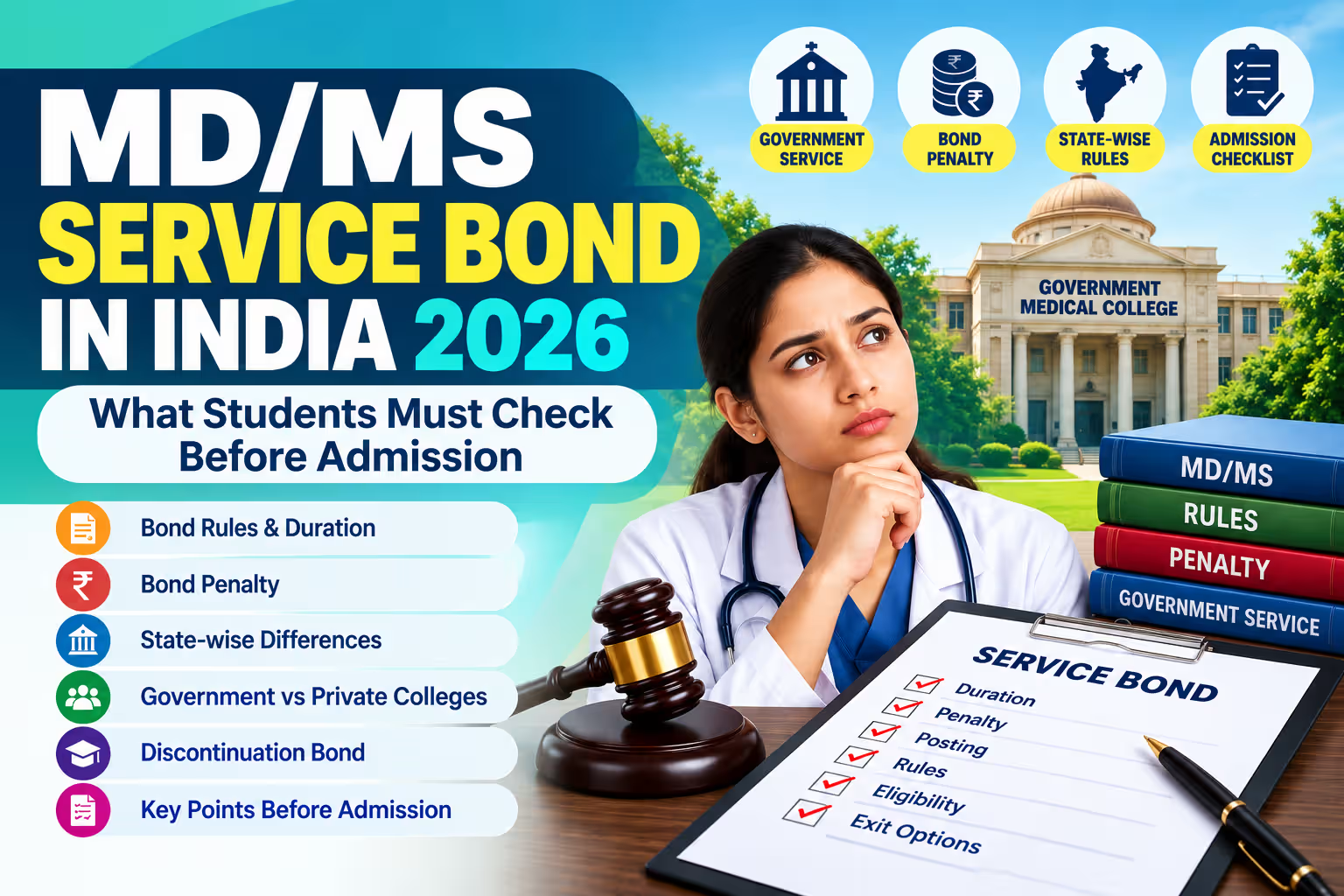
Read our dedicated article: MD/MS Service Bond in India 2026 – Rules, Penalties and Admission Guide.
ShikshaMed Advice: Never sign an admission undertaking or bond without reading the complete terms and understanding the possible financial consequences.
MD, MS and DNB are postgraduate medical training pathways, but candidates should not assume that their administrative admission processes are identical.
MD/MS courses are conducted through recognised medical colleges and universities, while DNB courses are offered through institutions accredited by the National Board of Examinations in Medical Sciences (NBEMS).
Depending on the course and institution, admission requirements, fee procedures, hospital joining formalities and training registration processes may differ.
Candidates allotted NBEMS seats should read the official NBEMS joining instructions alongside the MCC counselling rules.
Important responsibilities include verifying the accreditation of the allotted DNB programme, understanding training commencement requirements, completing the prescribed reporting process and ensuring that the hospital correctly updates the candidate’s joining status.
NBEMS has issued specific guidance regarding payment of the first-year annual course fee and the treatment of candidates opting for upgradation.
Under the revised guidance announced in October 2026, eligible candidates seeking seat upgradation may defer the first-year NBEMS course fee payment while following the prescribed upgrade procedure. This should not be treated as an exemption from all other reporting requirements.
Candidates accepting a final DNB seat must comply with the applicable fee payment and joining instructions.
The NBEMS-accredited institution has responsibilities for submitting the joining or non-joining status of its trainees through the designated system.
Candidates should confirm that the institution has correctly recorded their status wherever required.
A verbal confirmation from a hospital employee should not replace official documentation or a system-generated acknowledgement.
| Factor | MD/MS | DNB |
|---|---|---|
| Training institution | Medical college or university | NBEMS-accredited hospital or institution |
| Regulatory verification | Applicable NMC/university approvals | NBEMS accreditation and programme requirements |
| Joining process | College and counselling rules | MCC, NBEMS and allotted hospital instructions |
| Course fee | College/university fee notification | Applicable NBEMS and hospital fee instructions |
| Training conditions | College-specific | Accredited hospital and NBEMS-specific |
A candidate interested in DNB should also assess patient load, departmental training, academic teaching, faculty supervision and hospital infrastructure.
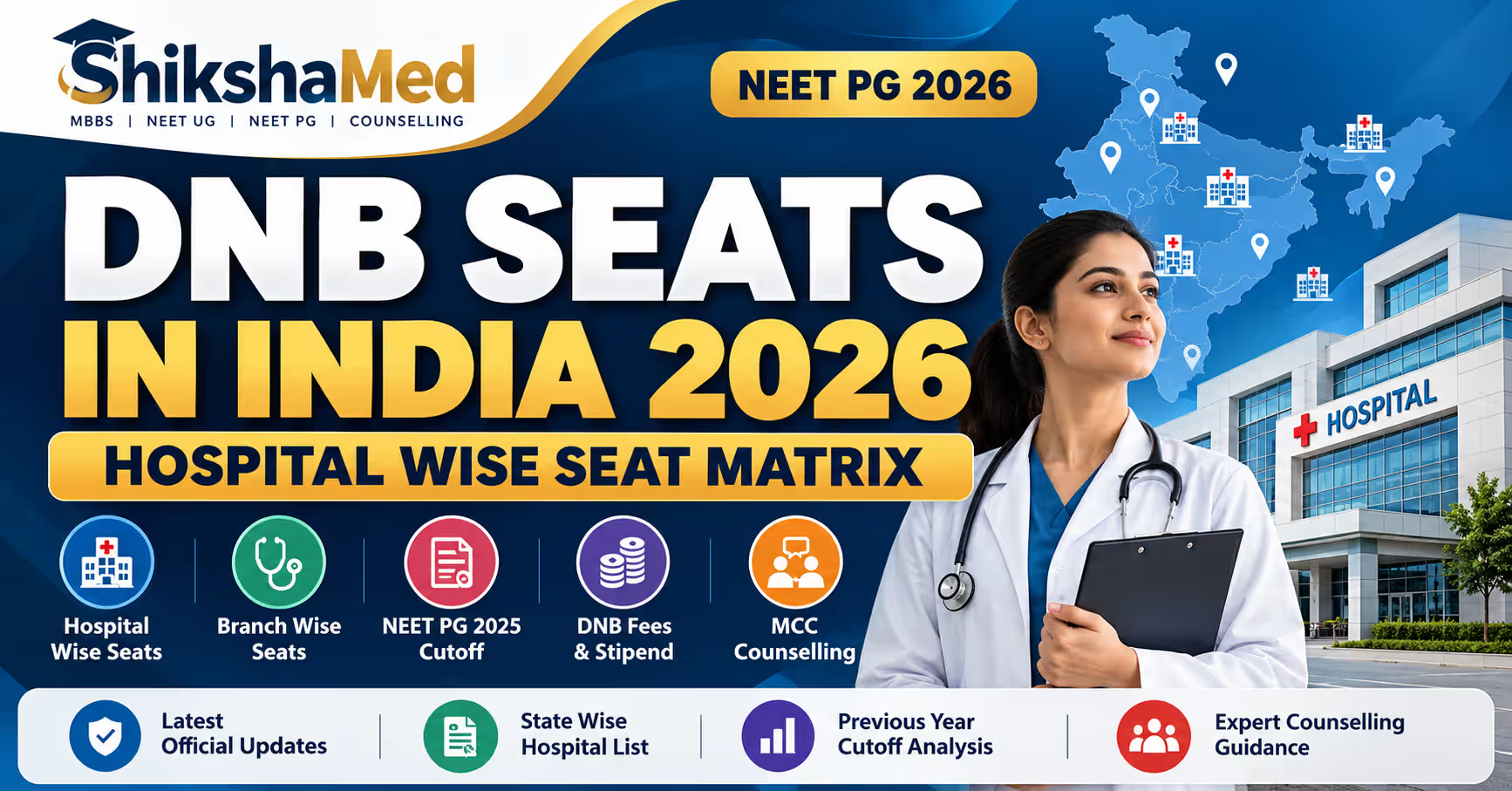
Explore our DNB Seats in India 2026 – Hospital-Wise Seat Matrix, Fees and Cutoffs.
If you are confused between the two pathways, read MD General Medicine vs DNB General Medicine 2026.
ShikshaMed Advice: Evaluate DNB as an individual postgraduate training opportunity rather than judging it only by the degree name.
Candidates often participate in multiple counselling rounds hoping for a better college or speciality.
Although upgradation can create opportunities, misunderstanding resignation and forfeiture rules may lead to significant financial consequences.
The counselling rules can become more restrictive in later rounds.
For example, an exit that is permitted without security deposit forfeiture at one stage may not be treated the same way after a subsequent allotment.
If a candidate receives an allotment but does not follow the applicable joining, resignation or upgrade procedure, their eligibility for subsequent rounds and treatment of the security deposit may be affected.
The exact consequences depend on the relevant round, quota, candidate status and current official MCC scheme.
Candidates should determine whether their proposed action is recognised as a free exit, formal resignation or another type of withdrawal under the applicable counselling rules.
They should check whether the seat has been formally joined, whether the resignation window remains open, and whether a subsequent seat has already been allotted.
Any required resignation must be completed through the officially prescribed procedure.
Do not rely solely on informal emails, phone conversations or handwritten acknowledgements where the authority requires an official system-generated resignation record.
Later counselling rounds may have stricter forfeiture and eligibility restrictions than Round 1.
Candidates must review the rules for their exact situation rather than assuming that every round follows identical conditions.
ShikshaMed Advice: Understand the financial and eligibility implications before selecting an option, resigning from a seat or skipping a reporting requirement.
A postgraduate medical degree is not simply an academic qualification. It is the foundation of your future specialist practice.
For clinical specialities, practical exposure, supervised procedures, patient diversity, emergency duties and departmental teaching can have a major influence on training.
Unfortunately, some candidates select their allotted institutions based primarily on location, advertised rankings or tuition fees.
For MD General Medicine, candidates may consider inpatient and outpatient workload, emergency exposure, intensive care training and academic case discussions.
For MS General Surgery, operation theatre exposure, emergency surgical workload, supervised procedures and progressive responsibility are particularly important.
For MD Anaesthesiology, the availability of surgical specialities, operation theatres, critical care units and appropriate supervision may affect training opportunities.
For MD Paediatrics, candidates may wish to assess neonatal care, paediatric intensive care, emergency exposure and the range of clinical cases.
For DNB programmes, hospital case load, academic arrangements, teaching commitment and hands-on learning opportunities deserve careful assessment.
Before making a final decision, speak with residents who are currently undergoing training at the institution.
Ask about actual clinical duties, department teaching, supervision, leave arrangements, working hours, stipend payments and availability of learning resources.
This information can help develop a more realistic understanding of the training environment.
However, individual experiences should be considered alongside official institutional information rather than treated as definitive evidence.
ShikshaMed Advice: A college should be evaluated for the quality and suitability of its training, not merely the popularity of its name.
Many NEET PG aspirants register for both All India Quota counselling and one or more eligible state counselling processes.
This can increase the number of institutions and specialities they may consider, but it also creates additional administrative responsibilities.
MCC and state authorities may publish different schedules for registration, choice filling, seat allotment, reporting, resignation and document verification.
Some candidates fail to monitor these schedules together, creating conflicts between counselling decisions.
Suppose a candidate receives a DNB seat through MCC counselling while also participating in a state counselling process for an MD/MS seat.
The candidate must understand whether they can continue in the state process, how an existing allotment affects eligibility, and whether any reporting or resignation obligations apply.
Different counselling authorities may exchange joined-candidate data or impose restrictions based on the counselling round and applicable rules.
Assuming that the two processes are completely independent can be risky.
Maintain a calendar containing the registration deadlines, choice filling and locking dates, allotment dates, reporting windows and resignation deadlines for every authority in which you are participating.
Keep separate records of payments and application credentials.
Before accepting or leaving an allotted seat, read both the MCC and relevant state counselling notices.
For example, Rajasthan candidates can refer to our Rajasthan NEET PG Counselling 2026 Guide.
For broader resources, visit the ShikshaMed NEET PG 2026 Counselling Hub.
ShikshaMed Advice: Your counselling strategy should consider all applicable participating authorities together, not one result at a time.
The final mistake is often less obvious than a missed document or deadline.
Many candidates decide to join a postgraduate course because they fear losing a year, feel pressure from family or believe that any speciality is better than no speciality.
However, postgraduate medical training demands considerable time, effort and financial commitment.
The speciality you select may shape your professional interests, clinical responsibilities, opportunities for further training and long-term career satisfaction.
Ask yourself whether you genuinely want to practise in the allotted speciality.
Consider whether the programme offers the training environment you need, whether its financial cost is sustainable and whether its location and working conditions are manageable.
You should also evaluate whether any service bond affects your future plans and whether you would remain comfortable with the seat if no further upgradation becomes available.
For example, a candidate may receive MD Pathology while preferring MD General Medicine.
Both are legitimate postgraduate career pathways, but they involve substantially different kinds of work.
The right decision should be based on individual interests, eligibility, current counselling opportunities, financial circumstances and long-term goals.
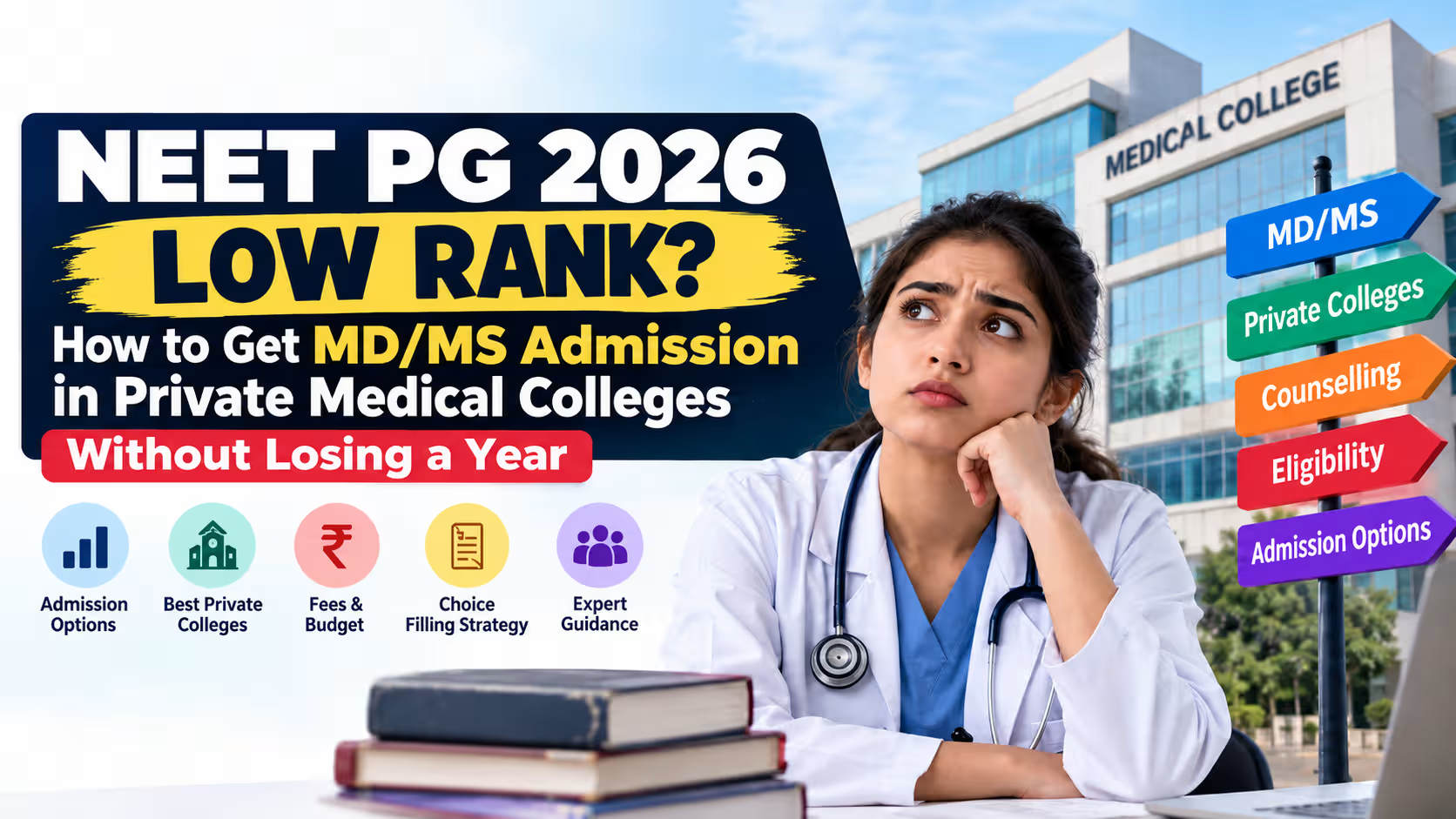
For candidates exploring options after a comparatively low rank, our article NEET PG 2026 Low Rank? How to Get MD/MS Admission Without Losing a Year explains how to evaluate genuine admission pathways.
ShikshaMed Advice: The best postgraduate seat is not necessarily the most expensive or the most famous. It is one that aligns with your medical career goals, eligibility, training needs and financial capacity.
After receiving a seat allotment, candidates should create a structured action plan instead of attempting to complete every requirement at the last moment.
Begin by downloading the final allotment letter from the official authority and verifying every detail against your application information.
Next, decide whether you intend to retain the seat, seek upgradation or use another officially permitted option.
Review all instructions regarding online willingness, reporting and joining. Contact the allotted institution for its specific document verification requirements.
Calculate the full financial commitment and arrange the required payment using only authorised methods.
Finally, complete the applicable admission formalities within the prescribed dates and keep copies of all receipts, acknowledgements and communications.
| Essential Task | Status to Confirm |
|---|---|
| Final seat allotment downloaded | Completed |
| Course and college details verified | Completed |
| Freeze/Float requirements understood | Completed |
| Reporting deadline confirmed | Completed |
| Original documents arranged | Completed |
| Category and quota eligibility verified | Completed |
| Tuition fee and other charges checked | Completed |
| Service bond and discontinuation terms reviewed | Completed |
| Hospital or college joining requirements confirmed | Completed |
| Official admission acknowledgement obtained | Completed |
This checklist is intended as a practical planning aid. It does not replace official instructions issued by MCC, NBEMS, the relevant state authority or the allotted institution.
Choosing between MD, MS and DNB requires an understanding of both speciality preference and training environment.
MD programmes generally focus on medical and non-surgical postgraduate specialities, although the exact professional scope depends on the speciality.
MS programmes focus on surgical disciplines and related areas.
DNB programmes provide postgraduate specialty training through NBEMS-accredited institutions, with training environments varying between hospitals and specialities.
A candidate comparing MD General Medicine and DNB General Medicine, for example, should look beyond the degree name.
The comparison should include faculty support, patient exposure, teaching activities, academic requirements, practical responsibilities, stipend and long-term training goals.
Rather than assuming one pathway is always superior, candidates should evaluate the individual institution and programme.
Read our detailed comparison: MD vs DNB General Medicine 2026 – Which Is Better?.
The visible tuition fee is only one component of the admission decision.
Depending on the institution, candidates may need to budget for accommodation, food, transport, examination-related expenses, deposits and other permitted institutional charges.
Some may also need to relocate to another state.
For a candidate entering a three-year postgraduate programme, these additional expenses can accumulate over time.
There is also a difference between an expense and a contingent financial liability. A service bond penalty may never become payable if all applicable conditions are fulfilled, but it should still be understood before joining.
Similarly, a refundable deposit is not the same as a non-refundable fee.
Always request official written documentation and avoid making unverified payments to third parties claiming guaranteed admission.
Seat upgradation can offer a candidate the possibility of moving to a more preferred course or institution, subject to the relevant counselling rules.
However, an upgrade is not guaranteed.
Availability depends on the seat matrix, candidate eligibility, choices submitted, merit order and subsequent counselling developments.
A candidate considering upgradation should first determine whether the currently allotted seat is acceptable as a final outcome.
Next, they should consider whether higher-preference choices truly offer a meaningful improvement in training, career alignment, location or financial feasibility.
Finally, they must understand how the official system treats their existing seat if an upgraded seat is allotted.
An incorrect assumption about upgradation can lead to disappointment or avoidable complications.
The safest approach is to follow the current MCC or state counselling scheme rather than relying on previous-year procedures.
NEET PG counselling requires candidates to evaluate several variables at the same time.
These include All India Rank, category eligibility, speciality preference, government and private medical college options, fees, stipend, bonds, historical cutoffs, seat matrices and round-wise admission rules.
For candidates participating in multiple counselling processes, comparing all these factors can become difficult.
Professional educational counselling may help candidates organise information, understand published rules and identify suitable options for further independent verification.
At ShikshaMed, our medical admission guidance services include assistance with college shortlisting, branch preference analysis, state-wise counselling information, choice filling strategies, fee comparisons, document preparation and admission planning.
Our objective is to help candidates make more informed decisions based on their individual profiles rather than general assumptions about ranks or college names.
Candidates must still satisfy official eligibility conditions and participate through the prescribed merit-based counselling system. Admission or seat upgradation cannot be guaranteed.
MCC published the final Round 1 allotment result on 24 October 2026. However, an allotment does not by itself complete admission. Candidates must follow all applicable seat acceptance, reporting, verification and joining requirements.
The published MCC Round 1 reporting and joining window is 26 October to 2 November 2026. Candidates should confirm whether any subsequent notice revises the schedule.
Freeze is the option intended for eligible candidates who wish to retain an allotted seat rather than seek upgradation in the next counselling round. The required joining formalities must still be completed.
Float permits eligible candidates to indicate their willingness to seek an upgraded seat according to the current counselling scheme. Its conditions differ from those of Freeze and must be followed carefully.
An eligible candidate may have upgradation opportunities under the applicable counselling rules. However, the process is not automatic and an upgraded seat is not guaranteed.
Common documents include the allotment letter, NEET PG admit card and scorecard, MBBS qualification records, internship certificate, medical registration, identity proof and applicable category or institutional documents.
The exact list must be verified with the official authority and allotted institution.
Physical reporting is required for candidates completing joining under the applicable rules. The revised 2026 freeze and float arrangements introduce differences in the upgradation process, so candidates should not assume that every option has identical physical reporting requirements.
NBEMS has issued revised fee instructions for certain candidates seeking upgradation. These provisions should not be treated as a general exemption from the first-year course fee for candidates completing final joining. Follow the current NBEMS notice for your exact situation.
Eligibility depends on the stage of counselling, whether a seat has been joined, the applicable MCC restrictions and the relevant state’s rules. Candidates should verify both authorities’ instructions before proceeding.
No single service bond policy applies identically to every MD/MS institution. Requirements may vary by state, college, course and quota. Candidates should verify the officially applicable bond conditions before admission.
Resignation rights and consequences depend on the counselling round, applicable resignation window, official rules and institutional obligations. Leaving a seat without following the required procedure may have financial or eligibility consequences.
Yes, security deposit forfeiture may apply under specified counselling conditions. The relevant rules vary by round and candidate status. The MCC 2026 information bulletin should be checked before taking any action.
DNB can be a suitable postgraduate training pathway depending on the speciality, accredited institution, clinical exposure, academic support and candidate’s career objectives. Each programme should be assessed individually.
Review the approved course and seat status, fee notification, total programme cost, clinical training environment, stipend, service bond, discontinuation conditions, accommodation and reporting requirements.
ShikshaMed provides educational guidance for MD/MS/DNB counselling, including college shortlisting, historical cutoff analysis, choice filling support, counselling updates, fee comparisons and document-related guidance.
NEET PG 2026 seat allotment is a major milestone, but the decisions made immediately afterward are equally important.
The difference between a smooth admission process and an avoidable complication often comes down to understanding the official rules, preparing documents in advance and evaluating the complete financial and academic commitments.
Whether you are planning to join MD General Medicine, MS General Surgery, MD Anaesthesiology, MD Paediatrics, DNB General Medicine or another speciality, do not rush through the reporting and joining process.
Take time to understand the freeze and float options, verify the prescribed deadlines, review your fee and bond obligations and assess the quality of training at the allotted institution.
Most importantly, make the final decision with your long-term medical career in mind.
A postgraduate seat is not just an admission opportunity. It is an important step towards becoming the specialist you want to be.
ShikshaMed – Your Medical Career, Our Guidance
Confused about your allotted college, counselling round, branch preference, fee structure, service bond or seat upgradation options?
Our team can help you understand the relevant information and plan your next steps.
Get guidance for:
Book Your Counselling Session Today
Website: www.shikshamed.com
NEET PG Resources: ShikshaMed PG Counselling
WhatsApp: +91 9041441450
Call: +91 9914148080
The right counselling information can help you avoid costly mistakes and make better admission decisions.
For the latest authoritative information, candidates should consult the following resources:
Medical Counselling Committee (MCC) – PG Medical Counselling, Allotment Results, Information Bulletin and Schedules
National Board of Examinations in Medical Sciences (NBEMS) – Official NBEMS Website
NBEMS DNB Joining Guidance – Official Joining and Non-Joining Status Instructions
ShikshaMed Further Reading:
Disclaimer: This article is provided for educational and informational purposes only. Counselling schedules, eligibility conditions, joining procedures, seat acceptance rules, fee instructions, service bonds and resignation policies may be revised by MCC, NBEMS, state counselling authorities or institutions. Candidates must verify the latest official notices before making admission or payment decisions. ShikshaMed provides admission guidance and does not guarantee allotment, admission, a particular college, branch or seat upgradation. All admissions are subject to eligibility, merit, seat availability and applicable official regulations.