Updated: November 2026 | Prepared by the Shiksha Med counselling team, Chandigarh
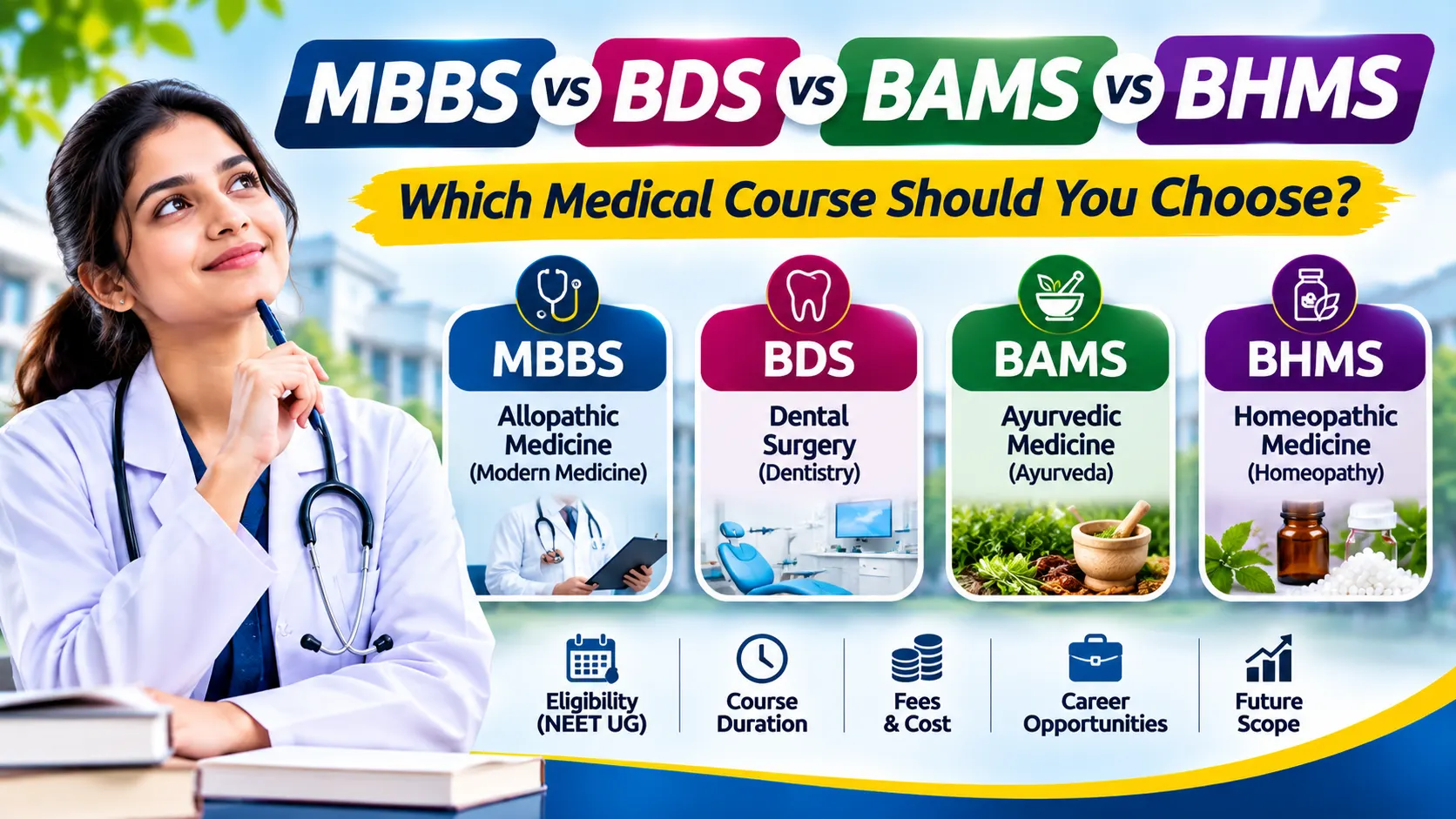
Every year, more than twenty lakh students sit for NEET UG, and almost all of them are asking the same question once the result arrives: which medical course should I choose? For most families the conversation starts and ends with MBBS. But India offers four major doctor-level undergraduate degrees through NEET UG: MBBS, BDS, BAMS and BHMS. Each one leads to a different profession, a different kind of patient interaction, a different cost, and a different future.
If you are preparing for NEET UG 2027, or you are a parent trying to plan ahead, this guide compares MBBS vs BDS vs BAMS vs BHMS side by side. We cover eligibility, duration, fees, career paths, higher studies and long-term scope, so you can decide with facts instead of pressure from relatives or social media.
A quick note on how to use this article. Rules, seat numbers and fees change every year. We have referred to the regulators that govern these courses: the National Medical Commission (NMC) for MBBS, the National Commission for Indian System of Medicine (NCISM) for Ayurveda, the National Commission for Homoeopathy (NCH) for Homoeopathy, and the Medical Counselling Committee (MCC) along with state counselling authorities for admissions. Always confirm the final details in the official notification for your year.
If you want personal guidance based on your NEET score, budget and state quota, you can book a free UG counselling session with Shiksha Med at any point while reading.
MBBS stands for Bachelor of Medicine and Bachelor of Surgery. It is the basic qualification to become a doctor of modern medicine in India. The course is regulated by the National Medical Commission, and the curriculum follows a competency-based model that moves students from pre-clinical subjects (Anatomy, Physiology, Biochemistry) to para-clinical subjects (Pathology, Pharmacology, Microbiology, Forensic Medicine) and then to clinical subjects such as Medicine, Surgery, Obstetrics and Gynaecology, and Paediatrics.
MBBS graduates register with the National Medical Commission or a State Medical Council and can practise modern medicine, work in government and private hospitals, join the armed forces medical services, and appear for postgraduate entrance exams.
Capacity in India: According to the NMC seat matrix for 2026-27, there are about 1,40,664 MBBS seats across 839 medical colleges (447 government and 392 private), not counting Institutes of National Importance such as AIIMS. These numbers are revised during the year as appeals are decided, so treat them as a snapshot.
Looking for state-wise options? Explore MBBS in India, or go directly to MBBS in Chandigarh, MBBS in Punjab, MBBS in Haryana and MBBS in Himachal Pradesh.
BDS stands for Bachelor of Dental Surgery. It trains students to diagnose, prevent and treat diseases of the teeth, gums, jaws and oral cavity. Students study basic medical sciences (anatomy, physiology, biochemistry) and then move to dental subjects such as Oral Pathology, Conservative Dentistry and Endodontics, Prosthodontics, Periodontics, Orthodontics, Oral and Maxillofacial Surgery, and Public Health Dentistry.
BDS is a four-year academic programme followed by a one-year compulsory rotating internship, so the total duration is five years. Graduates register with the Dental Council of India or the relevant State Dental Council. Dentists can open their own clinics, work in dental hospitals and teaching institutions, or join government health services.
The latest figures commonly cited for NEET UG counselling put the number of BDS seats at roughly 27,800 across the country. Admission is through NEET UG, and the same qualifying percentile applies as for MBBS. Read more on our BDS admission page.
BAMS stands for Bachelor of Ayurvedic Medicine and Surgery. It is a 5.5-year undergraduate degree in Ayurveda, regulated by NCISM. The structure is 4.5 years of academic study across professional phases followed by a one-year compulsory rotating internship.
The curriculum blends classical Ayurvedic subjects, many of them rooted in Sanskrit texts, with modern sciences such as anatomy, physiology, pathology and pharmacology. Students learn Ayurvedic diagnosis, Panchakarma therapies, herbal formulations, diet and lifestyle medicine, and basic surgical concepts under Shalya and Shalakya Tantra.
Admission is through NEET UG followed by AYUSH counselling. A candidate must have passed Class 12 with Physics, Chemistry, Biology and English. Reported figures for NEET UG counselling suggest more than 50,000 BAMS seats nationwide, which is a big reason students with mid-range NEET scores consider it seriously. Details of our guidance are on the BAMS admission page.
BHMS stands for Bachelor of Homoeopathic Medicine and Surgery. It is the undergraduate degree in Homoeopathy, regulated by the National Commission for Homoeopathy. Like BAMS, it runs for 5.5 years: 4.5 years of academic training plus a 1-year rotating internship.
The syllabus covers Organon of Medicine, Homoeopathic Materia Medica, Repertory, Homoeopathic Pharmacy and Philosophy, along with anatomy, physiology, pathology, surgery and gynaecology. Admission is through NEET UG and AYUSH counselling.
BHMS graduates register with the NCH Central Register or a state Homoeopathy council and typically build clinic-based practices, join government AYUSH services, work in research or pharma, or pursue an MD in Homoeopathy. See the BHMS admission page or our combined BAMS, BHMS and BUMS guide.
The table below puts the four courses side by side. Numbers such as fees are indicative and vary by state, college and quota.
| Parameter | MBBS | BDS | BAMS | BHMS |
|---|---|---|---|---|
| Full form | Bachelor of Medicine and Bachelor of Surgery | Bachelor of Dental Surgery | Bachelor of Ayurvedic Medicine and Surgery | Bachelor of Homoeopathic Medicine and Surgery |
| System of medicine | Modern (allopathic) | Dental science | Ayurveda | Homoeopathy |
| Regulator | NMC | Dental Council of India | NCISM | NCH |
| Entrance exam | NEET UG | NEET UG | NEET UG | NEET UG |
| Total duration | 5.5 years (4.5 years + 1 year internship) | 5 years (4 years + 1 year internship) | 5.5 years (4.5 years + 1 year internship) | 5.5 years (4.5 years + 1 year internship) |
| Counselling | MCC and state | MCC and state | AACCC and state AYUSH | AACCC and state AYUSH |
| Competition | Very high | High | Moderate | Moderate |
| Practice type | Hospital and clinic | Dental clinic and hospital | Clinic, wellness, AYUSH hospitals | Clinic-based, AYUSH |
| Main PG option | MD / MS / DNB | MDS | MD / MS (Ayurveda) | MD (Homoeopathy) |
| Government job route | Wide (health departments, hospitals, armed forces) | Dental surgeon posts | AYUSH medical officer posts | AYUSH medical officer posts |
MBBS has the widest scope by a clear margin because it opens the door to nearly every clinical specialty, from General Medicine to Cardiology to Radiology. The price of that scope is a longer, harder path: a competitive NEET rank, a heavy syllabus, and then another NEET PG attempt for specialisation.
BDS and the AYUSH degrees often let graduates start a small practice sooner, because clinic setup is simpler and patient volume in smaller towns can be steady. That said, building a real practice takes years in any field, and starting income depends heavily on location and reputation.
NEET UG is the common entrance exam for MBBS, BDS, BAMS, BHMS and other undergraduate medical courses, conducted by the National Testing Agency (NTA). NTA had not announced NEET UG 2027 dates when this article was updated, with the exam widely expected around May 2027 and registration expected in the early months of the year. Always check the official NTA NEET website and the information bulletin for exact dates and rules.
The minimum age is 17 years as on 31 December of the year of admission. Recent NEET UG bulletins have not carried an upper age limit. Some AYUSH admission authorities or universities may publish their own age rules, so check your state notification.
To become eligible for counselling, candidates must secure at least the qualifying percentile in NEET UG. The widely published criteria are as follows.
| Category | Minimum qualifying percentile |
|---|---|
| General / EWS | 50th percentile |
| SC / ST / OBC | 40th percentile |
| General / EWS – PwD | 45th percentile |
| SC / ST / OBC – PwD | 40th percentile |
Qualifying is only the first step. A seat depends on your rank, category, quota, state domicile rules and the cut-off of each college in each counselling round. Many students qualify NEET and still do not get MBBS in a particular state, which is exactly why alternatives such as BDS, BAMS and BHMS matter.
If you want to understand how your state quota works, read our guides on NEET UG personalised counselling and NRI quota MBBS admission.
All four courses include a compulsory internship, and you cannot register as a practitioner until it is completed.
| Course | Academic study | Internship | Total |
|---|---|---|---|
| MBBS | 4.5 years | 1 year | 5.5 years |
| BDS | 4 years | 1 year | 5 years |
| BAMS | 4.5 years | 1 year | 5.5 years |
| BHMS | 4.5 years | 1 year | 5.5 years |
During internship you rotate through clinical departments under supervision and handle real patients. For MBBS, the internship usually comes with a stipend that differs from state to state and between government and private colleges. We have a dedicated guide on this: MBBS internship stipend in India 2026.
Fees are the single biggest practical factor for most families. The ranges below are rough and meant for planning only. Actual fees depend on the state, the college, the quota (government, management, NRI) and the year, and they are notified by the state fee regulatory committee or the university. Please verify them from the official brochure of the college you are considering.
| Course | Government college (approx. total) | Private college (approx. total) |
|---|---|---|
| MBBS | Very low; from a few lakh rupees or less over the whole course in many states | Often tens of lakhs to over a crore for the full course, depending on state and quota |
| BDS | Low | Roughly in the range of ₹20–50 lakh or more |
| BAMS | Low | Roughly in the range of ₹8–25 lakh |
| BHMS | Low | Roughly in the range of ₹5–20 lakh |
For a college-wise breakdown, see our fee structure page and the list of deemed universities. If your NEET score is not enough for a government MBBS seat, you can also compare MBBS abroad options, where total cost can be different but eligibility and recognition rules must be checked carefully against NMC requirements.
BAMS and BHMS graduates are trained and registered for their own systems of medicine. What they are legally allowed to prescribe or perform beyond that differs by state and is the subject of ongoing legal and policy debate in India. Before choosing an AYUSH course with the idea of practising modern medicine, check the current rules of the state where you plan to work and your registration body. Choose these courses because you believe in the system, not as a shortcut.
Salary in medicine depends less on the degree name and more on specialisation, city, experience, sector (government or private) and personal practice growth. Treat the following as directional rather than exact.
| Course | Early career (first few years) | Long-term potential |
|---|---|---|
| MBBS | Intern stipend, then junior resident or medical officer pay; varies a lot by state and sector | Highest ceiling after MD/MS or super-specialisation; also strong with a successful private practice |
| BDS | Associate dentist or clinic job pay is modest at first | Good with own clinic, MDS and a strong local patient base |
| BAMS | Clinic associate, AYUSH medical officer, or wellness centre roles | Depends on practice building, government posts and growth of the wellness sector |
| BHMS | Clinic associate or AYUSH medical officer roles | Depends on patient base and reputation built over time |
There is no single best course. There is a best course for you. Work through the questions below honestly.
Use last year’s closing ranks for your category and state as a guide, not a guarantee. A good MBBS seat in a government college may need a strong rank, while BDS, BAMS and BHMS seats are available across a wider rank range. Do not drop to a course you do not want just because a relative suggests it, and do not refuse every alternative while waiting for a seat that may never open.
A private MBBS seat can be a very large financial commitment. A loan that takes fifteen years to repay can shape your whole early career. Compare the total cost of the full course, not just the first-year fee.
MBBS is broad, hospital-heavy and often involves long shifts and emergency work. BDS is precise, hands-on and procedure-based, with more predictable working hours in private practice. BAMS and BHMS are consultation-focused and philosophy-driven, with patients who actively choose these systems.
This matters more than students expect. If you do not trust Ayurveda or Homoeopathy, five and a half years of studying them will feel long. If you love the idea of surgery and emergency medicine, BAMS or BHMS may feel like a mismatch.
For MBBS, specialisation means NEET PG, which is highly competitive. If you want a clinical life without that extra exam pressure, BDS, BAMS and BHMS can give you a practising degree sooner, though they have their own PG routes.
| If this describes you | Consider |
|---|---|
| Strong rank, want the widest medical scope and are ready for NEET PG | MBBS |
| Like precise hands-on work, want your own clinic and a more predictable schedule | BDS |
| Interested in Ayurveda, wellness and lifestyle medicine | BAMS |
| Interested in Homoeopathy and long-term patient relationships | BHMS |
| Rank is borderline for government MBBS and the budget is tight | Compare state options, BDS, and AYUSH seats before deciding |
Choosing between MBBS, BDS, BAMS and BHMS is a big decision, and it should be based on your NEET score, category, state quota and budget, not on guesswork. Shiksha Med has guided students since 2000 across MBBS in India and abroad, BDS, BAMS, BHMS and PG medical admissions, with offices in Chandigarh, Kharar, Ludhiana, Bathinda, Dehradun, Faridabad and Muzaffarnagar.
Here is how we can help:
Share your NEET score, state and budget, and a counsellor will explain your options clearly.
Call: +91 99141 48080
WhatsApp: +91 90414 41450
Email: info@shikshamed.com
Head office: SCO 80-81-82, Sector 34 A, opposite Passport Office, Chandigarh 160022
MBBS offers the widest scope and the strongest specialisation pathway, but it is the most competitive and often the most expensive in private colleges. BDS, BAMS and BHMS are good fits if you are drawn to dentistry, Ayurveda or Homoeopathy and want a more accessible entry. The best choice depends on your rank, budget and genuine interest.
Yes. NEET UG is the common entrance examination for MBBS, BDS, BAMS, BHMS and other AYUSH courses under the relevant regulatory frameworks.
The minimum age is 17 years as on 31 December of the year of admission. Recent bulletins have had no upper age limit, but confirm in the official NTA bulletin for 2027 and in your state or AYUSH notification.
MBBS, BAMS and BHMS are each 5.5 years including a one-year internship. BDS is 5 years including a one-year internship.
You can reappear in NEET UG and compete for MBBS again, but you will need to follow the admission rules for the year and take a fresh seat through counselling. Check the current rules on seat surrender, bonds and exit conditions of your earlier seat before you decide.
Government seats in all three are relatively affordable. In private colleges, BHMS and BAMS are usually less expensive than BDS, but fees vary a lot by state and college. Always verify the exact fee from the official brochure or state notification.
BAMS and BHMS graduates are registered for Ayurveda and Homoeopathy respectively. What additional treatments they may legally provide differs by state and is a subject of continuing legal debate. Check your state’s current rules and your registration authority before assuming any such scope.
MBBS has the broadest range of government roles. BDS has dental surgeon posts. BAMS and BHMS have AYUSH medical officer posts. The number of vacancies and recruitment cycles vary by state.
A low score reduces your chances in government MBBS, but you still have options such as BDS, BAMS and BHMS, and sometimes private MBBS if your budget allows. A counsellor can map your score to specific states and quotas rather than leaving it to chance. Our free UG counselling exists for exactly this situation.
The NMC seat matrix for 2026-27 lists about 1,40,664 MBBS seats across 839 medical colleges, excluding Institutes of National Importance. Figures can change when appeal decisions are issued.
It can be, especially if your budget or rank does not support an Indian seat. Indian students generally need to qualify NEET UG, and you must verify the university’s recognition and the current NMC rules before applying. Read our MBBS abroad guide and speak to a counsellor.
The MBBS vs BDS vs BAMS vs BHMS question does not have a universal answer. MBBS gives the broadest medical career but asks for the most effort and money. BDS builds a focused dental practice. BAMS and BHMS let you serve patients through traditional systems with growing demand. What matters is matching your NEET rank, budget and personal interest with a course you can finish with commitment.
Start early, verify every rule from official sources such as NMC, NCISM, NCH and MCC, and keep a backup plan. When you are ready to talk it through, the Shiksha Med team is a call away. You can also keep reading on our blog for more NEET UG and counselling updates.
Disclaimer: This article is for general guidance only. Eligibility rules, seat numbers, fees and counselling schedules change every year and differ by state. Please confirm all details with the official notifications of NTA, NMC, NCISM, NCH, MCC and your state counselling authority before making any admission decision.