Updated: November 2026 | By Team ShikshaMed
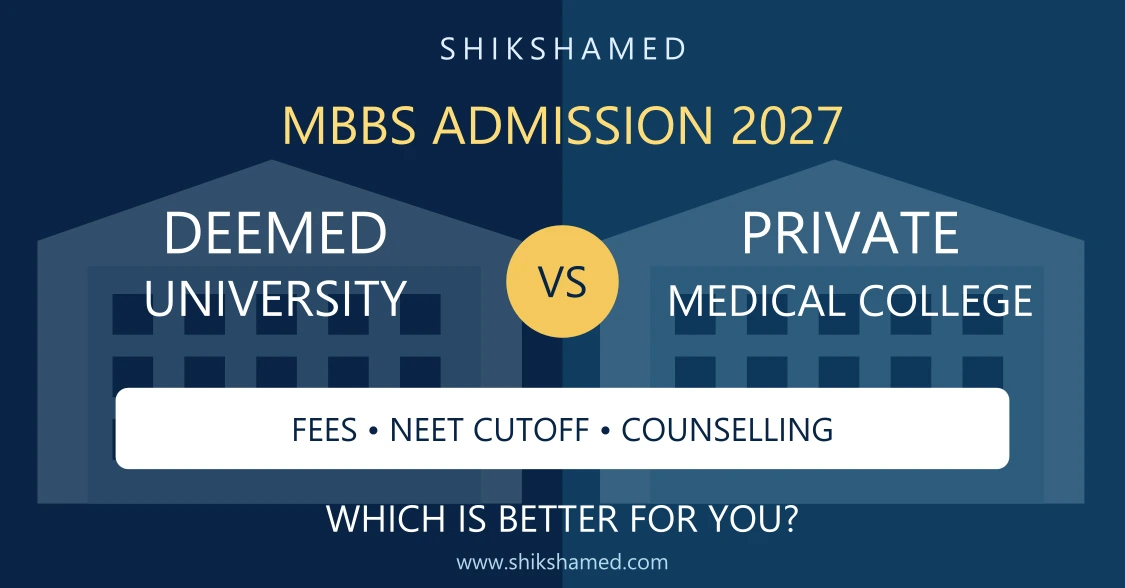
Choosing between a deemed university and a private medical college for MBBS in India is one of the most important decisions for NEET aspirants and their parents. With increasing competition for government medical seats, many students explore private medical colleges, deemed universities, management quota seats and NRI quota admission opportunities to fulfil their dream of becoming a doctor.
However, securing an MBBS seat should not be your only priority. Selecting the right medical college based on its fee structure, clinical exposure, hospital patient flow, academic quality, internship opportunities and long-term career prospects is equally important.
Many parents have common questions:
In this comprehensive guide, ShikshaMed explains the difference between deemed universities and private medical colleges to help students make informed decisions for MBBS admission in India 2027.
Students looking for personalised admission assistance can explore our MBBS admission counselling services in India to understand suitable opportunities based on their NEET rank, eligibility, budget and preferred location.
Important 2027 admission update: This guide is based on the admission framework and available information from the 2026 academic session. Final NEET UG 2027 eligibility criteria, counselling schedules, seat matrices, fees and closing ranks must be confirmed after their official publication.
A deemed-to-be university is a higher education institution granted university status under Section 3 of the University Grants Commission (UGC) Act, 1956.
Medical institutions operating under deemed universities have institutional autonomy in several academic and administrative matters, subject to applicable regulations. Their medical courses, approved seat intake, curriculum and clinical training requirements remain subject to National Medical Commission (NMC) regulations.
For MBBS admission, students generally participate in centralised counselling conducted by the Medical Counselling Committee (MCC) for the seats listed under deemed universities.
One significant advantage of the deemed university admission route is that eligible students from different Indian states can compete for its generally open paid seats without the conventional state domicile restrictions applicable to many state quota seats.
However, being a deemed university does not automatically mean that an institution offers better education than a private medical college. Every institution must be assessed individually.
For detailed information about institutions, admission opportunities and historical fee structures, read our complete guide to deemed universities in India for MBBS.
A private medical college is an institution established and managed by a private organisation, trust, society or other eligible entity.
Many private medical colleges are affiliated with state health sciences universities, while others operate under private universities.
Although deemed medical institutions can also be privately managed, the term “private medical college” in this comparison refers primarily to institutions whose MBBS seats are allotted through state-level counselling rather than the deemed university counselling route.
Private medical colleges may offer different seat categories, depending on state regulations and institutional status.
These may include:
The availability, eligibility conditions and fee structure of these categories vary across states and colleges.
Some states permit candidates from outside the state to participate in specified private medical college seat categories. Other states impose domicile, educational or additional eligibility requirements.
Therefore, students must understand the individual state counselling rules before applying.
For a broader overview of medical institutions, explore our guide to top medical colleges in India, fees, cutoffs and admission opportunities.
| Comparison Factor | Deemed Medical University | State-Counselled Private Medical College |
|---|---|---|
| Admission examination | NEET UG | NEET UG |
| Counselling authority | MCC for designated deemed seats | Respective state counselling authority |
| Domicile requirement | Generally not required for open paid seats | Depends on state and seat category |
| Fee structure | Institution-specific, subject to applicable rules | State and institution-specific |
| Government quota seats | Not generally part of the standard deemed paid-seat structure; exceptions may exist | Available in participating institutions |
| Management or paid seats | Available as notified | Available as notified |
| NRI quota | Available in eligible institutions | Available in eligible institutions |
| Admission basis | NEET rank, eligibility and choices | NEET rank, eligibility and choices |
| MBBS duration | 5.5 years | 5.5 years |
| Clinical exposure | Depends on institution | Depends on institution |
| Degree awarded by | Respective deemed university | Affiliated or applicable university |
| NMC status | Must be verified | Must be verified |
| Internship | Compulsory | Compulsory |
| Postgraduate opportunities | Subject to applicable eligibility | Subject to applicable eligibility |
The biggest practical differences between deemed universities and private medical colleges are their counselling authorities, admission eligibility, seat categories and fee structures.
Neither category is automatically superior. The best choice depends on the individual institution and the student’s circumstances.
The cost of pursuing MBBS is one of the most important considerations for Indian families.
A medical college may appear affordable based on its annual tuition fee, but the complete expense over the academic and internship period can be considerably higher.
Before selecting a medical college, parents should calculate the total financial commitment rather than focusing only on the first-year fee.
| Medical Seat Category | Illustrative Annual Tuition Fee Range |
|---|---|
| Government medical college | ₹10,000–₹2 lakh or more |
| Government quota in private medical colleges | ₹1.5–₹10 lakh or more |
| Private medical college management quota | ₹10–₹25 lakh or more |
| Deemed university paid seats | ₹15–₹30 lakh or more |
| NRI quota seats | ₹20–₹45 lakh or more, or foreign-currency fees |
These are broad planning ranges, not official 2027 fee notifications. Individual colleges may charge significantly less or more. NRI fees may also be published as a total course amount in US dollars rather than annual tuition.
In many cases, private medical colleges offering government quota or relatively affordable state-counselled seats may be less expensive than deemed university paid seats.
However, this is not a universal rule.
Certain deemed universities may have lower overall fees than expensive private medical colleges in particular states.
The correct approach is to compare actual college-wise fees for the same admission year and eligible seat category.
For state-wise and college-wise fee information, students can visit the ShikshaMed MBBS fee structure page.
Historical fee information helps parents understand the financial differences between institutions before the NEET UG 2027 admission process begins.
| Institution / Seat Category | Published 2026 Fee Reference |
|---|---|
| Kasturba Medical College, Manipal – General category | ₹71,00,500 total programme fee |
| Kasturba Medical College, Manipal – NRI/Foreign category | USD 197,200 total programme fee |
| Dayanand Medical College, Ludhiana – Government quota | ₹4,47,000 listed fee |
| Dayanand Medical College, Ludhiana – Management quota | ₹11,49,000 listed fee |
| Punjab Institute of Medical Sciences, Jalandhar – Government quota | ₹4,47,000 listed fee |
| Punjab Institute of Medical Sciences, Jalandhar – Management quota | ₹11,49,000 listed fee |
Sources: Official MAHE MBBS programme fee information and ShikshaMed’s 2026 Punjab fee reference.
The Manipal figures represent the published total programme fee, whereas the Punjab figures are listed quota-specific fee references and are not total course fees. The Punjab amounts should be reconfirmed against official state notifications, including their applicable year, instalments and additional charges.
These figures are provided for historical comparison only. Students should not treat them as confirmed MBBS fees for 2027.
Many families prepare their budget according to tuition fees but overlook additional expenses.
Before finalising a private medical college or deemed university, check whether the following charges apply:
Parents should obtain a written fee schedule covering the entire course and clarify whether hostel accommodation is compulsory.
It is also important to distinguish between refundable deposits, non-refundable charges and recurring expenses.
Always verify the permitted fee-charging duration under prevailing NMC regulations. Do not assume that tuition is payable for the entire 5.5-year programme merely because the course includes a one-year internship.
The following table illustrates how different annual tuition fees can affect the overall academic budget.
| Annual Tuition Fee | Illustrative Tuition for 4.5 Years | Assumed Living & Other Expenses | Estimated Total |
|---|---|---|---|
| ₹10 lakh | ₹45 lakh | ₹10 lakh | ₹55 lakh |
| ₹15 lakh | ₹67.5 lakh | ₹12 lakh | ₹79.5 lakh |
| ₹20 lakh | ₹90 lakh | ₹15 lakh | ₹1.05 crore |
| ₹25 lakh | ₹1.125 crore | ₹15 lakh | ₹1.275 crore |
| ₹30 lakh | ₹1.35 crore | ₹20 lakh | ₹1.55 crore |
These are mathematical budgeting examples, not actual college fee quotations. The number of instalments, permitted charges, hostel costs and payment schedules differ between institutions.
A family considering MBBS admission should also preserve a reasonable financial reserve for unexpected educational and personal expenses.
Read our comprehensive MBBS admission guidance and budget planning guide for parents 2027 before making a major financial commitment.
NEET UG qualification is compulsory for MBBS admission in India, including private medical colleges, deemed universities, management quota and NRI quota seats.
However, qualifying NEET does not guarantee an MBBS seat.
Students must understand the difference between the NEET qualifying cutoff and the medical college admission cutoff.
The qualifying cutoff determines whether a candidate satisfies the minimum NEET examination requirement for participating in the medical admission process, subject to other eligibility conditions.
The standard qualifying percentile framework in recent admission cycles has been:
| Category | Standard Qualifying Percentile |
|---|---|
| General / EWS | 50th percentile |
| OBC / SC / ST | 40th percentile |
| General / EWS PwBD | 45th percentile |
| OBC / SC / ST PwBD | 40th percentile |
The corresponding marks change each year depending on examination performance and applicable official rules.
Candidates must refer to the official NEET UG website for the final 2027 eligibility and qualifying criteria.
The admission cutoff generally refers to the rank or score at which a particular seat category in a medical college was allotted during a specified counselling round.
It depends on several factors:
A well-established deemed medical university may have a considerably more competitive closing rank than a less preferred private medical college.
Similarly, affordable government quota seats within private colleges may require much stronger ranks than expensive management quota seats.
There is no single NEET score that guarantees admission to every private or deemed medical college.
Instead of relying on fixed marks, students should analyse historical All India Rank data for individual colleges.
A useful preliminary strategy is:
| Candidate Situation | Admission Options to Evaluate |
|---|---|
| Strong NEET rank and limited budget | Government colleges and affordable government quota seats |
| Competitive rank but no government seat | Established private colleges and eligible deemed institutions |
| Moderate NEET rank | Private management quota and deemed paid seats |
| Relatively low but qualifying NEET rank | Eligible colleges with historically less competitive closing ranks |
| Eligible NRI candidate | NRI quota seats in participating institutions |
| NEET not qualified | Reattempt NEET or explore other eligible educational pathways |
This table is a planning framework, not an admission prediction.
For the upcoming 2027 session, students should compare the 2024, 2025 and 2026 college-wise allotment trends once the relevant historical records are available.
Official historical allotment information can be accessed through the MCC UG counselling archive and 2026 UG counselling results and notices.
Students concerned about their NEET performance can also read our guide to MBBS admission opportunities after a low NEET rank.
Yes, a relatively low NEET rank may still allow a qualified candidate to compete for certain MBBS seats, depending on:
However, no legitimate consultant, college or intermediary can guarantee an MBBS seat regardless of the candidate’s eligibility and rank.
A common mistake is assuming that a higher budget automatically guarantees admission to any medical college.
Even for expensive management or NRI quota seats, candidates must satisfy official admission requirements and follow the prescribed counselling process.
Students searching for the best MBBS counselling consultant in Chandigarh for low NEET scores can seek professional assistance to evaluate realistic admission options.
Understanding the difference between MCC counselling and state counselling is essential for NEET aspirants.
Many students focus only on their home state and overlook opportunities for which they may be eligible elsewhere.
The Medical Counselling Committee conducts centralised counselling for designated medical seats under the Directorate General of Health Services.
Under the existing admission framework, MCC handles MBBS seats notified for deemed universities, along with various other centrally administered seats.
Students interested in deemed medical universities must register on the MCC portal for the applicable counselling process.
The general admission procedure includes:
Candidates should carefully examine the rules regarding seat acceptance, upgradation, resignation and security deposit forfeiture before participating in any round.
For official reference, consult the MCC counselling portal and the revised UG counselling information bulletin for 2026.
Private medical college seats under state counselling are allotted by the respective designated state authorities.
Each state publishes its own admission prospectus, eligibility requirements, seat matrix, fee structure and counselling schedule.
Students planning private MBBS admission must identify:
Admission regulations may differ considerably between states.
| State | Counselling Authority / Official Portal |
|---|---|
| Punjab | Baba Farid University of Health Sciences |
| Haryana | Haryana Medical Counselling Portal |
| Uttar Pradesh | Directorate General of Medical Education, UP |
| Rajasthan | Designated state NEET UG counselling board |
| Karnataka | Karnataka Examinations Authority |
| Uttarakhand | HNB Uttarakhand Medical Education University |
| Madhya Pradesh | Directorate of Medical Education, MP |
| Maharashtra | State Common Entrance Test Cell |
| Tamil Nadu | Selection Committee, Directorate of Medical Education |
| Kerala | Commissioner for Entrance Examinations |
Candidates must use the final officially notified portals and authorities for the 2027 academic session.
Eligible students can generally register for both MCC and applicable state counselling processes, subject to their respective rules.
This can help expand admission opportunities across:
However, students must carefully manage overlapping counselling schedules, existing allotments, joining conditions and restrictions on further participation.
Holding or joining a seat may affect eligibility for subsequent counselling rounds.
Professional guidance can help candidates coordinate these processes and reduce the risk of missing suitable opportunities.
India has several established deemed medical universities offering undergraduate medical education and hospital-based clinical training.
Students may consider researching the following institutions based on their individual requirements.
| Medical College / University | Location |
|---|---|
| Kasturba Medical College, Manipal | Karnataka |
| Kasturba Medical College, Mangalore | Karnataka |
| JSS Medical College, Mysuru | Karnataka |
| Jawaharlal Nehru Medical College, Belagavi | Karnataka |
| K.S. Hegde Medical Academy | Karnataka |
| Sri Ramachandra Medical College and Research Institute | Tamil Nadu |
| SRM Medical College Hospital and Research Centre | Tamil Nadu |
| Saveetha Medical College and Hospital | Tamil Nadu |
| Amrita School of Medicine, Kochi | Kerala |
| Dr. D. Y. Patil Medical College, Pune | Maharashtra |
| Bharati Vidyapeeth Medical College, Pune | Maharashtra |
| Datta Meghe Medical Institutions, Wardha | Maharashtra |
| Santosh Medical College, Ghaziabad | Uttar Pradesh |
This is an illustrative research shortlist, not an official ranking or confirmed 2027 seat matrix.
Students should verify the exact institution name, NMC status, approved intake, available seat categories, counselling route and current fee structure before adding any college to their choice list.
Explore our dedicated Deemed Universities MBBS Admission page for further institution-specific information.
Private medical colleges across India offer different combinations of academic infrastructure, hospital exposure and fee structures.
Examples of institutions students may research include:
| Medical College | State |
|---|---|
| Dayanand Medical College and Hospital, Ludhiana | Punjab |
| Christian Medical College, Ludhiana | Punjab |
| Punjab Institute of Medical Sciences, Jalandhar | Punjab |
| Gian Sagar Medical College and Hospital | Punjab |
| Adesh Institute of Medical Sciences and Research | Punjab |
| Maharaja Agrasen Medical College, Agroha | Haryana |
| Subharti Medical College, Meerut | Uttar Pradesh |
| Shri Ram Murti Smarak Institute of Medical Sciences | Uttar Pradesh |
| Hind Institute of Medical Sciences, Barabanki | Uttar Pradesh |
| Era’s Lucknow Medical College and Hospital | Uttar Pradesh |
| Mahatma Gandhi Medical College and Hospital, Jaipur | Rajasthan |
| Geetanjali Medical College and Hospital, Udaipur | Rajasthan |
| M.S. Ramaiah Medical College, Bengaluru | Karnataka |
Certain institutions may have special minority, sponsorship, domicile or other admission conditions.
Candidates should evaluate them individually instead of assuming that every seat is open to all NEET-qualified students.
For students interested in North India, our detailed guides on MBBS admission in Punjab and MBBS admission in Rajasthan provide useful starting points.
Yes. An MBBS qualification from a deemed university is valid for the applicable professional pathway when the medical institution and qualification have the necessary regulatory recognition and the student completes the prescribed admission, academic, internship and registration requirements.
A recognised MBBS degree from a deemed university can provide a pathway towards:
The same principle applies to recognised MBBS qualifications awarded through private medical colleges.
Students should not assume that a degree is invalid simply because the institution is privately managed or classified as a deemed university.
Before admission, always verify the institution and approved MBBS course through the National Medical Commission’s college and course search.
Clinical exposure is one of the most important factors in choosing a medical college.
A beautiful campus, expensive infrastructure and impressive marketing materials do not necessarily guarantee excellent practical medical training.
An MBBS student needs opportunities to observe, understand and participate in supervised patient care throughout clinical education.
| Factor | Why It Matters |
|---|---|
| OPD patient flow | Provides exposure to different medical conditions |
| IPD occupancy | Helps students understand inpatient management |
| Emergency department | Offers supervised exposure to acute medical conditions |
| Operation theatres | Supports surgical learning |
| Faculty availability | Influences teaching quality |
| Department diversity | Helps develop broad clinical knowledge |
| Diagnostic facilities | Supports understanding of investigations |
| Internship rotations | Develops practical clinical competence |
| Student-to-patient ratio | Influences opportunities for clinical learning |
| Skills laboratories | Supports supervised practical training |
Some established private medical colleges may provide better patient exposure than certain expensive deemed universities.
Similarly, some deemed medical universities have excellent teaching hospitals, advanced diagnostic facilities and strong academic systems.
Students should compare actual hospital performance rather than deciding solely on the institution’s category.
Where possible, visit the teaching hospital and speak with current MBBS students and interns before finalising your college preferences.
Under the existing NMC academic framework, the MBBS programme consists of approximately four and a half years of academic education followed by one year of compulsory rotating medical internship.
The internship helps students develop clinical skills and practical experience under supervision.
Before selecting a medical college, students should examine:
Students should verify the actual stipend and fee policies through official institutional disclosures and current NMC directions.
An institution charging higher MBBS fees does not necessarily provide a higher internship stipend or better clinical training.
Management quota is a recognised seat category in eligible private medical colleges, subject to applicable state and institutional admission regulations.
In deemed university counselling, similar higher-fee seats are commonly described as paid or management seats in the notified counselling framework.
These seats may provide additional admission opportunities for eligible NEET-qualified students.
However, management quota does not mean that students can bypass NEET or official counselling.
Candidates must generally:
The availability of management quota seats, applicable eligibility and fee structures differ between states and institutions.
No student should rely on an unofficial promise of direct admission or make an undocumented payment to reserve a seat.
NRI quota seats are available in certain government, private and deemed medical institutions, depending on the applicable regulations and published seat matrix.
Eligible candidates may include NRIs and other applicants meeting officially notified sponsorship, relationship or guardianship conditions.
However, having a relative living abroad does not automatically make every student eligible for an NRI quota seat.
Applicants must satisfy the specific requirements of the relevant counselling authority.
Depending on the applicable rules, candidates may be required to submit:
NRI quota fees can be substantially different from regular paid-seat fees and may be denominated in foreign currency.
Students and parents should prepare the necessary documents in advance rather than waiting until counselling registration begins.
Read our comprehensive NRI Quota MBBS Admission in India 2027: Eligibility, Sponsor Rules and Required Documents for detailed guidance.
Students seeking private MBBS admission should research multiple states instead of restricting their choices to their home state.
The availability of open-category or management seats for outside-state candidates depends on the officially notified rules.
| State | Important Considerations |
|---|---|
| Punjab | Government, management, minority and NRI seat categories in participating institutions |
| Haryana | Institution-specific fees and applicable state eligibility |
| Uttar Pradesh | Private medical college options and state counselling rules |
| Rajasthan | Seat-category eligibility and domicile conditions |
| Karnataka | Different private seat categories and eligibility requirements |
| Madhya Pradesh | State-specific priority and eligibility rules |
| Uttarakhand | Institution-wise fees and seat-category conditions |
| Maharashtra | Domicile, institutional quota and other admission requirements |
| Tamil Nadu | Government quota, management quota and institution-specific conditions |
| Kerala | Applicable state, minority and NRI admission rules |
Candidates must confirm whether outside-state applicants are eligible for each specific seat category during the 2027 admission session.
Registering for an ineligible counselling process can result in unnecessary expenses and missed opportunities.
Students planning MBBS admission in either a deemed university or private medical college should prepare according to the established eligibility framework.
The general requirements include:
Students appearing for Class 12 examinations or studying additional subjects should carefully review the applicable NEET eligibility provisions.
The final eligibility requirements will be governed by the official NEET UG 2027 information bulletin and applicable regulatory notifications.
Candidates should prepare their original documents and required photocopies before counselling begins.
| Document | Requirement |
|---|---|
| NEET UG scorecard | Required |
| NEET UG admit card | Generally required |
| Class 10 marksheet and certificate | Required |
| Class 12 marksheet and certificate | Required |
| Government-issued identity proof | Required as specified |
| Passport-size photographs | As specified |
| Transfer certificate | Institution-specific |
| Migration certificate | Where applicable |
| Character certificate | Where applicable |
| Domicile certificate | For applicable state seats |
| Category certificate | Where applicable |
| EWS certificate | Where applicable |
| PwBD certificate | Where applicable |
| Minority certificate | Where applicable |
| NRI sponsorship documents | For eligible NRI applicants |
| Medical fitness certificate | As prescribed |
| Seat allotment letter | Required after allotment |
| Fee payment receipt | Required as specified |
Students should ensure that names, dates of birth and other important personal details are consistent across their documents.
Any discrepancies should be addressed through the appropriate issuing authorities before counselling begins.
A strong NEET preparation strategy remains the foundation of medical admission.
Students should focus on improving their performance rather than relying entirely on alternative seat categories.
After the result declaration, evaluate your All India Rank, category and qualification status.
Compare your rank with relevant historical college-wise closing ranks rather than depending only on marks.
Calculate the total academic and living expenses your family can reasonably afford.
Include tuition fees, hostel charges, compulsory expenses and potential financial contingencies.
Determine whether you should register for MCC counselling, your home state counselling or additional state counselling opportunities.
Review the eligibility criteria before paying registration fees.
Prepare a college shortlist based on:
Register through the appropriate official counselling portals within their prescribed deadlines.
Pay only the officially notified registration fees and security deposits through authorised payment channels.
Arrange medical colleges according to your genuine preferences and affordability.
Do not place an unaffordable college above an affordable preferred institution simply because its previous cutoff was more competitive.
Carefully review the allotted college, seat category, reporting requirements and fee structure.
Understand the applicable rules before accepting, upgrading or declining an allotted seat.
Visit the designated reporting institution or centre as instructed by the counselling authority.
Submit the required documents and complete all prescribed formalities.
Complete the official fee payment and obtain proper admission documentation and receipts.
Students should retain copies of all counselling records, allotment letters and fee-related documents.
Choice filling is one of the most important stages of NEET UG counselling.
Candidates sometimes lose suitable admission opportunities because they misunderstand their eligibility, select too few colleges or fill choices without evaluating the complete financial commitment.
A well-planned choice list should include a balanced combination of:
Remember that historical ranks only provide an indication of previous competition.
A college with a less competitive closing rank in 2026 may become more competitive in 2027 because of fee changes, increased demand, seat availability or changing candidate preferences.
Never include a college that you are unwilling or financially unable to join, particularly in rounds where non-joining or resignation can lead to significant penalties.
A low fee does not automatically make a medical college the best option.
Compare its hospital exposure, academic environment and student support systems.
University status alone does not determine the quality of medical education.
Always verify the current approval status and authorised MBBS seat intake before admission.
Marks fluctuate every year. Historical rank trends are usually more useful for comparisons.
The complete MBBS budget should cover more than the published tuition fee.
Candidates may overlook eligible admission opportunities by registering only for MCC or their home state.
No legitimate admission service can guarantee an MBBS seat outside official eligibility and allotment rules.
Hospital patient flow and supervised clinical training are essential for professional development.
Counselling decisions can have financial consequences, especially during later rounds.
Always verify the recipient, payment purpose, official authorisation and refund conditions before transferring money.
There is no universal answer.
A deemed university may be suitable for students seeking broader geographical admission opportunities and who can afford the institution’s total fee structure.
A private medical college may be preferable for students who qualify for affordable state-counselled seats or wish to study at an established institution closer to home.
| Your Priority | What You Should Explore |
|---|---|
| Minimum possible MBBS fees | Government and eligible subsidised quota seats |
| Wider geographical opportunities | Deemed universities and eligible open-state private seats |
| Studying near home | Suitable private or government colleges in your region |
| Excellent clinical exposure | Institution-specific hospital performance |
| Strong academic reputation | Established colleges across both categories |
| Relatively low qualifying NEET rank | Eligible paid and management quota opportunities |
| NRI sponsorship | Officially notified NRI quota seats |
| Strict financial budget | Complete written fee comparison |
The right medical college should offer a balance between affordability, academic development, clinical training and personal suitability.
Medical admission counselling involves more than simply selecting a college.
Students must understand complex admission regulations, multiple counselling authorities, different fee structures, changing cutoffs and important reporting deadlines.
At ShikshaMed, our objective is to help NEET aspirants and their parents make informed medical admission decisions based on their individual circumstances.
Whether you are exploring MBBS admission in Punjab, Haryana, Uttar Pradesh, Rajasthan, Karnataka or another eligible state, ShikshaMed can help you understand your available options.
Students and parents searching for the best MBBS consultant in Chandigarh or expert medical admission counselling across India can connect with our team for personalised guidance.
We encourage students to evaluate their medical college choices carefully rather than making rushed decisions based on unofficial admission promises.
Explore why students choose ShikshaMed for medical admission counselling.
Not necessarily. The quality of medical education depends on the individual college, teaching hospital, faculty, academic facilities and clinical exposure.
Yes. Candidates must qualify NEET UG and satisfy the applicable eligibility and counselling requirements.
No. NEET qualification and the prescribed official admission process are mandatory for MBBS admission in India.
Fees vary considerably by institution and seat category. Many deemed university paid seats require substantial annual tuition. Students should verify the complete official programme fee rather than relying on general estimates.
Private medical colleges offering subsidised government quota seats may be more affordable. However, some deemed universities may cost less than particular private colleges. Compare actual fee schedules.
Generally, eligible students can apply for open deemed university paid seats through MCC counselling without conventional state domicile requirements. Check the individual seat-category conditions.
The Medical Counselling Committee conducts counselling for designated deemed university MBBS seats.
The respective designated state counselling authorities generally handle state-counselled private medical college seats.
It cannot be determined in advance. Admission would depend on whether the score qualifies under the applicable criteria, the resulting rank, seat availability, budget and counselling rules. No fixed score guarantees admission.
It may be possible in certain institutions or seat categories, particularly where subsidised or affordable tuition is available. Eligibility, rank and complete expenses must be evaluated.
A recognised MBBS qualification can provide eligibility for postgraduate medical entrance examinations, subject to applicable internship, registration and examination requirements.
Eligible candidates can generally register for both, but must comply with allotment, joining, resignation and subsequent-round participation rules.
No. Candidates must follow the prescribed official counselling and admission process for the relevant seat category.
Yes, NRI seats are available in certain deemed universities as notified in the official seat matrix, subject to eligibility and documentation requirements.
Some deemed institutions offer excellent clinical exposure, but this varies individually. Students should evaluate actual hospital patient flow, departments and internship arrangements.
Yes, provided the qualification is recognised and the candidate fulfils the applicable postgraduate admission eligibility requirements.
The final admission schedule will be announced by the relevant examination and counselling authorities. Candidates should regularly check official notices.
Visit the official National Medical Commission website and review the college’s current recognition, permission and approved seat intake information.
No. Fee levels are influenced by several institutional factors and are not a reliable standalone measure of academic quality or clinical training.
ShikshaMed provides personalised counselling based on NEET rank, eligibility, budget, historical allotment trends, medical college preferences and official admission rules.
Students should regularly consult the following official websites for reliable admission information:
Always give priority to current official notifications, approved fee schedules, counselling prospectuses and seat matrices over unofficial information.
Choosing between a deemed university and a private medical college is not simply a choice between two categories of institutions.
It is a decision that can influence your medical education, financial commitments, clinical development and future professional opportunities.
Students should consider their NEET rank, financial budget, state eligibility, hospital exposure, academic reputation, institutional recognition and long-term career objectives before selecting a medical college.
While deemed universities may offer broader geographical admission opportunities, private medical colleges may provide access to affordable seat categories and established regional institutions.
The best MBBS college is not necessarily the most expensive or the most popular. It is the recognised medical institution that offers suitable academic and clinical training within your eligibility and financial capacity.
With timely planning, accurate information and professional medical admission counselling, students can approach NEET UG 2027 with greater clarity and confidence.
Don’t select your medical college based on guesswork. Understand your rank, budget and admission opportunities before making a decision.
Connect with ShikshaMed for personalised medical admission guidance.
SHIKSHAMED PRIVATE LIMITED
MBBS Admission | NEET UG Counselling | Deemed Universities | Private Medical Colleges | Management Quota | NRI Quota | MD/MS/DNB Admission
Head Office – Chandigarh
SCO 81–82, Ground Floor, Opposite Passport Office, Sector 34A, Chandigarh – 160022
Call / WhatsApp:
+91 9041441449 | +91 9041441450
Website: www.shikshamed.com
Our Branches: Explore ShikshaMed counselling offices
SHIKSHAMED – WE PLAN, YOU ACHIEVE!
Disclaimer: This article is for educational and admission guidance purposes. Fees, cutoffs, seat availability, eligibility, recognition status and counselling regulations are subject to change. Historical information and illustrative budgets should not be treated as confirmed 2027 admission data. All admissions are subject to applicable regulations, official counselling and candidate eligibility.