Every year, lakhs of students crack NEET UG with the singular dream of becoming a doctor. But once the white coat ceremony is over and the MBBS degree is finally in hand, a new and often more confusing question begins to echo in every fresh graduate’s mind — “What next?” If you are a NEET 2026 aspirant, an MBBS student, or a parent trying to understand the real scope of a medical degree in India, this guide is written specifically for you.
Completing MBBS is not the finish line — it is the starting point of a much bigger journey. The Indian healthcare industry is expanding faster than ever, government schemes like Ayushman Bharat are creating fresh demand for doctors in every corner of the country, and international opportunities are opening up for Indian-trained medical graduates too. In such a dynamic environment, choosing the right career path after MBBS can define the next 30-40 years of your professional life.
In this comprehensive guide, we will walk you through every major career option available after MBBS in India — from postgraduate specialization to government jobs, private practice, research, teaching, defence services, and even entrepreneurship in healthcare. Whether you have already scored well in NEET or are still preparing for NEET 2026, understanding these pathways early will help you make smarter decisions about your medical career.
And if you ever feel stuck or need one-on-one expert guidance, the counsellors at Shiksha Med — India’s trusted MBBS and medical admission consultancy with over 26 years of experience and 30,000+ students guided — are always ready to help you choose the right path based on your NEET score, budget, and career goals.
Most students spend years preparing for NEET UG but very little time actually planning what comes after MBBS. This is a critical gap. Medicine today is not a single-track profession — it has splintered into dozens of specializations, sub-specializations, government pathways, private sector opportunities, and even non-clinical careers like healthcare consulting and medical writing.
If you are appearing for NEET 2026 or are currently pursuing your MBBS in India, understanding the landscape now — rather than in your final year — gives you a massive head start. You can choose your electives, internships, and even your NEET PG subject preferences strategically, instead of scrambling at the last moment.
This is exactly why platforms like the Shiksha Med Blog regularly publish updated, NEET-2026-specific guidance, because career clarity early on directly improves outcomes later.
For the overwhelming majority of MBBS graduates in India, the natural next step is postgraduate specialization. An MBBS degree alone qualifies you as a General Physician, but a postgraduate degree opens the door to specialist practice, higher salaries, and much greater respect and demand in both government and private hospitals.
Choosing between MD and MS depends entirely on whether you enjoy clinical diagnosis and medicine management (MD) or hands-on surgical procedures (MS). Both routes require clearing NEET PG or INICET, and both routes have highly competitive seat allocation, especially for popular branches.
If you want to explore branch-wise details, duration, fees, and career scope, the full list is available on the MD/MS Branches page on Shiksha Med.
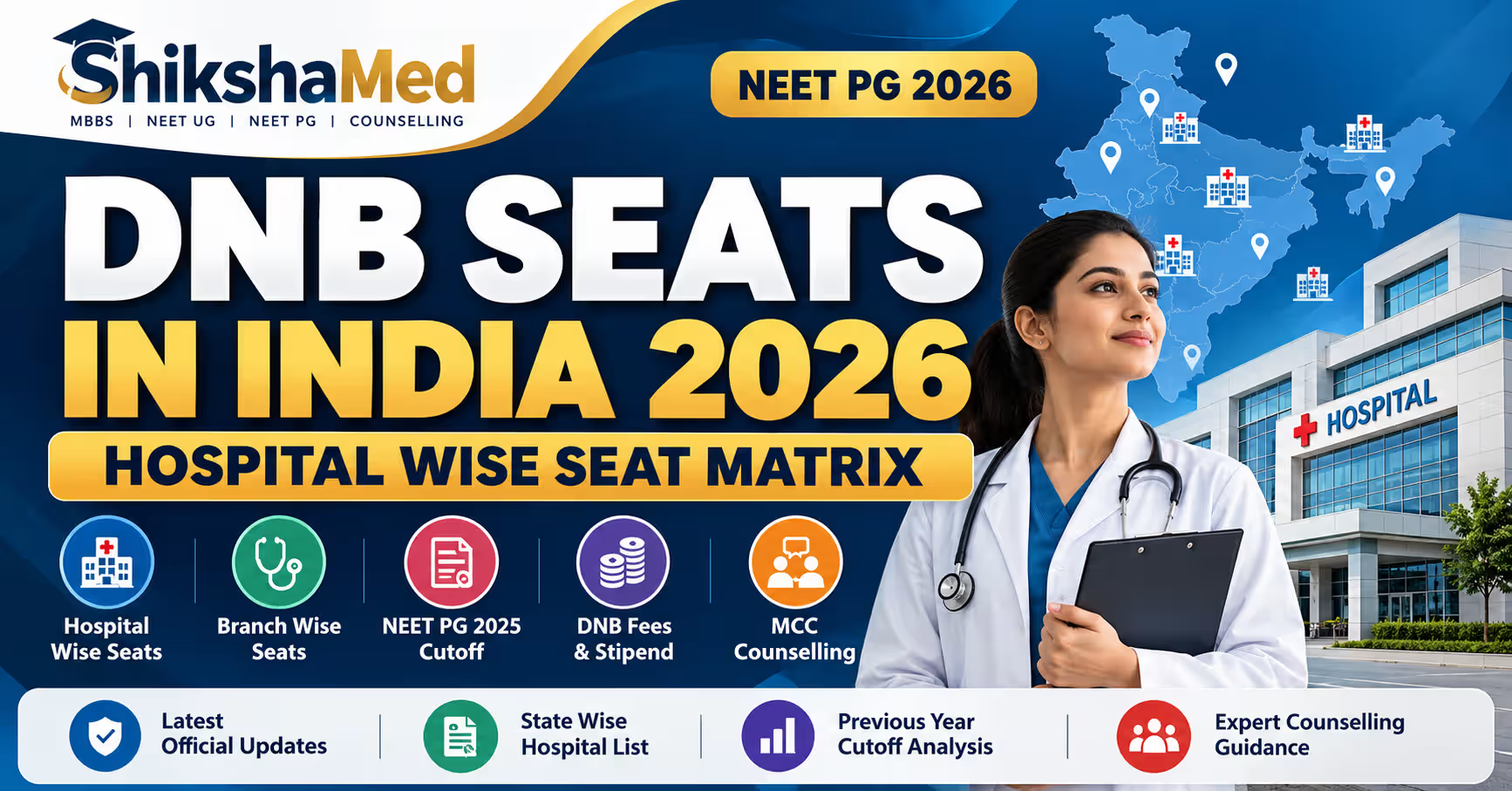
To pursue MD, MS, or Diploma courses in India, MBBS graduates must qualify NEET PG (National Eligibility cum Entrance Test for Postgraduate courses) or INICET (for AIIMS and select central institutes). These exams are significantly more competitive than NEET UG because the number of postgraduate seats is far smaller than the number of MBBS graduates every year.
Key things NEET 2026 aspirants and current MBBS students should know:
Given the complexity of counselling rounds, quota systems, and category-wise cutoffs, many students prefer personalized NEET PG Counselling support to avoid losing a good seat due to procedural mistakes.
Not every MBBS graduate wants to pursue PG immediately, and that is a completely valid choice. Many doctors choose to work as Medical Officers in government hospitals and Primary Health Centres (PHCs) right after completing their compulsory rotatory internship.
Why this path is attractive:
This path suits students who prefer job security and community-level healthcare service over the intense competition of postgraduate entrance exams.
Many MBBS graduates choose to join private hospitals as Junior Residents, Medical Officers, or Emergency Physicians. Private sector salaries vary widely (roughly ₹40,000 – ₹1,00,000 per month for freshers) depending on the hospital’s reputation, city, and the doctor’s skill set.
Some doctors also choose to set up independent clinics after gaining a few years of general practice experience, especially in semi-urban and rural areas where the doctor-to-patient ratio is still below WHO recommended standards. This route requires strong clinical confidence, patient trust-building, and often works best when combined with a diploma or certificate course in a focused area like ultrasonography, dermatology procedures, or emergency medicine.
For MBBS graduates who want to combine medicine with a prestigious central government career, the UPSC Combined Medical Services (CMS) Examination is a major opportunity. It opens doors to postings in:
These roles offer excellent job security, structured career growth, and a good work-life balance compared to the demanding schedules of private practice or PG residency.
If you enjoy studying medicine more than practicing it clinically day-to-day, academics and research could be your calling. After MD/MS, doctors can join medical colleges as Assistant Professors, eventually progressing to Associate Professor and Professor roles. This path also naturally opens doors to:
Teaching careers in medicine are especially rewarding for those who want to shape the next generation of doctors while continuing limited clinical practice on the side.
MBBS graduates can also join the Armed Forces Medical Services (AFMS) as Short Service Commissioned Officers or through Permanent Commission routes in the Army, Navy, or Air Force. This path combines the honour of serving the nation with excellent pay, allowances, accommodation, and post-retirement benefits. Doctors selected through AFMS often get fast-tracked postgraduate training opportunities as well through the Armed Forces Medical College (AFMC) system.
Not every doctor wants to remain purely clinical. A growing number of MBBS graduates are pursuing an MBA in Hospital Administration or a Master’s in Public Health (MPH) to move into:
This non-clinical route is ideal for doctors who are more interested in systems, operations, and large-scale healthcare impact rather than one-on-one patient treatment.
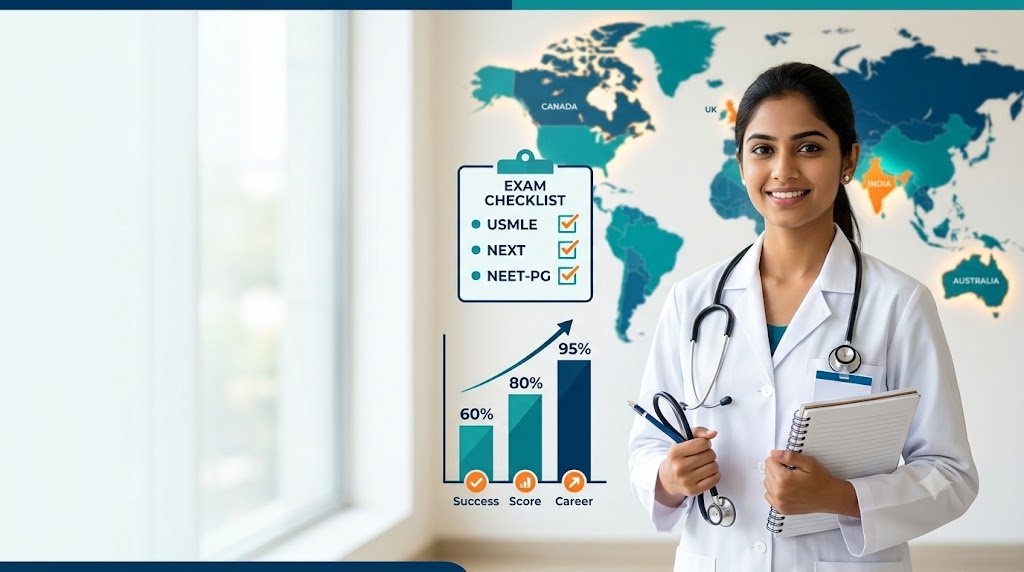
An increasing number of Indian MBBS graduates are also exploring international licensing exams to practice or pursue postgraduate studies abroad, such as:
Since these exams require early preparation and a clear understanding of eligibility, timelines, and documentation, students who are still deciding between an MBBS in India versus MBBS abroad should explore the country-wise details on Shiksha Med’s dedicated pages, including MBBS in Russia, MBBS in Georgia, MBBS in Kyrgyzstan, and MBBS in the UK, along with the complete MBBS in Abroad overview page.
| Career Path | Approx. Starting Monthly Salary | Growth Potential |
|---|---|---|
| Government Medical Officer | ₹60,000 – ₹1,20,000 | Steady with promotions & allowances |
| Junior Doctor (Private Sector) | ₹40,000 – ₹1,00,000 | Depends on hospital, city, experience |
| PG Resident (MD/MS/DNB) | ₹80,000 – ₹2,50,000 | Rapid rise with super-specialization |
| Practice Abroad (US/UK/Aus) | ₹3,00,000+ | Varies by licensing exam & location |
(Figures are indicative and vary by state, institution, and year of counselling. Always verify current stipend structures through official notifications.)
Since 2000, Shiksha Med has guided over 30,000 students across India toward the right medical college, the right specialization, and the right country — whether in India or abroad. With 6 offices across North India (Chandigarh, Kharar, Ludhiana, Bathinda, Dehradun, Faridabad, and Muzaffarnagar) and tie-ups with 440+ medical colleges and 100+ partner universities worldwide, Shiksha Med offers:
Whether you are unsure about which PG branch to choose, confused between an Indian or foreign medical college, or simply need help understanding the NEET 2026 counselling schedule, you can contact Shiksha Med for a free, no-obligation consultation.
Q1. Is it compulsory to do PG after MBBS?
No, it is not compulsory. Many MBBS graduates work successfully as General Physicians, Medical Officers, or in non-clinical roles without pursuing a postgraduate degree.
Q2. What is the best career option after MBBS for NEET 2026 aspirants?
There is no single “best” option — it depends on your interest (clinical vs. non-clinical), risk appetite, financial goals, and whether you prefer government stability or private sector growth. Most toppers pursue MD/MS through NEET PG, but government jobs, defence services, and research are equally valid and rewarding paths.
Q3. How competitive is NEET PG compared to NEET UG?
NEET PG is generally considered more competitive because the ratio of postgraduate seats to eligible MBBS graduates is much lower than the ratio of MBBS seats to NEET UG aspirants.
Q4. Can I practice abroad after completing MBBS from India?
Yes, but you will need to clear the respective licensing exam of that country — such as USMLE for the USA, PLAB for the UK, or AMC for Australia — along with meeting other eligibility and registration requirements.
Q5. How can Shiksha Med help me after I complete my MBBS?
Shiksha Med provides personalized counselling for NEET PG admissions, deemed university selection, fee and bond structure clarity, and even MBBS-abroad pathways if you are considering international higher studies. You can book a free counselling session here.
The truth is, there is no single “correct” career path after MBBS — there are only the right paths for you, based on your interests, financial situation, risk tolerance, and long-term vision. Some doctors thrive in the fast-paced world of surgery, others find deep satisfaction in rural government service, and some discover their true calling far away from the operation theatre — in research labs, classrooms, or hospital boardrooms.
What matters most for NEET 2026 students and current MBBS aspirants is starting this reflection early, gathering accurate and updated information, and seeking expert guidance when the system feels overwhelming — because in Indian medical admissions, a single wrong counselling decision can cost a student an entire academic year.
For personalized, up-to-date, and completely transparent guidance on your MBBS journey — from NEET UG admission all the way to NEET PG specialization or MBBS abroad — reach out to the expert counsellors at Shiksha Med, India’s most trusted medical admission advisory platform with over two decades of proven results.
📞 Call: +91 9914148080 / +91 9041441450 🌐 Visit: https://shikshamed.com 📩 Email: info@shikshamed.com